Congo Machine Safety Market: Top 5 Importing Countries and Market Competition (HHI) Analysis
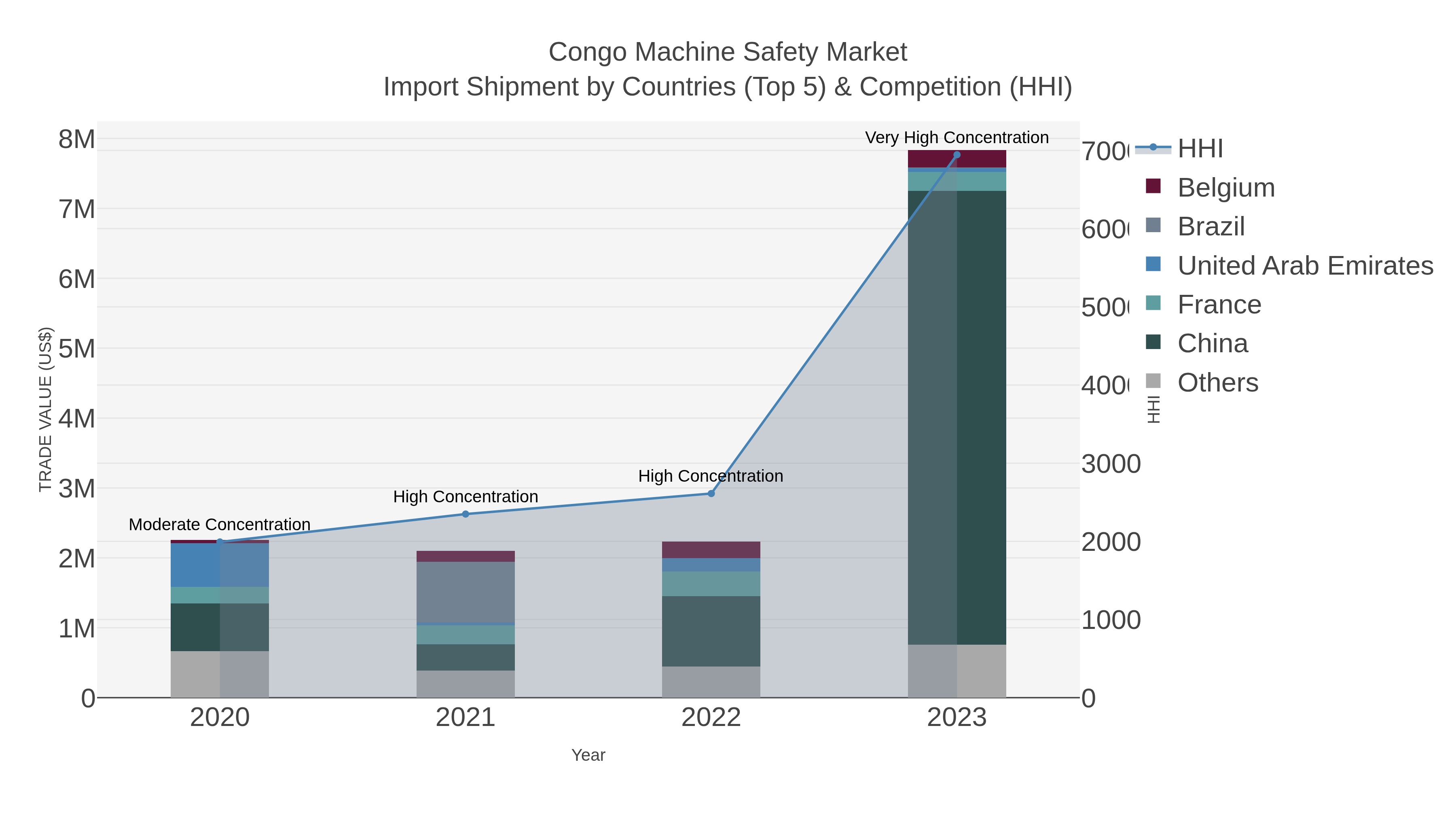
The Congo machine safety import market saw a significant shift in 2023, with top exporters including China, United Kingdom, France, Belgium, and United Arab Emirates. The Herfindahl-Hirschman Index (HHI) indicated a transition from high concentration to very high concentration within the market. The impressive Compound Annual Growth Rate (CAGR) of 51.38% and growth rate of 251.01% underscore the rapid expansion and competitiveness of this sector, highlighting the increasing importance of safety standards in machinery imports to Congo.
Congo Machine Safety Market Overview
The Congo machine safety market is concerned with solutions and technologies designed to ensure the safe operation of machinery in industrial settings. This market is driven by stringent safety regulations and the increasing emphasis on workplace safety. Machine safety solutions help prevent accidents and injuries, thus protecting workers and reducing liability for companies. Challenges include the cost of safety equipment and the need for continuous updates to comply with evolving safety standards.
Drivers of the market
The Congo Machine Safety Market is driven by stringent regulations and standards aimed at ensuring workplace safety. The implementation of safety systems and technologies helps in minimizing risks associated with machine operations and protecting workers from injuries. The increasing focus on occupational health and safety, coupled with advancements in safety equipment and systems, drives the market. Additionally, the rise in industrial automation and the need for compliance with safety standards are significant factors contributing to market growth.
Challenges of the market
Challenges in the Congo Machine Safety Market include insufficient safety regulations and enforcement, leading to poor safety standards in industrial settings. There is also a lack of awareness and training related to machine safety practices among workers and employers. The market faces difficulties due to limited access to advanced safety technologies and equipment. Additionally, high costs associated with safety upgrades and compliance further constrain market growth.
Government Policy of the market
Machine safety is becoming a priority for the Congolese government as part of its broader industrial safety initiatives. New regulations are being established to enforce safety standards for machinery and equipment in various sectors. The government is also working on implementing safety training programs for workers and encouraging companies to adopt safety technologies to prevent accidents and improve workplace safety.
Key Highlights of the Report:
- Congo Machine Safety Market Outlook
- Market Size of Congo Machine Safety Market, 2024
- Forecast of Congo Machine Safety Market, 2031
- Historical Data and Forecast of Congo Machine Safety Revenues & Volume for the Period 2021-2031
- Congo Machine Safety Market Trend Evolution
- Congo Machine Safety Market Drivers and Challenges
- Congo Machine Safety Price Trends
- Congo Machine Safety Porter`s Five Forces
- Congo Machine Safety Industry Life Cycle
- Historical Data and Forecast of Congo Machine Safety Market Revenues & Volume By Component for the Period 2021-2031
- Historical Data and Forecast of Congo Machine Safety Market Revenues & Volume By Presence Sensing Safety Sensors for the Period 2021-2031
- Historical Data and Forecast of Congo Machine Safety Market Revenues & Volume By Safety PLCs for the Period 2021-2031
- Historical Data and Forecast of Congo Machine Safety Market Revenues & Volume By Safety Modules/Controllers/Relays for the Period 2021-2031
- Historical Data and Forecast of Congo Machine Safety Market Revenues & Volume By Application for the Period 2021-2031
- Historical Data and Forecast of Congo Machine Safety Market Revenues & Volume By Assembly for the Period 2021-2031
- Historical Data and Forecast of Congo Machine Safety Market Revenues & Volume By Packaging for the Period 2021-2031
- Historical Data and Forecast of Congo Machine Safety Market Revenues & Volume By Robotics for the Period 2021-2031
- Congo Machine Safety Import Export Trade Statistics
- Market Opportunity Assessment By Component
- Market Opportunity Assessment By Application
- Congo Machine Safety Top Companies Market Share
- Congo Machine Safety Competitive Benchmarking By Technical and Operational Parameters
- Congo Machine Safety Company Profiles
- Congo Machine Safety Key Strategic Recommendations






































