Congo Pressure Vessel Market: Top 5 Importing Countries and Market Competition (HHI) Analysis
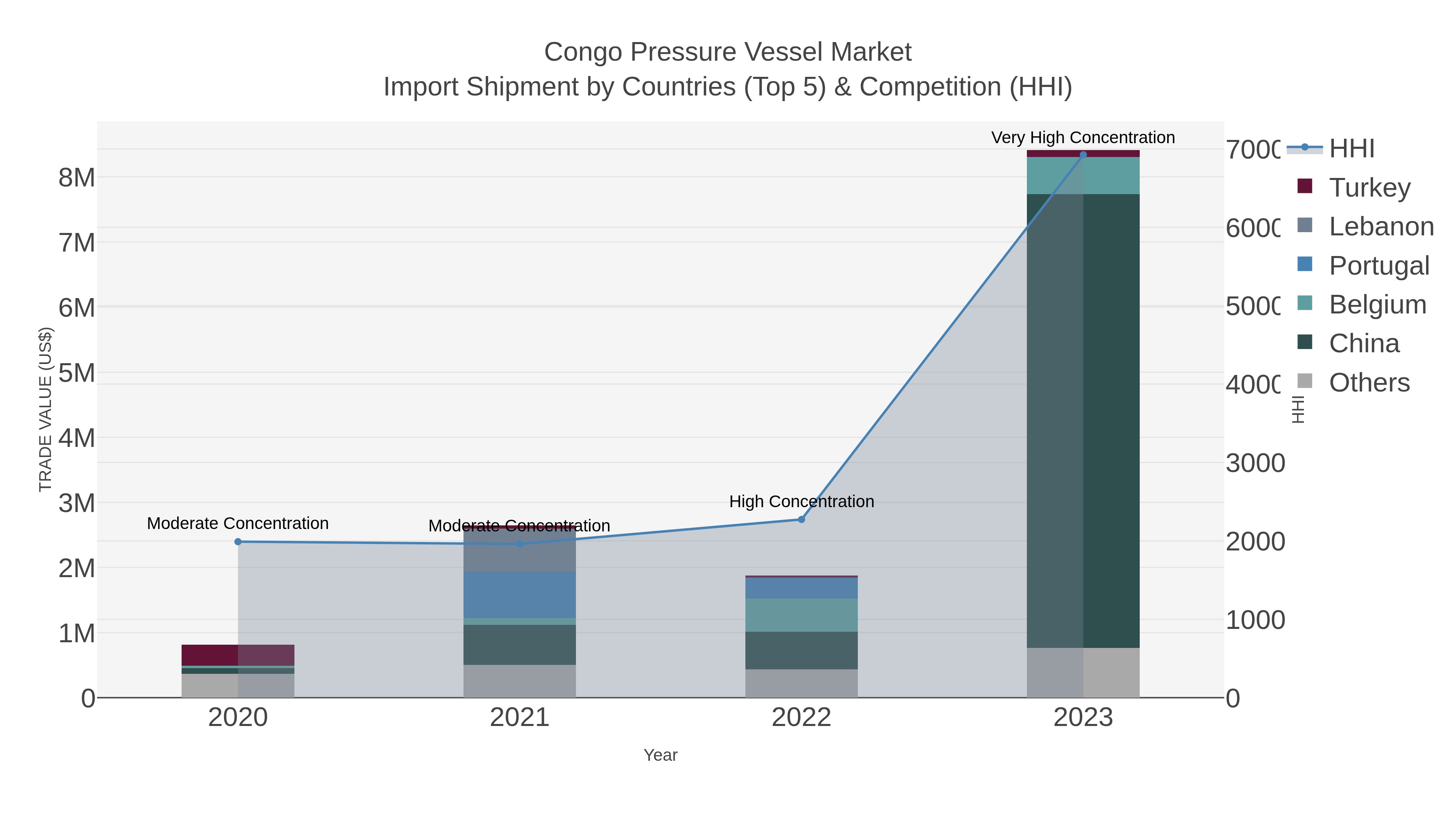
The Congo pressure vessel import market experienced significant growth in 2023, with a very high concentration of shipments from top exporters such as China, Belgium, Equatorial Guinea, Malta, and Turkey. The Herfindahl-Hirschman Index (HHI) shifted from high concentration in 2022 to very high concentration in 2023, indicating a more consolidated market. The impressive Compound Annual Growth Rate (CAGR) of 117.92% and a remarkable growth rate of 348.84% underscore the robust expansion of pressure vessel imports in Congo, reflecting strong demand and increasing market competitiveness among key exporting countries.
Congo Pressure Vessel Market Overview
The pressure vessel market in Congo is crucial for industries such as chemicals, oil and gas, and power generation. The need for safe storage and transportation of gases and liquids under high pressure drives the demand for pressure vessels. The markets growth is moderated by regulatory standards and the cost of high-quality materials.
Drivers of the market
The Congo pressure vessel market is driven by the increasing demand for pressure vessels in industries such as chemicals, oil and gas, and power generation. The growing number of industrial projects and energy production activities is fueling the demand for pressure vessels, which are essential for storing and transporting gases and liquids under pressure. Additionally, stringent safety regulations push the adoption of high-quality pressure vessels.
Challenges of the market
The pressure vessel market in Congo faces challenges related to high production costs and stringent safety regulations. The lack of local manufacturing capacity forces companies to rely on imports, increasing overall expenses. Additionally, limited industrial demand and a shortage of skilled technicians hinder market development.
Government Policy of the market
The governments infrastructure development policies, especially in the energy and petrochemical sectors, are driving the growth of the pressure vessel market. These policies emphasize the importance of meeting international safety standards and ensuring the integrity of equipment used in high-pressure environments.
Key Highlights of the Report:
- Congo Pressure Vessel Market Outlook
- Market Size of Congo Pressure Vessel Market, 2024
- Forecast of Congo Pressure Vessel Market, 2031
- Historical Data and Forecast of Congo Pressure Vessel Revenues & Volume for the Period 2021-2031
- Congo Pressure Vessel Market Trend Evolution
- Congo Pressure Vessel Market Drivers and Challenges
- Congo Pressure Vessel Price Trends
- Congo Pressure Vessel Porter`s Five Forces
- Congo Pressure Vessel Industry Life Cycle
- Historical Data and Forecast of Congo Pressure Vessel Market Revenues & Volume By Type for the Period 2021-2031
- Historical Data and Forecast of Congo Pressure Vessel Market Revenues & Volume By Boiler for the Period 2021-2031
- Historical Data and Forecast of Congo Pressure Vessel Market Revenues & Volume By Reactor for the Period 2021-2031
- Historical Data and Forecast of Congo Pressure Vessel Market Revenues & Volume By Separator for the Period 2021-2031
- Historical Data and Forecast of Congo Pressure Vessel Market Revenues & Volume By Heat Source for the Period 2021-2031
- Historical Data and Forecast of Congo Pressure Vessel Market Revenues & Volume By Fired Pressure Vessel for the Period 2021-2031
- Historical Data and Forecast of Congo Pressure Vessel Market Revenues & Volume By Unfired Pressure Vessel for the Period 2021-2031
- Historical Data and Forecast of Congo Pressure Vessel Market Revenues & Volume By Application for the Period 2021-2031
- Historical Data and Forecast of Congo Pressure Vessel Market Revenues & Volume By Storage Vessels for the Period 2021-2031
- Historical Data and Forecast of Congo Pressure Vessel Market Revenues & Volume By Processing Vessels for the Period 2021-2031
- Congo Pressure Vessel Import Export Trade Statistics
- Market Opportunity Assessment By Type
- Market Opportunity Assessment By Heat Source
- Market Opportunity Assessment By Application
- Congo Pressure Vessel Top Companies Market Share
- Congo Pressure Vessel Competitive Benchmarking By Technical and Operational Parameters
- Congo Pressure Vessel Company Profiles
- Congo Pressure Vessel Key Strategic Recommendations






































