Congo Razor Blade Market: Top 5 Importing Countries and Market Competition (HHI) Analysis
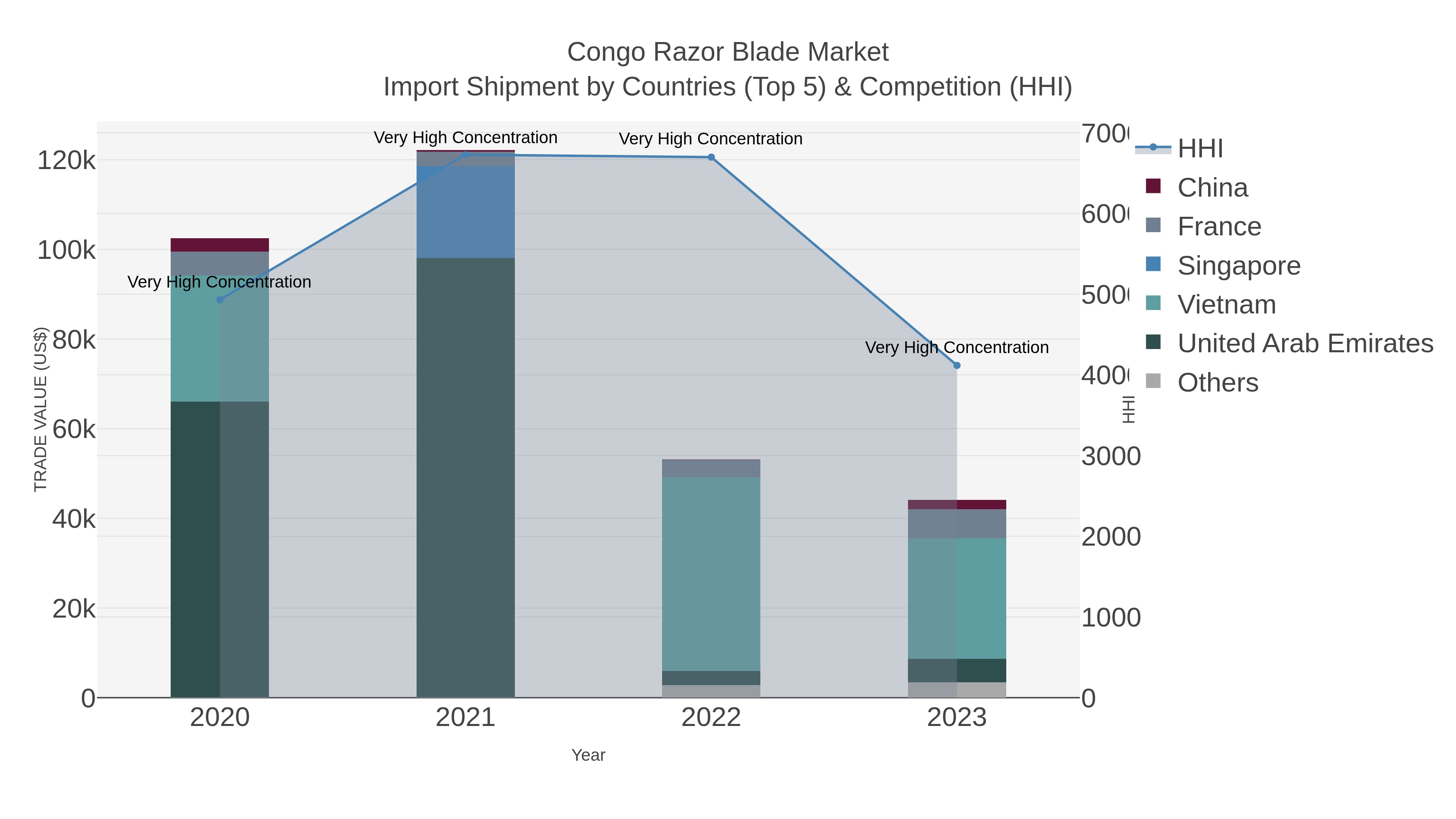
In 2023, Congo continued to rely on imports of razor blades, with top exporters being Vietnam, France, United Arab Emirates, Cameroon, and China. The market remains highly concentrated, with a very high Herfindahl-Hirschman Index (HHI). However, the industry experienced a significant decline, with a negative Compound Annual Growth Rate (CAGR) of -24.49% and a growth rate of -17.04%. This suggests a challenging environment for razor blade importers in Congo, potentially indicating shifts in consumer preferences or market dynamics.
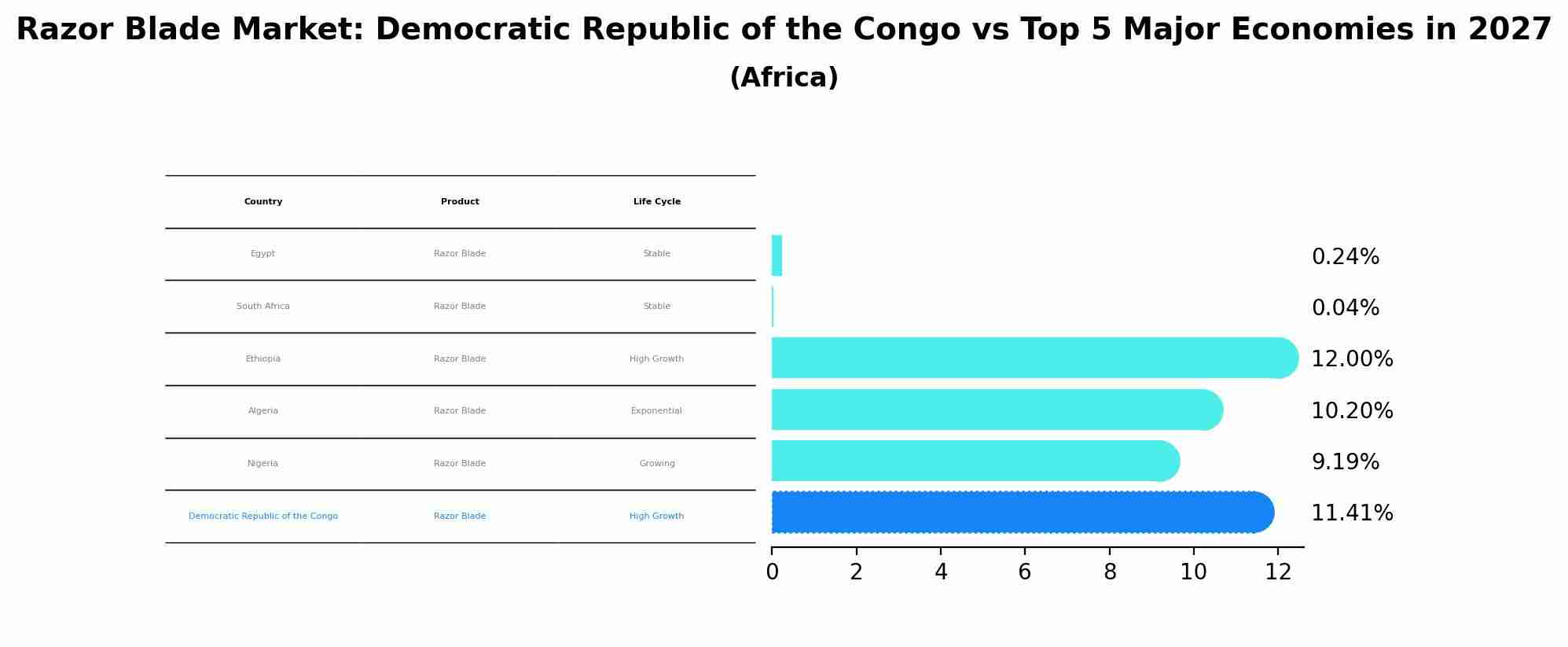
Razor Blade Market: Democratic Republic of the Congo vs Top 5 Major Economies in 2027 (Africa)
By 2027, Democratic Republic of the Congo's Razor Blade market is forecasted to achieve a high growth rate of 11.41%, with Egypt leading the Africa region, followed by South Africa, Ethiopia, Algeria and Nigeria.
Congo Razor Blade Market Overview
The razor blade market in Congo is driven by personal grooming needs, with demand from both men and women. The market includes disposable razors, cartridge systems, and safety razors, with growth linked to increasing disposable incomes and urbanization.
Drivers of the market
The Congo Razor Blade market benefits from the rising demand for personal grooming products and the growing focus on male grooming trends. Razor blades are essential for shaving and personal care, and the market is expanding due to increased consumer spending on grooming products and innovations in blade technology.
Challenges of the market
The Congo Razor Blade market encounters challenges such as high import costs and limited local manufacturing capabilities. Regulatory issues related to product safety and quality standards also affect market dynamics. Furthermore, competition from alternative grooming products and fluctuating raw material prices impact market growth and development.
Government Policy of the market
Government policies affecting the razor blade market in Congo include regulations related to manufacturing standards and consumer safety. Policies support the local production of razor blades by providing incentives and ensuring adherence to quality standards. Challenges include limited local manufacturing infrastructure, outdated technological capabilities, and inconsistent enforcement of regulations.
Key Highlights of the Report:
- Congo Razor Blade Market Outlook
- Market Size of Congo Razor Blade Market, 2024
- Forecast of Congo Razor Blade Market, 2031
- Historical Data and Forecast of Congo Razor Blade Revenues & Volume for the Period 2021-2031
- Congo Razor Blade Market Trend Evolution
- Congo Razor Blade Market Drivers and Challenges
- Congo Razor Blade Price Trends
- Congo Razor Blade Porter`s Five Forces
- Congo Razor Blade Industry Life Cycle
- Historical Data and Forecast of Congo Razor Blade Market Revenues & Volume By Type for the Period 2021-2031
- Historical Data and Forecast of Congo Razor Blade Market Revenues & Volume By Single Edge for the Period 2021-2031
- Historical Data and Forecast of Congo Razor Blade Market Revenues & Volume By Double Edge for the Period 2021-2031
- Historical Data and Forecast of Congo Razor Blade Market Revenues & Volume By Blade Material for the Period 2021-2031
- Historical Data and Forecast of Congo Razor Blade Market Revenues & Volume By Carbon Steel for the Period 2021-2031
- Historical Data and Forecast of Congo Razor Blade Market Revenues & Volume By Stainless Steel for the Period 2021-2031
- Historical Data and Forecast of Congo Razor Blade Market Revenues & Volume By End User for the Period 2021-2031
- Historical Data and Forecast of Congo Razor Blade Market Revenues & Volume By Men for the Period 2021-2031
- Historical Data and Forecast of Congo Razor Blade Market Revenues & Volume By Women for the Period 2021-2031
- Historical Data and Forecast of Congo Razor Blade Market Revenues & Volume By Distribution Channel for the Period 2021-2031
- Historical Data and Forecast of Congo Razor Blade Market Revenues & Volume By Supermarkets/Hypermarkets for the Period 2021-2031
- Historical Data and Forecast of Congo Razor Blade Market Revenues & Volume By Departmental Stores for the Period 2021-2031
- Historical Data and Forecast of Congo Razor Blade Market Revenues & Volume By Convenience Stores for the Period 2021-2031
- Historical Data and Forecast of Congo Razor Blade Market Revenues & Volume By Online for the Period 2021-2031
- Congo Razor Blade Import Export Trade Statistics
- Market Opportunity Assessment By Type
- Market Opportunity Assessment By Blade Material
- Market Opportunity Assessment By End User
- Market Opportunity Assessment By Distribution Channel
- Congo Razor Blade Top Companies Market Share
- Congo Razor Blade Competitive Benchmarking By Technical and Operational Parameters
- Congo Razor Blade Company Profiles
- Congo Razor Blade Key Strategic Recommendations






































