Topics Covered in Costa Rica Food Service Market Report
Costa Rica Food Service Market Report thoroughly covers the market by type, service type, cuisine and end-user. Costa Rica Food Service Market Outlook report provides an unbiased and detailed analysis of the ongoing Costa Rica Food Service Market trends, opportunities/high growth areas, and market drivers. This would help stakeholders devise and align their market strategies according to the current and future market dynamics.
Costa Rica Food Service Market Synopsis
Costa Rica food service market has grown in recent years, supported by strong tourism expansion, rising demand from high-income consumers, and an increasing expatriate population. Changing consumer preferences toward healthy, gourmet, and plant-based options, along with higher demand for dining-out across urban and tourist hubs, have further fueled market growth. Moreover, between 2022 and 2025, Costa Rica’s HORECA sector (hotels, restaurants, and cafés) rebounded strongly alongside tourism recovery, directly driving the food service market.
Accommodation and food service activities grew in a moderate percentage in 2022 due to higher international arrivals and domestic dining demand, increasing overall consumption across restaurants and cafés. Further, By 2025, more than half of hotels reported improved performance, while restaurant operators also saw higher footfall and revenues, reflecting sector expansion. These trends demonstrate rising consumer spending and operational activity, supporting the growth of the food service market.
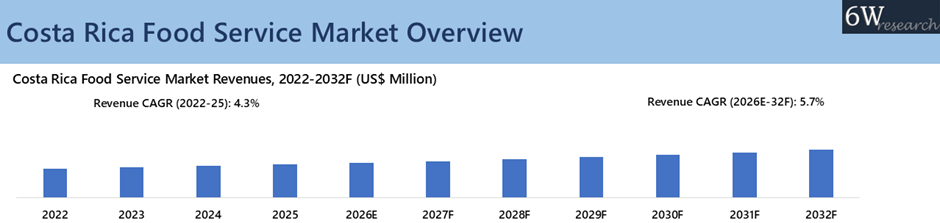
According to 6Wresearch, Costa Rica Food Services Market revenue size is projected to grow at a CAGR of 5.7% during 2026-2032. The market would experience sustained growth due to continued tourist arrivals. With several visitors arriving in just the first two months of the year, tourism authorities expect continued growth throughout 2026 as international travel demand remains high. This influx of tourists is expected to significantly boost demand for out-of-home dining, premium cuisines, and diverse food offerings, especially in key tourist destinations, boosting the overall growth of the food service market by increasing footfall in restaurants, hotels, and cafes, driving higher sales, and encouraging investment in new food service establishments to cater to the growing demand.
Additionally, the surge in new developments in the HoReCa sector, including upcoming luxury hotels such as St. Regis Papagayo Resort (2027) and an LXR Hotels & Resorts property in Manuel Antonio (mid-2028), along with several other projects, is expected to further drive the Costa Rica food service market by expanding high-end dining capacity, increasing demand for premium ingredients, and elevating service standards.
Market Segmentation By Type
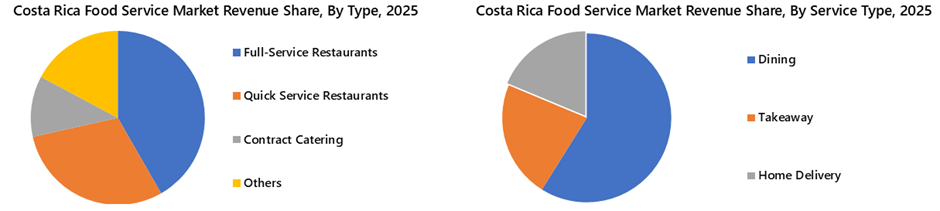
The Quick Service Restaurants (QSR) segment in the Costa Rica Food Services Market is expected to witness the fastest growth through 2032, driven by the increasing demand for convenient, affordable, and quick meal options. The growth of delivery platforms such as Uber Eats and DiDi Food, combined with the expansion of global QSR chains such as McDonald's and Burger King, is significantly contributing to the shift towards digital ordering and home delivery. This shift is particularly fueled by the growing urbanization, time-sensitive consumers, and an evolving dining culture in Costa Rica, where fast, quality food with efficient service has become a preferred choice for both locals and tourists.
Market Segmentation By Service Type
The Home Delivery segment in the Costa Rica Food Services Market is expected to witness the fastest growth through 2032, driven by the increasing adoption of digital ordering platforms and the rise of food delivery services such as Uber Eats and DiDi Food. The growing preference for convenience, combined with the widespread use of smartphones and online platforms, is encouraging consumers to opt for home delivery as a more convenient dining solution. The shift toward home delivery is further accelerated by the expanding urban population, busy lifestyles, and a booming tourism sector, where both locals and tourists prefer having meals delivered to their doorsteps.
Market Segmentation By Cuisine
Asian Cuisine is expected to witness the fastest growth in the Costa Rica Food Services Market through 2032, driven by the growing consumer demand for diverse and innovative dining options. As urbanization and global culinary influences continue to shape the food culture, there is an increasing preference for healthier, unique, and flavorful alternatives. The rise of delivery platforms and the expanding presence of Asian restaurants, particularly those offering sushi, Thai, and fusion dishes, are accelerating the shift toward Asian cuisine.
Market Segmentation By End User
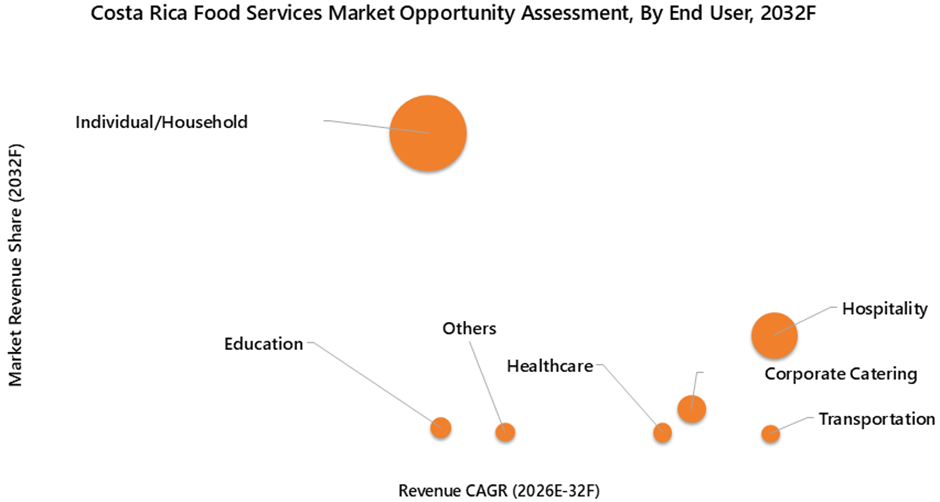
The Hospitality segment is expected to witness the fastest growth in the Costa Rica Food Services Market through 2032, driven by the increasing influx of international tourists and expanding luxury hotel developments. With Costa Rica continuing to position itself as a leading eco-tourism and vacation destination, the demand for high-quality food and beverage offerings within hotels, resorts, and upscale tourist destinations is rapidly growing. This trend is further supported by significant investments in the hospitality sector, including major expansions from global hotel chains and the development of new resorts, which are driving the need for enhanced dining experiences to cater to a growing tourist base.
Key Attractiveness of the Report
- 10 Years Market Numbers.
- Historical Data Starting from 2022 to 2025
- Base Year: 2025
- Forecast Data until 2032
- Key Performance Indicators Impacting the Market.
- Major Upcoming Developments and Projects.
Key Highlights of the Report:
- Global Food Services Market Overview
- Costa Rica Food Services Market Overview
- Costa Rica Food Services Market Outlook
- Costa Rica Food Services Market Forecast
- Historical Data and Forecast of Costa Rica Food Services Market Revenues for the Period 2022-2032F
- Historical Data and Forecast of Costa Rica Food Services Market Revenues, By Type, for the Period 2022-2032F
- Historical Data and Forecast of Costa Rica Food Services Market Revenues, By Service Type, for the Period 2022-2032F
- Historical Data and Forecast of Costa Rica Food Services Market Revenues, By Cuisine, for the Period 2022-2032F
- Historical Data and Forecast of Costa Rica Food Services Market Revenues, By End User, for the Period 2022-2032F
- Industry Life Cycle
- Porter’s Five Force Analysis
- Costa Rica Food Services Market Drivers and Restraints
- Market Trends & Evolution
- Market Opportunity Assessment
- Costa Rica Food Services Market Revenue Share, By Top 5 Companies
- Competitive Benchmarking
- Company Profiles
- Key Strategic Recommendations
Market Scope and Segmentation
The report provides a detailed analysis of the following market segments:
By Type
- Full-Service Restaurants
- Quick Service Restaurants
- Contract Catering
- Others
By Service Type
- Dining
- Takeaway
- Home Delivery
By Cuisine
- American Cuisine
- Latin American/Traditional Cuisine
- Asian Cuisine
- Mediterranean Cuisine
- Others
By End User
- Individual/Household
- Corporate Catering
- Hospitality
- Healthcare
- Education
- Transportation
- Others






































