Costa Rica Non-alcoholic Drink Market: Top 5 Importing Countries and Market Competition (HHI) Analysis
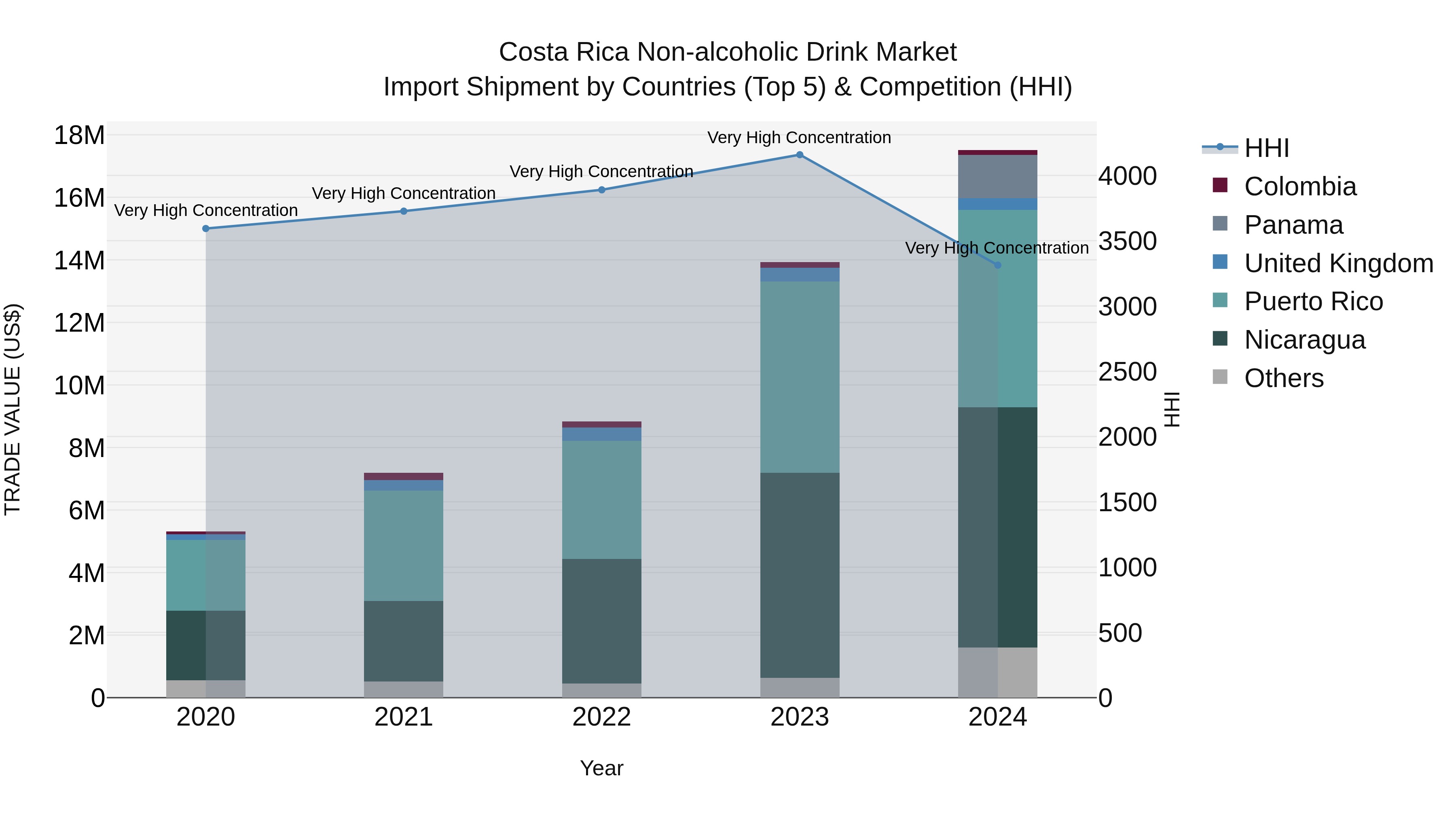
Costa Rica saw a significant increase in non-alcoholic drink import shipments in 2024, with top exporting countries being Nicaragua, Puerto Rico, Panama, Guatemala, and the United Kingdom. The market remains highly concentrated, as indicated by the high HHI. The impressive compound annual growth rate (CAGR) of 34.71% from 2020 to 2024 showcases a thriving industry. Moreover, the growth rate of 25.71% from 2023 to 2024 indicates continued expansion and opportunities for both local consumers and international suppliers in the Costa Rican non-alcoholic beverage market.
Costa Rica Export Potential Assessment For Non-alcoholic Drink Market (Values in USD Thousand)
Key Highlights of the Report:
- Costa Rica Non-alcoholic Drink Market Outlook
- Market Size of Costa Rica Non-alcoholic Drink Market, 2025
- Forecast of Costa Rica Non-alcoholic Drink Market, 2032
- Historical Data and Forecast of Costa Rica Non-alcoholic Drink Revenues & Volume for the Period 2022 - 2032F
- Costa Rica Non-alcoholic Drink Market Trend Evolution
- Costa Rica Non-alcoholic Drink Market Drivers and Challenges
- Costa Rica Non-alcoholic Drink Price Trends
- Costa Rica Non-alcoholic Drink Porter`s Five Forces
- Costa Rica Non-alcoholic Drink Industry Life Cycle
- Historical Data and Forecast of Costa Rica Non-alcoholic Drink Market Revenues & Volume By Product Types for the Period 2022 - 2032F
- Historical Data and Forecast of Costa Rica Non-alcoholic Drink Market Revenues & Volume By CarbonatedDrinks for the Period 2022 - 2032F
- Historical Data and Forecast of Costa Rica Non-alcoholic Drink Market Revenues & Volume By Non-CarbonatedDrinks for the Period 2022 - 2032F
- Historical Data and Forecast of Costa Rica Non-alcoholic Drink Market Revenues & Volume By Distribution Channel for the Period 2022 - 2032F
- Historical Data and Forecast of Costa Rica Non-alcoholic Drink Market Revenues & Volume By Online for the Period 2022 - 2032F
- Historical Data and Forecast of Costa Rica Non-alcoholic Drink Market Revenues & Volume By Offline for the Period 2022 - 2032F
- Costa Rica Non-alcoholic Drink Import Export Trade Statistics
- Market Opportunity Assessment By Product Types
- Market Opportunity Assessment By Distribution Channel
- Costa Rica Non-alcoholic Drink Top Companies Market Share
- Costa Rica Non-alcoholic Drink Competitive Benchmarking By Technical and Operational Parameters
- Costa Rica Non-alcoholic Drink Company Profiles
- Costa Rica Non-alcoholic Drink Key Strategic Recommendations






































