Costa Rica Organic Rice Market: Top 5 Importing Countries and Market Competition (HHI) Analysis
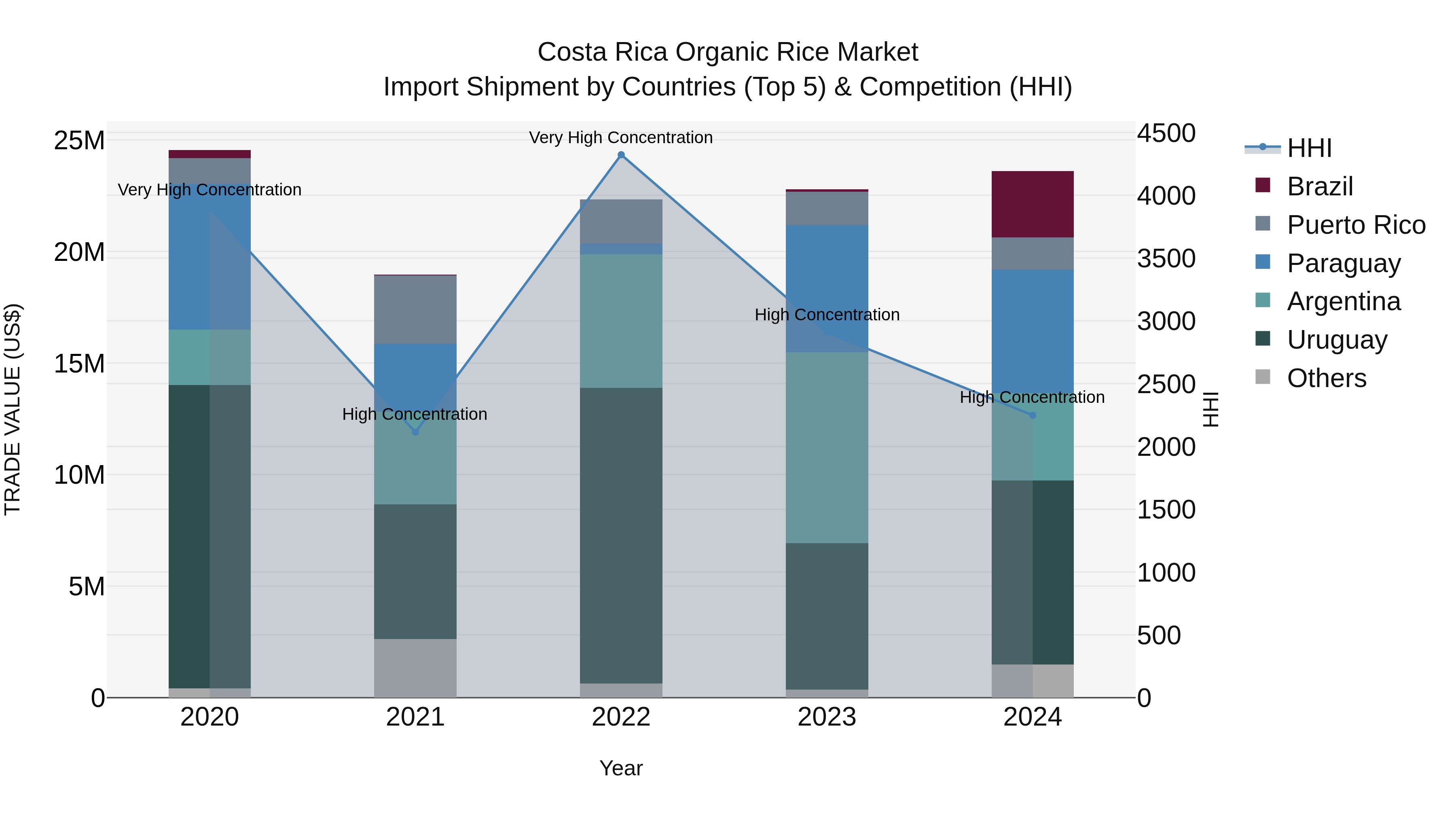
Costa Rica continues to see a steady flow of organic rice imports from Uruguay, Paraguay, Argentina, Brazil, and Puerto Rico in 2024. Despite a minor decline in the CAGR from 2020-24, the market experienced a growth rate of 3.61% in 2023-24. The high Herfindahl-Hirschman Index (HHI) indicates a concentrated market, suggesting opportunities for market players to innovate and differentiate their offerings to meet the increasing demand for organic rice in Costa Rica.
Costa Rica Organic Rice Market Overview
The organic rice market in Costa Rica is experiencing steady growth driven by increasing consumer awareness of the benefits of organic products and a growing demand for healthier food options. Local farmers are increasingly adopting organic farming practices to cater to this demand, resulting in a wider availability of organic rice varieties in the market. The government`s support for sustainable agriculture and organic farming initiatives has also contributed to the expansion of the organic rice sector. Key players in the market include both local producers and international brands offering organic rice products. With a focus on sustainability and quality, the Costa Rica organic rice market is expected to continue its growth trajectory in the coming years, presenting opportunities for further market expansion and innovation.
Costa Rica Organic Rice Market Trends and Opportunities
The Costa Rica Organic Rice Market is experiencing a growing demand due to increasing consumer awareness about health and sustainability. Consumers are seeking organic rice products that are free from pesticides and chemicals. This trend is creating opportunities for rice farmers to shift towards organic farming practices to cater to this demand. Additionally, the export market for organic rice is expanding, presenting opportunities for Costa Rican rice producers to tap into international markets. Collaborations with retailers and online platforms can also help in reaching a wider consumer base. Overall, the trend towards organic rice consumption in Costa Rica presents a promising opportunity for farmers and businesses in the sector to capitalize on the growing market demand.
Costa Rica Organic Rice Market Challenges
In the Costa Rica Organic Rice Market, challenges include limited consumer awareness and understanding of the benefits of organic rice, which can lead to lower demand and market penetration. Additionally, the higher production costs associated with organic farming methods can result in elevated prices for organic rice products, making them less competitive compared to conventional rice options. Another challenge is the lack of widespread certification and standardization processes for organic rice production, leading to difficulties in verifying the authenticity and quality of organic rice in the market. Addressing these challenges will require targeted marketing efforts to educate consumers, improved cost-efficiency in organic rice production, and the establishment of clear regulations and certifications to ensure transparency and trust in the organic rice sector.
Costa Rica Organic Rice Market Drivers
The Costa Rica Organic Rice Market is primarily driven by increasing consumer awareness and preference for organic and healthier food options. Rising concerns over the environmental impact of conventional agriculture practices, such as chemical pesticides and fertilizers, have led to a growing demand for organic products, including rice. Additionally, the government initiatives promoting sustainable farming practices and the support for organic agriculture are further boosting the market growth. Health-conscious consumers seeking pesticide-free and non-GMO food products are also driving the demand for organic rice in Costa Rica. Furthermore, the availability of organic certification programs and the expansion of distribution channels are facilitating easier access to organic rice products, contributing to the market`s positive trajectory.
Costa Rica Organic Rice Market Government Policies
Costa Rica has implemented various government policies to support the organic rice market. These policies include the promotion of sustainable agriculture practices, financial incentives for organic rice producers, and the establishment of certification programs to ensure the authenticity of organic products. The government also provides technical assistance and training to farmers to help them transition to organic farming methods. Additionally, Costa Rica has strict regulations in place to control the use of synthetic pesticides and fertilizers in rice cultivation, further promoting the growth of the organic rice sector. Overall, these government policies aim to encourage the production and consumption of organic rice while protecting the environment and promoting sustainability in the agricultural sector of Costa Rica.
Costa Rica Organic Rice Market Future Outlook
The future outlook for the Costa Rica Organic Rice Market appears positive, driven by increasing consumer awareness and demand for organic and sustainably produced food products. As more consumers prioritize health and environmental sustainability, there is a growing preference for organic rice due to its perceived health benefits and lower environmental impact compared to conventionally grown rice. The Costa Rican government`s support for organic farming practices and the country`s rich biodiversity provide a conducive environment for the growth of the organic rice sector. Additionally, the rising trend of organic food consumption globally presents export opportunities for Costa Rican organic rice producers. Overall, the Costa Rica Organic Rice Market is poised for growth, supported by changing consumer preferences and favorable market conditions.
Key Highlights of the Report:
- Costa Rica Organic Rice Market Outlook
- Market Size of Costa Rica Organic Rice Market, 2024
- Forecast of Costa Rica Organic Rice Market, 2031
- Historical Data and Forecast of Costa Rica Organic Rice Revenues & Volume for the Period 2021- 2031
- Costa Rica Organic Rice Market Trend Evolution
- Costa Rica Organic Rice Market Drivers and Challenges
- Costa Rica Organic Rice Price Trends
- Costa Rica Organic Rice Porter's Five Forces
- Costa Rica Organic Rice Industry Life Cycle
- Historical Data and Forecast of Costa Rica Organic Rice Market Revenues & Volume By Type for the Period 2021- 2031
- Historical Data and Forecast of Costa Rica Organic Rice Market Revenues & Volume By Polished Glutinous Rice (Sticky Rice) for the Period 2021- 2031
- Historical Data and Forecast of Costa Rica Organic Rice Market Revenues & Volume By Indica (long-shaped Rice) for the Period 2021- 2031
- Historical Data and Forecast of Costa Rica Organic Rice Market Revenues & Volume By Polished Round-grained Rice for the Period 2021- 2031
- Historical Data and Forecast of Costa Rica Organic Rice Market Revenues & Volume By Application for the Period 2021- 2031
- Historical Data and Forecast of Costa Rica Organic Rice Market Revenues & Volume By Direct Edible for the Period 2021- 2031
- Historical Data and Forecast of Costa Rica Organic Rice Market Revenues & Volume By Deep Processing for the Period 2021- 2031
- Historical Data and Forecast of Costa Rica Organic Rice Market Revenues & Volume By End User for the Period 2021- 2031
- Historical Data and Forecast of Costa Rica Organic Rice Market Revenues & Volume By Bakery & Confectionary for the Period 2021- 2031
- Historical Data and Forecast of Costa Rica Organic Rice Market Revenues & Volume By Beverages for the Period 2021- 2031
- Historical Data and Forecast of Costa Rica Organic Rice Market Revenues & Volume By Desert & Dairy Products for the Period 2021- 2031
- Historical Data and Forecast of Costa Rica Organic Rice Market Revenues & Volume By Meat for the Period 2021- 2031
- Historical Data and Forecast of Costa Rica Organic Rice Market Revenues & Volume By Poultry & Seafood Products for the Period 2021- 2031
- Historical Data and Forecast of Costa Rica Organic Rice Market Revenues & Volume By Infant Formula for the Period 2021- 2031
- Historical Data and Forecast of Costa Rica Organic Rice Market Revenues & Volume By Others for the Period 2021- 2031
- Costa Rica Organic Rice Import Export Trade Statistics
- Market Opportunity Assessment By Type
- Market Opportunity Assessment By Application
- Market Opportunity Assessment By End User
- Costa Rica Organic Rice Top Companies Market Share
- Costa Rica Organic Rice Competitive Benchmarking By Technical and Operational Parameters
- Costa Rica Organic Rice Company Profiles
- Costa Rica Organic Rice Key Strategic Recommendations






































