Croatia Acetonitrile Market Size (2020-2030)
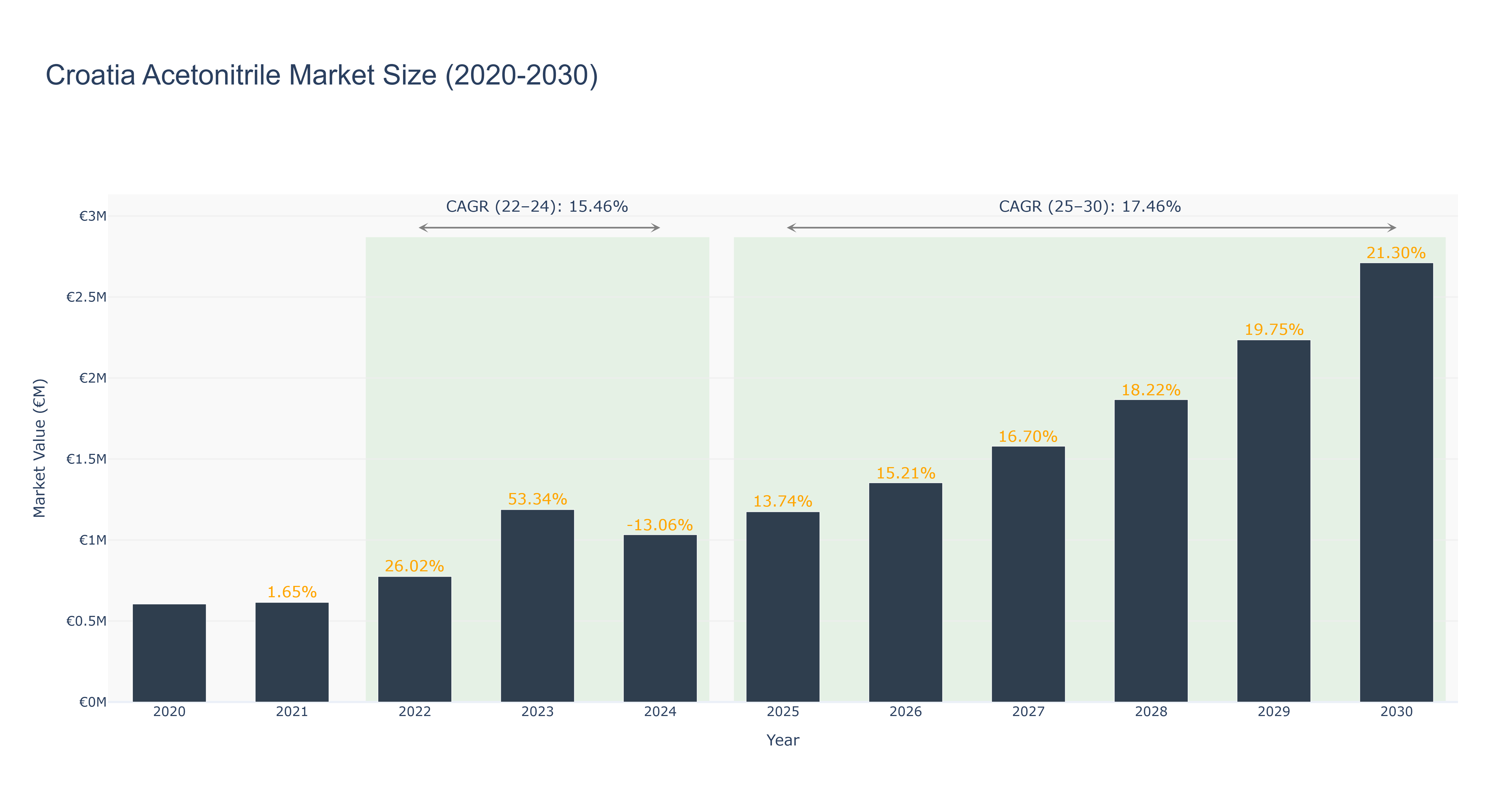
Croatia's Acetonitrile Market has shown a steady growth trajectory over the years. The peak market size of €2.71 million is forecasted for 2030, with a notable increase in growth rate. From 2020 to 2024, the market size saw fluctuations, reaching a low of €1.03 million in 2024 due to a temporary dip in demand. However, from 2025 to 2030, the market is expected to experience robust growth, with a CAGR of 17.46%. The industry drivers behind this positive trend include increasing industrial applications and a growing demand for specialty chemicals in the region. Looking ahead, Croatia is set to witness new investments in the chemical sector, particularly in research and development initiatives aimed at enhancing product quality and expanding market reach.
Croatia Acetonitrile Market: Production & Trade Performance (2019-2025)
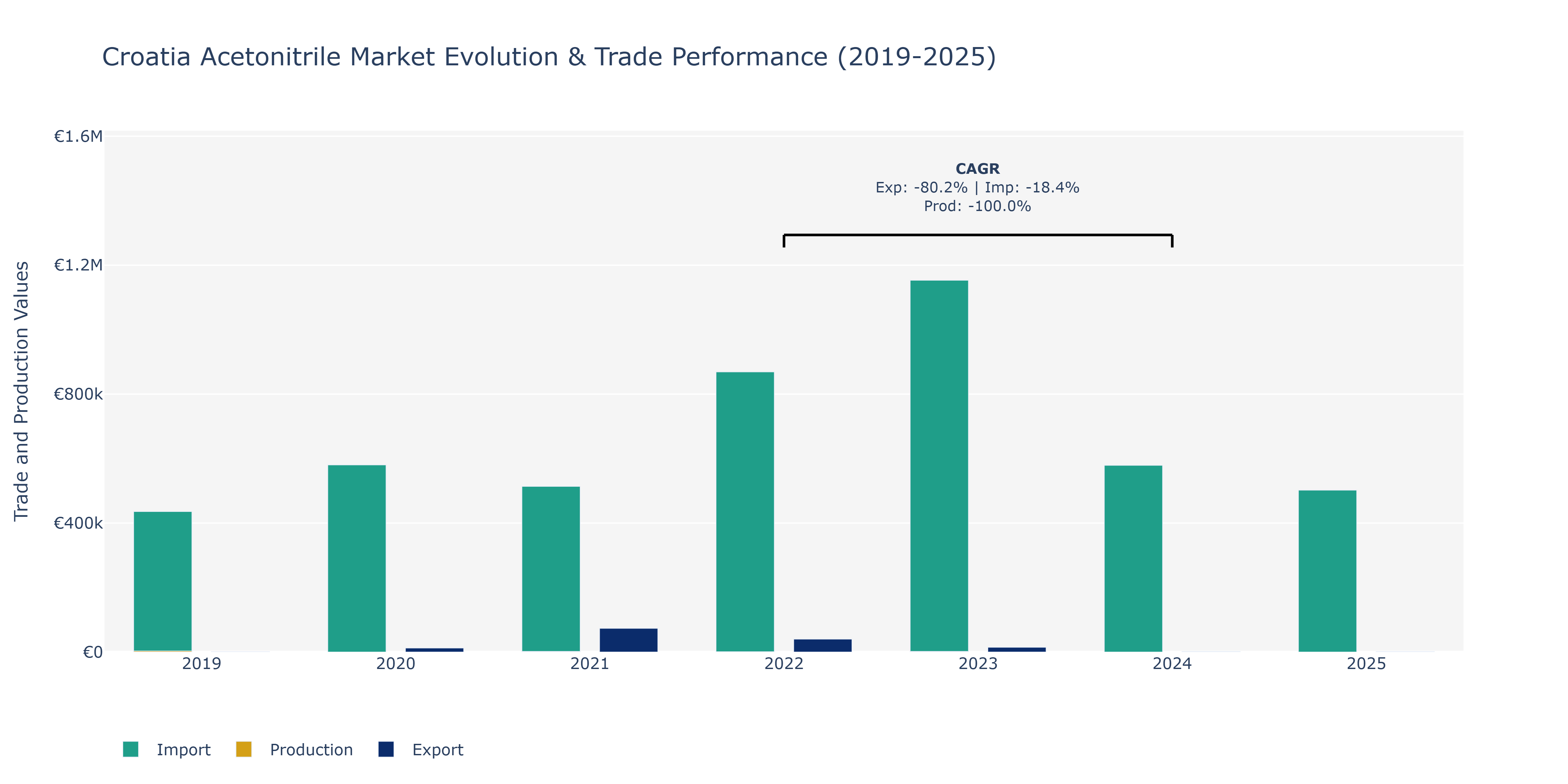
Between 2019 and 2025, Croatia's Acetonitrile Market experienced notable dynamics in exports, imports, and production. In 2019, exports were at €1.04 thousand, showing a substantial surge to approximately €73.42 thousand in 2021 before declining to around €11.8 thousand in 2025. Conversely, imports steadily increased from €435.6 thousand in 2019 to approximately €1.15 million in 2023, then decreased slightly to about €502.03 thousand in 2025. Production, on the other hand, fluctuated, reaching €3.37 thousand in 2019, dropping to €1 thousand in 2022, and then rising to €2 thousand in 2023 before falling to an undisclosed amount in 2024. The decline in exports after 2021 could be attributed to shifts in demand or global market conditions, while varying Import value may reflect changes in domestic consumption patterns or competitive pricing strategies. The fluctuating production levels might indicate adjustments in manufacturing capacities or technological advancements impacting output efficiency. Such market movements underscore the need for strategic planning to navigate changing trade landscapes and production capabilities in Croatia's Acetonitrile Market.
Key Highlights of the Report:
- Croatia Acetonitrile Market Outlook
- Market Size of Croatia Acetonitrile Market, 2025
- Forecast of Croatia Acetonitrile Market, 2032
- Historical Data and Forecast of Croatia Acetonitrile Revenues & Volume for the Period 2022 - 2032F
- Croatia Acetonitrile Market Trend Evolution
- Croatia Acetonitrile Market Drivers and Challenges
- Croatia Acetonitrile Price Trends
- Croatia Acetonitrile Porter`s Five Forces
- Croatia Acetonitrile Industry Life Cycle
- Historical Data and Forecast of Croatia Acetonitrile Market Revenues & Volume By Type for the Period 2022 - 2032F
- Historical Data and Forecast of Croatia Acetonitrile Market Revenues & Volume By Derivative for the Period 2022 - 2032F
- Historical Data and Forecast of Croatia Acetonitrile Market Revenues & Volume By Solvent for the Period 2022 - 2032F
- Historical Data and Forecast of Croatia Acetonitrile Market Revenues & Volume By Application for the Period 2022 - 2032F
- Historical Data and Forecast of Croatia Acetonitrile Market Revenues & Volume By Pharmaceutical for the Period 2022 - 2032F
- Historical Data and Forecast of Croatia Acetonitrile Market Revenues & Volume By Analytical Industry for the Period 2022 - 2032F
- Historical Data and Forecast of Croatia Acetonitrile Market Revenues & Volume By Agrochemical for the Period 2022 - 2032F
- Historical Data and Forecast of Croatia Acetonitrile Market Revenues & Volume By Extraction for the Period 2022 - 2032F
- Croatia Acetonitrile Import Export Trade Statistics
- Market Opportunity Assessment By Type
- Market Opportunity Assessment By Application
- Croatia Acetonitrile Top Companies Market Share
- Croatia Acetonitrile Competitive Benchmarking By Technical and Operational Parameters
- Croatia Acetonitrile Company Profiles
- Croatia Acetonitrile Key Strategic Recommendations






































