Croatia Artificial Flowers Market Size (2020-2030)
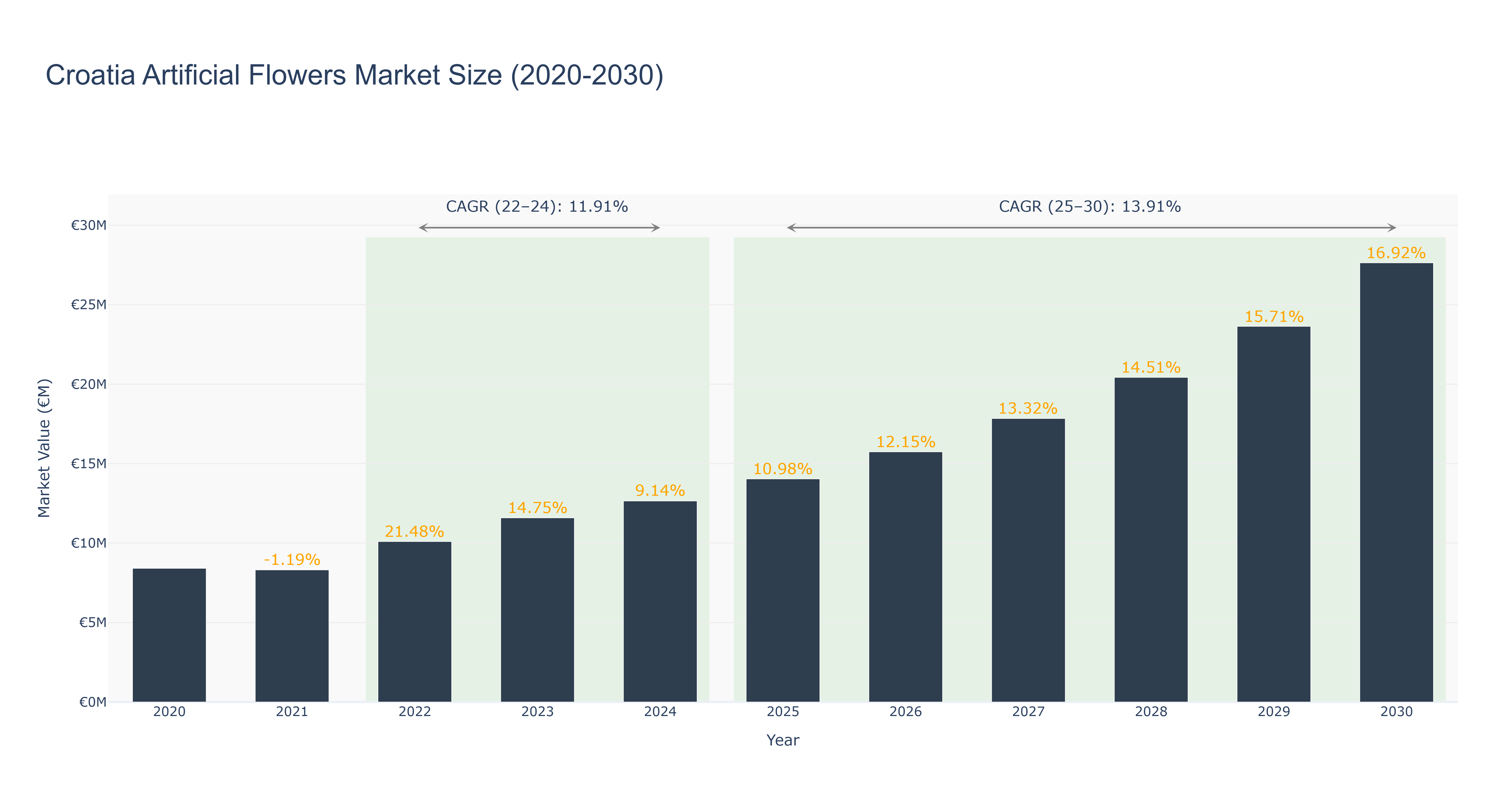
Croatia Artificial Flowers Market has shown a steady growth trajectory over the past decade. The peak market size of €27.63 million is forecasted for 2030, with a notable growth rate of 16.92%. From 2020 to 2024, the market size has increased from €8.41 million to €12.65 million, driven by increasing consumer demand for artificial flowers in home decor and events. The market experienced a significant spike in growth from 2022 to 2024, attributed to innovative product offerings and expanding distribution channels. Looking ahead, the projected CAGR from 2025 to 2030 stands at 13.91%, showcasing sustained market expansion. Recent developments include partnerships with local artisans for unique designs and upcoming initiatives to promote sustainable practices in artificial flower production, positioning Croatia as a hub for quality artificial floral products.
Croatia Artificial Flowers Market: Production & Trade Performance (2019-2025)
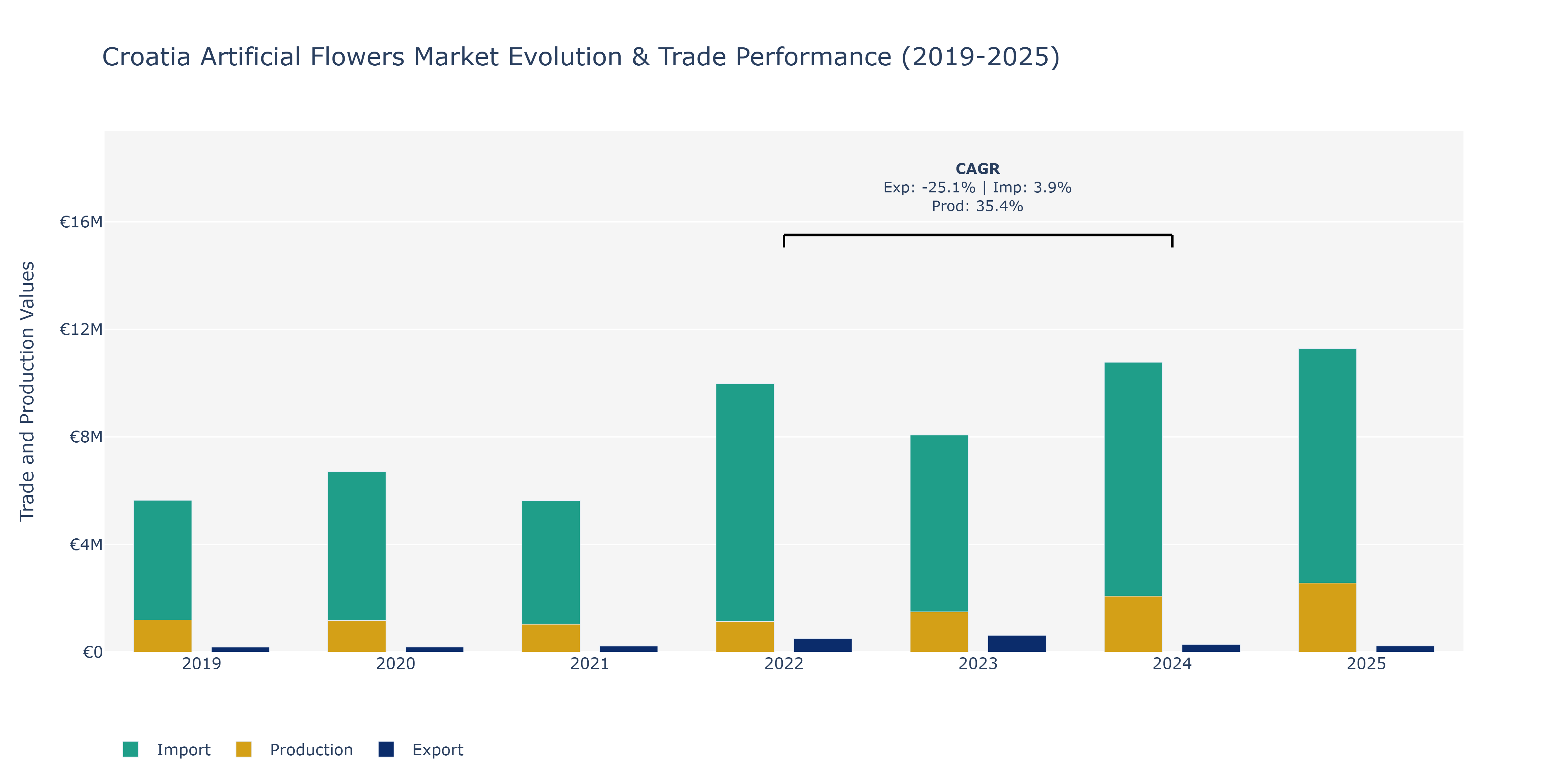
In the Croatia Artificial Flowers Market, exports exhibited fluctuations over the analyzed period, with a peak in 2022 at €501.1 thousand, driven by potential increased demand or possibly a strategic market expansion effort. Imports steadily increased from €5.64 million in 2019 to €11.29 million in 2025, indicating a consistent influx of foreign artificial flowers, perhaps due to evolving consumer preferences or competitive pricing abroad. Production saw a significant growth, reaching €2.6 billion in 2025, reflecting a strong domestic manufacturing capacity supported by technological advancements or operational efficiencies. The market's dynamics suggest a balancing act between international trade dependencies and local production capabilities, emphasizing the need for market players to optimize sourcing strategies and operational processes to remain competitive in the global artificial flowers industry.
Key Highlights of the Report:
- Croatia Artificial Flowers Market Outlook
- Market Size of Croatia Artificial Flowers Market, 2024
- Forecast of Croatia Artificial Flowers Market, 2031
- Historical Data and Forecast of Croatia Artificial Flowers Revenues & Volume for the Period 2021-2031
- Croatia Artificial Flowers Market Trend Evolution
- Croatia Artificial Flowers Market Drivers and Challenges
- Croatia Artificial Flowers Price Trends
- Croatia Artificial Flowers Porter`s Five Forces
- Croatia Artificial Flowers Industry Life Cycle
- Historical Data and Forecast of Croatia Artificial Flowers Market Revenues & Volume By Material Type for the Period 2021-2031
- Historical Data and Forecast of Croatia Artificial Flowers Market Revenues & Volume By Clay & Porcelain for the Period 2021-2031
- Historical Data and Forecast of Croatia Artificial Flowers Market Revenues & Volume By Cotton & Silk for the Period 2021-2031
- Historical Data and Forecast of Croatia Artificial Flowers Market Revenues & Volume By Leather & Nylon for the Period 2021-2031
- Historical Data and Forecast of Croatia Artificial Flowers Market Revenues & Volume By Paper & Wax for the Period 2021-2031
- Historical Data and Forecast of Croatia Artificial Flowers Market Revenues & Volume By Plastic & Polyester for the Period 2021-2031
- Historical Data and Forecast of Croatia Artificial Flowers Market Revenues & Volume By Application for the Period 2021-2031
- Historical Data and Forecast of Croatia Artificial Flowers Market Revenues & Volume By Commercial for the Period 2021-2031
- Historical Data and Forecast of Croatia Artificial Flowers Market Revenues & Volume By Residential for the Period 2021-2031
- Croatia Artificial Flowers Import Export Trade Statistics
- Market Opportunity Assessment By Material Type
- Market Opportunity Assessment By Application
- Croatia Artificial Flowers Top Companies Market Share
- Croatia Artificial Flowers Competitive Benchmarking By Technical and Operational Parameters
- Croatia Artificial Flowers Company Profiles
- Croatia Artificial Flowers Key Strategic Recommendations






































