Croatia Canned Food Market Top 5 Importing Countries and Market Competition (HHI) Analysis
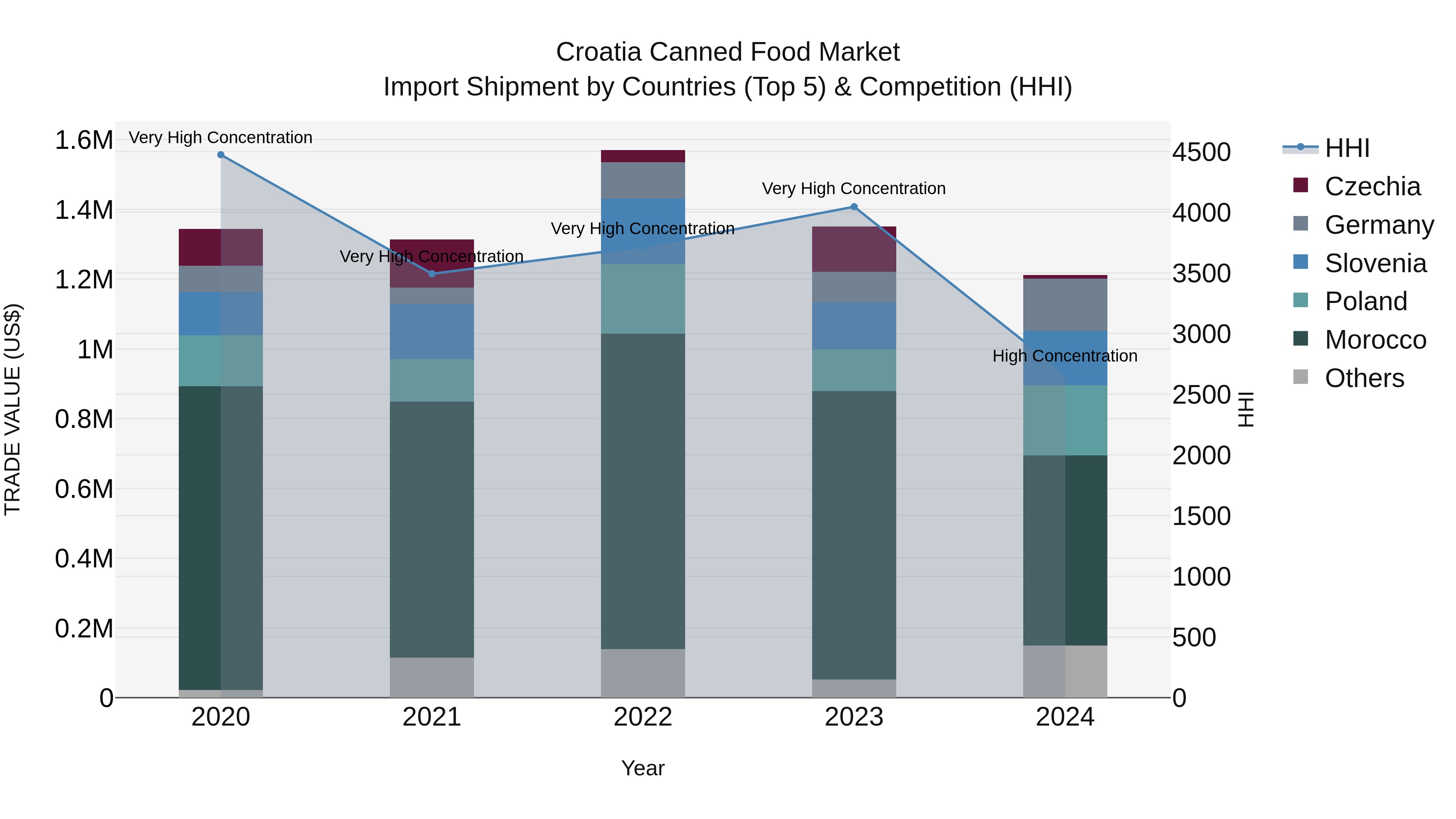
Croatia canned food import market saw a shift in concentration in 2024, with top exporters being Morocco, Poland, Slovenia, Germany, and Serbia. Despite a declining CAGR of -2.55% from 2020 to 2024, the market experienced a significant decrease in growth rate from 2023 to 2024 at -10.28%. The high concentration of the Herfindahl-Hirschman Index (HHI) in 2023 remained relatively high in 2024, indicating a competitive market landscape. Stakeholders should closely monitor these trends to adapt strategies and capitalize on emerging opportunities in the Croatian canned food import market.
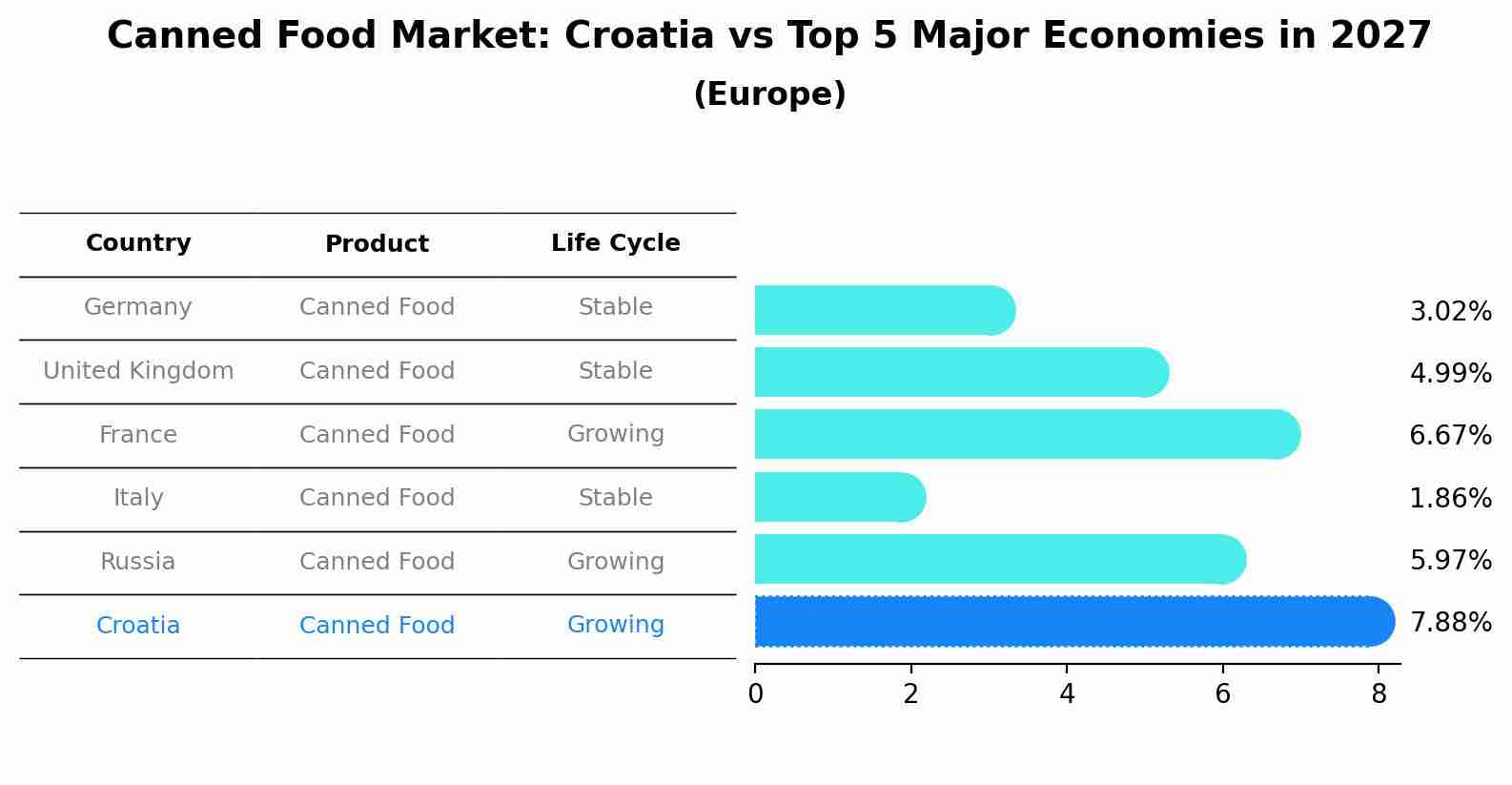
Canned Food Market: Croatia vs Top 5 Major Economies in 2027 (Europe)
In the Europe region, the Canned Food market in Croatia is projected to expand at a growing growth rate of 7.88% by 2027. The largest economy is Germany, followed by United Kingdom, France, Italy and Russia.
Croatia Canned Food Market Overview
The canned food market in Croatia offers a range of processed and preserved foods, including vegetables, meats, and fruits. This market is supported by consumer demand for long-lasting, ready-to-eat food products and Croatias agricultural output.
Drivers of the market
The Croatian canned food market is driven by the growing demand for convenient, shelf-stable food products. The increasing urbanization, busy lifestyles, and desire for affordable and nutritious meal options contribute to the rising consumption of canned food.
Challenges of the market
The canned food market in Croatia encounters challenges related to raw material costs and regulatory compliance. The prices of raw materials used in canned food production can be volatile, impacting operational costs and profitability. Additionally, the market must adhere to stringent food safety and labeling regulations, which can increase compliance costs. The industry also faces competition from alternative food preservation methods and changing consumer preferences. Balancing cost-effectiveness with regulatory compliance and market demand is a key challenge for the industry.
Government Policy of the market
Regulations related to food safety, quality, and packaging in Croatia impact the canned food market. The government adheres to EU directives on food preservation, labeling, and safety standards to ensure consumer protection and product quality.
Key Highlights of the Report:
- Croatia Canned Food Market Outlook
- Market Size of Croatia Canned Food Market, 2024
- Forecast of Croatia Canned Food Market, 2031
- Historical Data and Forecast of Croatia Canned Food Revenues & Volume for the Period 2021-2031
- Croatia Canned Food Market Trend Evolution
- Croatia Canned Food Market Drivers and Challenges
- Croatia Canned Food Price Trends
- Croatia Canned Food Porter`s Five Forces
- Croatia Canned Food Industry Life Cycle
- Historical Data and Forecast of Croatia Canned Food Market Revenues & Volume By Product Type for the Period 2021-2031
- Historical Data and Forecast of Croatia Canned Food Market Revenues & Volume By Canned meat & seafood for the Period 2021-2031
- Historical Data and Forecast of Croatia Canned Food Market Revenues & Volume By Canned fruit & vegetables for the Period 2021-2031
- Historical Data and Forecast of Croatia Canned Food Market Revenues & Volume By Canned ready meals for the Period 2021-2031
- Historical Data and Forecast of Croatia Canned Food Market Revenues & Volume By Others for the Period 2021-2031
- Historical Data and Forecast of Croatia Canned Food Market Revenues & Volume By Type for the Period 2021-2031
- Historical Data and Forecast of Croatia Canned Food Market Revenues & Volume By Organic for the Period 2021-2031
- Historical Data and Forecast of Croatia Canned Food Market Revenues & Volume By Conventional for the Period 2021-2031
- Historical Data and Forecast of Croatia Canned Food Market Revenues & Volume By Distribution Channel for the Period 2021-2031
- Historical Data and Forecast of Croatia Canned Food Market Revenues & Volume By Supermarket/Hypermarket for the Period 2021-2031
- Historical Data and Forecast of Croatia Canned Food Market Revenues & Volume By Convenience stores for the Period 2021-2031
- Historical Data and Forecast of Croatia Canned Food Market Revenues & Volume By E-commerce for the Period 2021-2031
- Historical Data and Forecast of Croatia Canned Food Market Revenues & Volume By Others for the Period 2021-2031
- Croatia Canned Food Import Export Trade Statistics
- Market Opportunity Assessment By Product Type
- Market Opportunity Assessment By Type
- Market Opportunity Assessment By Distribution Channel
- Croatia Canned Food Top Companies Market Share
- Croatia Canned Food Competitive Benchmarking By Technical and Operational Parameters
- Croatia Canned Food Company Profiles
- Croatia Canned Food Key Strategic Recommendations






































