Croatia Chewing Gum Market Size (2020-2030)
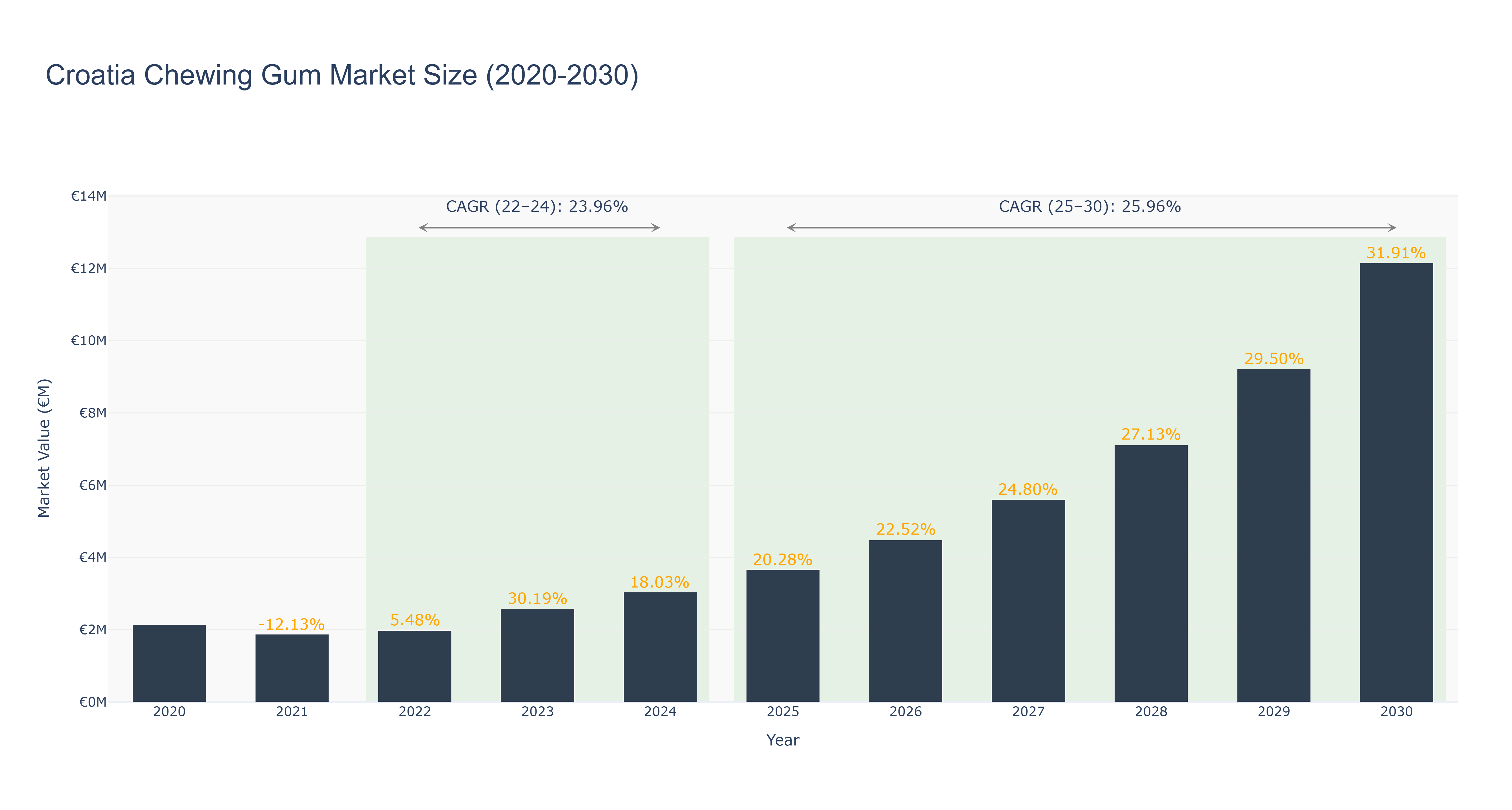
The Croatia Chewing Gum Market experienced a notable recovery from €1.88 million in 2021 to €2.58 million in 2023, reflecting a significant actual growth rate of 30.19%. The market is expected to continue its upward trajectory, reaching €3.04 million in 2024, with a compound annual growth rate (CAGR) of 23.96% from 2022 to 2024. This resurgence can be attributed to increased consumer demand for innovative and healthier gum options, alongside a growing trend towards sugar-free products. Looking ahead, the forecasted period from 2025 to 2030 indicates robust growth, with market size projected to reach €12.15 million by 2030, supported by a CAGR of 25.96%. Anticipated developments in product diversification and marketing strategies, along with rising disposable incomes and changing consumer preferences, are expected to drive this expansion in the Croatian chewing gum sector.
Croatia Chewing Gum Market: Production & Trade Performance (2019-2025)
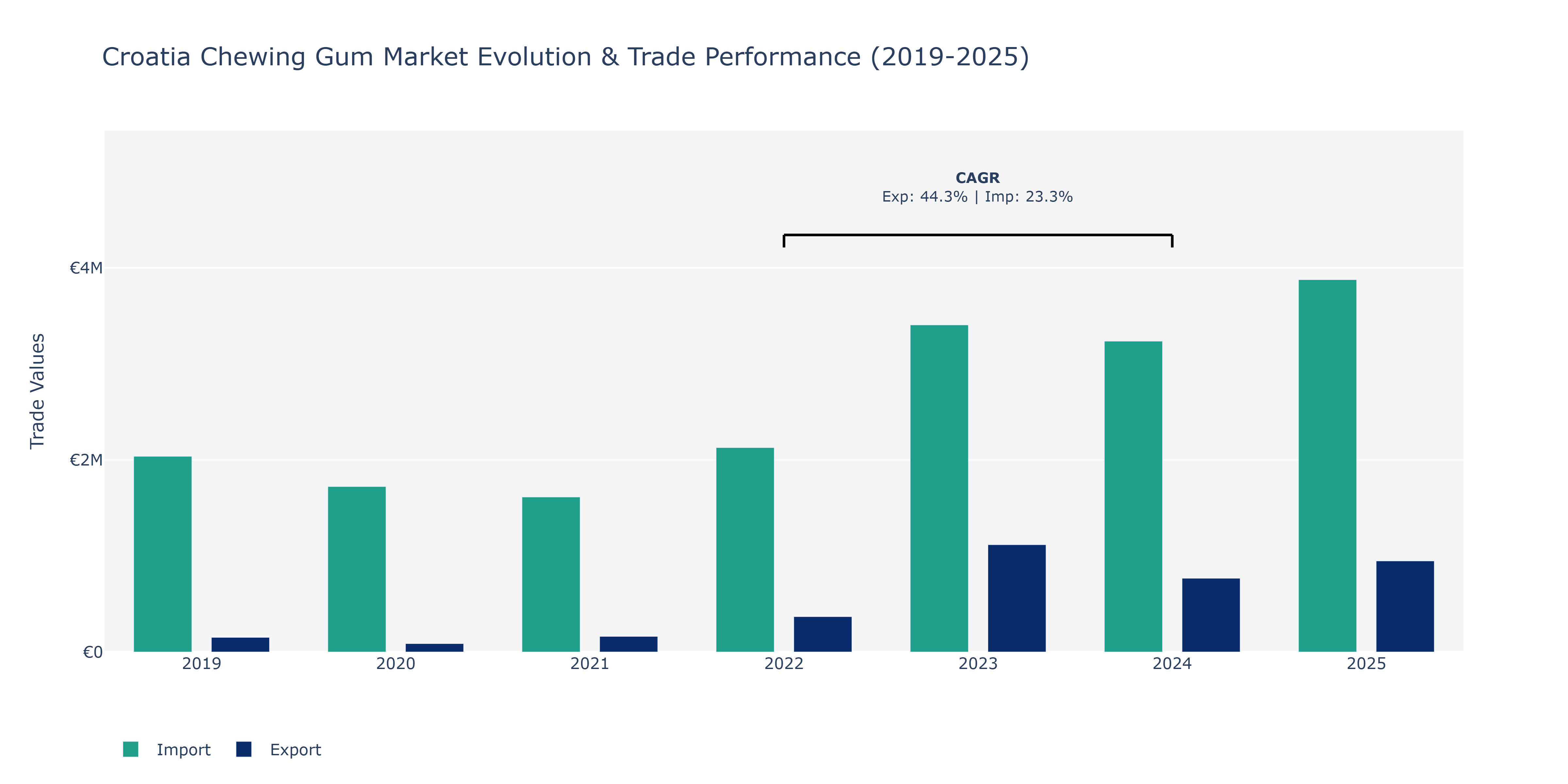
In the Croatia Chewing Gum Market, exports experienced notable fluctuations over the years, with a peak in 2023 at €1.12 million, a significant increase from 2019. However, exports declined in 2024 to around €769.19 thousand before rebounding slightly in 2025 to approximately €948.82 thousand. On the other hand, imports followed a more consistent trend, peaking in 2023 at €3.41 million. Despite a slight decrease in 2024 to around €3.24 million, imports surged to about €3.88 million in 2025. These fluctuations can be attributed to various factors, including changes in consumer preferences, economic conditions affecting disposable income, and fluctuations in raw material costs. The increase in exports in 2023 could be due to successful marketing strategies or increased demand from international markets. Conversely, the fluctuation in imports might reflect changes in global trade dynamics or efforts to diversify sourcing channels. To sustain growth, stakeholders could focus on innovation, quality improvements, and strategic pricing strategies to remain competitive in the global chewing gum market.
Croatia Chewing Gum Market Overview
The chewing gum market in Croatia is primarily driven by consumer demand for functional and flavored gums. Products with added health benefits, such as sugar-free and dental care-enhancing gums, are becoming increasingly popular. Additionally, the market is supported by impulse purchases, particularly in urban areas.
Drivers of the market
The chewing gum market in Croatia is driven by consumer preferences for convenience, flavor variety, and oral care benefits. The popularity of chewing gum as a snack and its role in promoting dental health contribute to the market`s growth, supported by innovation in flavors and functional ingredients.
Challenges of the market
The chewing gum market in Croatia faces challenges related to consumer preferences and market competition. Consumer preferences for flavors and formulations can change rapidly, requiring manufacturers to adapt and innovate continuously. Additionally, the market is competitive, with numerous brands offering similar products, impacting pricing and market share. Balancing consumer demands with market competition and managing production costs are key challenges for this market.
Government Policy of the market
The chewing gum market in Croatia is influenced by regulations on food safety and product labeling. The government enforces EU standards for the production and labeling of chewing gum, ensuring product safety and transparency for consumers.
Key Highlights of the Report:
- Croatia Chewing Gum Market Outlook
- Market Size of Croatia Chewing Gum Market, 2024
- Forecast of Croatia Chewing Gum Market, 2031
- Historical Data and Forecast of Croatia Chewing Gum Revenues & Volume for the Period 2021-2031
- Croatia Chewing Gum Market Trend Evolution
- Croatia Chewing Gum Market Drivers and Challenges
- Croatia Chewing Gum Price Trends
- Croatia Chewing Gum Porter`s Five Forces
- Croatia Chewing Gum Industry Life Cycle
- Historical Data and Forecast of Croatia Chewing Gum Market Revenues & Volume By Product Type for the Period 2021-2031
- Historical Data and Forecast of Croatia Chewing Gum Market Revenues & Volume By Sugared Chewing Gum for the Period 2021-2031
- Historical Data and Forecast of Croatia Chewing Gum Market Revenues & Volume By Sugar-free Chewing Gum for the Period 2021-2031
- Historical Data and Forecast of Croatia Chewing Gum Market Revenues & Volume By Distribution Channel for the Period 2021-2031
- Historical Data and Forecast of Croatia Chewing Gum Market Revenues & Volume By Supermarkets and Hypermarkets for the Period 2021-2031
- Historical Data and Forecast of Croatia Chewing Gum Market Revenues & Volume By Convenience Stores for the Period 2021-2031
- Historical Data and Forecast of Croatia Chewing Gum Market Revenues & Volume By Specialist Retailers for the Period 2021-2031
- Historical Data and Forecast of Croatia Chewing Gum Market Revenues & Volume By Online Retail for the Period 2021-2031
- Historical Data and Forecast of Croatia Chewing Gum Market Revenues & Volume By Others for the Period 2021-2031
- Croatia Chewing Gum Import Export Trade Statistics
- Market Opportunity Assessment By Product Type
- Market Opportunity Assessment By Distribution Channel
- Croatia Chewing Gum Top Companies Market Share
- Croatia Chewing Gum Competitive Benchmarking By Technical and Operational Parameters
- Croatia Chewing Gum Company Profiles
- Croatia Chewing Gum Key Strategic Recommendations






































