Croatia Coal Tar Market - Import Trends (2019-2025)
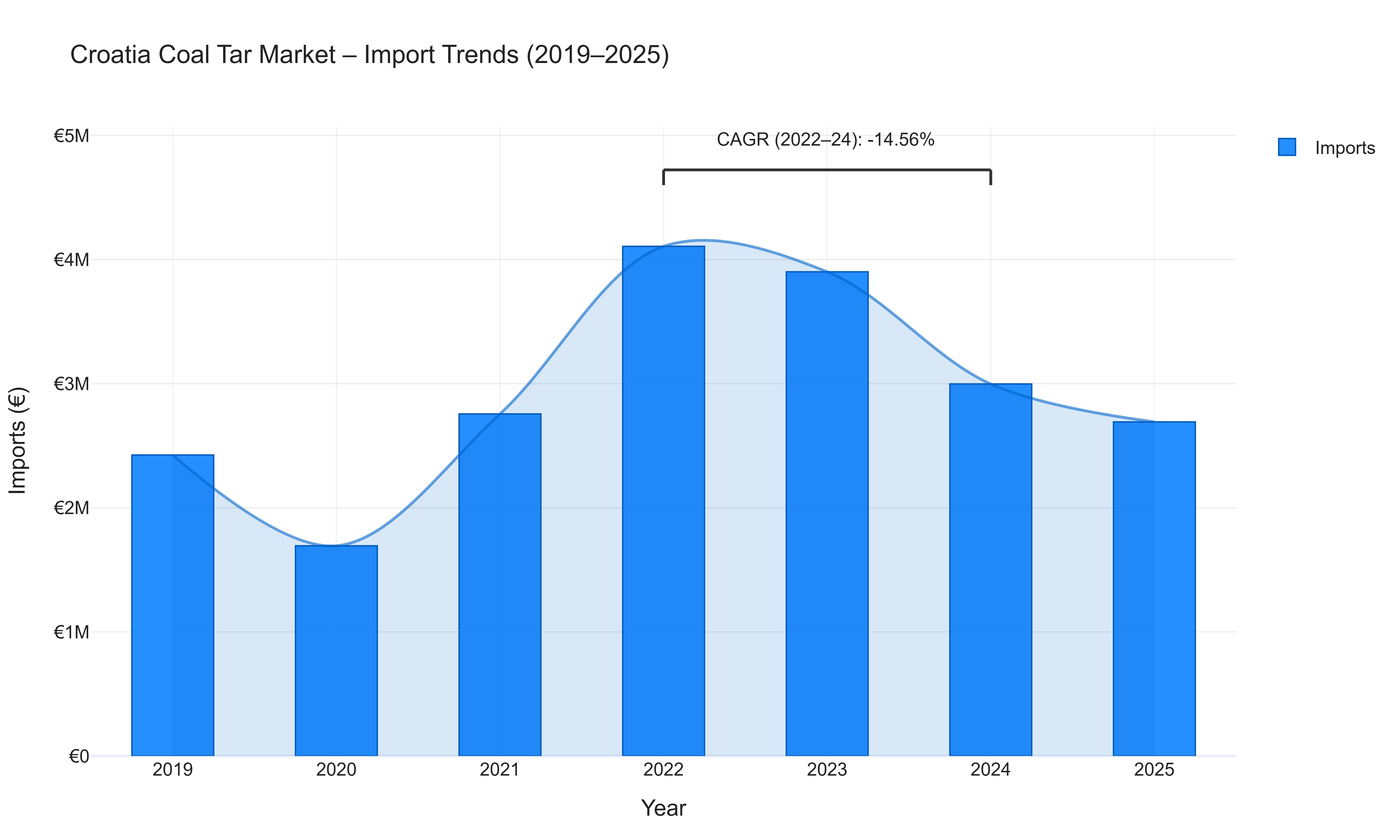
The Croatia Coal Tar Market witnessed fluctuating Import Values over the past years, with notable peaks in 2022 at €4.11 million and a decline in 2023 to €3.90 million. The Import Values surged by 62.75% in 2021 but experienced a downturn in subsequent years, notably in 2020 with a -30.16% decrease. The market saw a significant drop in 2024 to €3.00 million, followed by a slight decrease in 2025 to €2.69 million. These fluctuations can be attributed to various factors such as changes in global coal tar prices, shifts in supplier dynamics, and evolving demand patterns within the industry. The Compound Annual Growth Rate (CAGR) of -14.56% from 2022 to 2024 indicates a substantial decline in import values during this period, reflecting a challenging market environment and potential shifts in market dynamics impacting import trends.
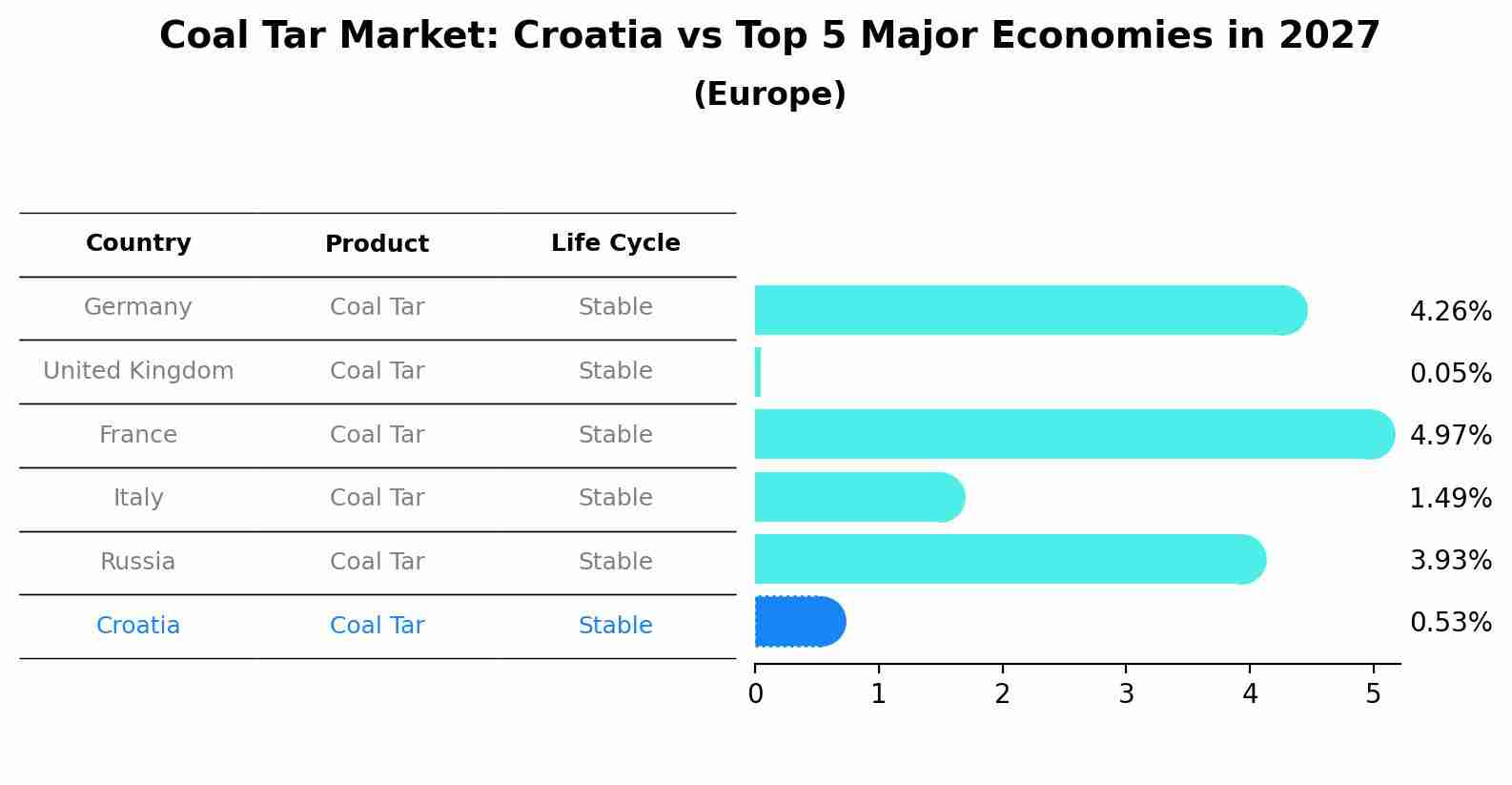
Coal Tar Market: Croatia vs Top 5 Major Economies in 2027 (Europe)
In the Europe region, the Coal Tar market in Croatia is projected to expand at a stable growth rate of 0.53% by 2027. The largest economy is Germany, followed by United Kingdom, France, Italy and Russia.
Croatia Coal Tar Market Overview
The coal tar market in Croatia focuses on products derived from coal tar, used in various applications such as roofing, road construction, and chemical manufacturing. The market is influenced by industrial demand and environmental regulations related to the use of coal tar products.
Drivers of the market
The coal tar market in Croatia is influenced by its applications in various industrial sectors, including construction, manufacturing, and chemical production. Coal tar is used in the production of products such as asphalt, coatings, and pharmaceuticals. The demand for these products drives the coal tar market. Additionally, advancements in coal tar processing and the development of new applications support market growth.
Challenges of the market
The coal tar market in Croatia faces challenges related to environmental regulations and market competition. Coal tar, used in various industrial applications, is subject to environmental regulations due to its potential health and environmental impacts. Additionally, the market is competitive, with alternative materials and technologies emerging. Balancing regulatory compliance with market demands and operational costs is a key challenge.
Government Policy of the market
The Croatian government regulates the coal tar market through environmental and health safety regulations. Policies aim to manage the use and disposal of coal tar by-products to minimize environmental contamination and health risks. There is also support for research into safer alternatives and technologies that reduce the environmental impact of coal tar.
Key Highlights of the Report:
- Croatia Coal Tar Market Outlook
- Market Size of Croatia Coal Tar Market, 2024
- Forecast of Croatia Coal Tar Market, 2031
- Historical Data and Forecast of Croatia Coal Tar Revenues & Volume for the Period 2021-2031
- Croatia Coal Tar Market Trend Evolution
- Croatia Coal Tar Market Drivers and Challenges
- Croatia Coal Tar Price Trends
- Croatia Coal Tar Porter`s Five Forces
- Croatia Coal Tar Industry Life Cycle
- Historical Data and Forecast of Croatia Coal Tar Market Revenues & Volume By Type for the Period 2021-2031
- Historical Data and Forecast of Croatia Coal Tar Market Revenues & Volume By Low Temperature Coal Tar for the Period 2021-2031
- Historical Data and Forecast of Croatia Coal Tar Market Revenues & Volume By Medium Temperature Coal Tar for the Period 2021-2031
- Historical Data and Forecast of Croatia Coal Tar Market Revenues & Volume By High Temperature Coal Tar for the Period 2021-2031
- Historical Data and Forecast of Croatia Coal Tar Market Revenues & Volume By Application for the Period 2021-2031
- Historical Data and Forecast of Croatia Coal Tar Market Revenues & Volume By Coal Tar Pitch for the Period 2021-2031
- Historical Data and Forecast of Croatia Coal Tar Market Revenues & Volume By Carbon Black Oil for the Period 2021-2031
- Historical Data and Forecast of Croatia Coal Tar Market Revenues & Volume By Specialty Oils for the Period 2021-2031
- Historical Data and Forecast of Croatia Coal Tar Market Revenues & Volume By End-use for the Period 2021-2031
- Historical Data and Forecast of Croatia Coal Tar Market Revenues & Volume By Aluminum Industry for the Period 2021-2031
- Historical Data and Forecast of Croatia Coal Tar Market Revenues & Volume By Roofing for the Period 2021-2031
- Historical Data and Forecast of Croatia Coal Tar Market Revenues & Volume By Tire Industry for the Period 2021-2031
- Historical Data and Forecast of Croatia Coal Tar Market Revenues & Volume By Paint Industry for the Period 2021-2031
- Historical Data and Forecast of Croatia Coal Tar Market Revenues & Volume By Wood Preservation for the Period 2021-2031
- Historical Data and Forecast of Croatia Coal Tar Market Revenues & Volume By Others for the Period 2021-2031
- Historical Data and Forecast of Croatia Coal Tar Market Revenues & Volume By Marketing Channel for the Period 2021-2031
- Historical Data and Forecast of Croatia Coal Tar Market Revenues & Volume By Online for the Period 2021-2031
- Historical Data and Forecast of Croatia Coal Tar Market Revenues & Volume By Offline for the Period 2021-2031
- Croatia Coal Tar Import Export Trade Statistics
- Market Opportunity Assessment By Type
- Market Opportunity Assessment By Application
- Market Opportunity Assessment By End-use
- Market Opportunity Assessment By Marketing Channel
- Croatia Coal Tar Top Companies Market Share
- Croatia Coal Tar Competitive Benchmarking By Technical and Operational Parameters
- Croatia Coal Tar Company Profiles
- Croatia Coal Tar Key Strategic Recommendations






































