Croatia Glycerol Market Size (2020-2030)
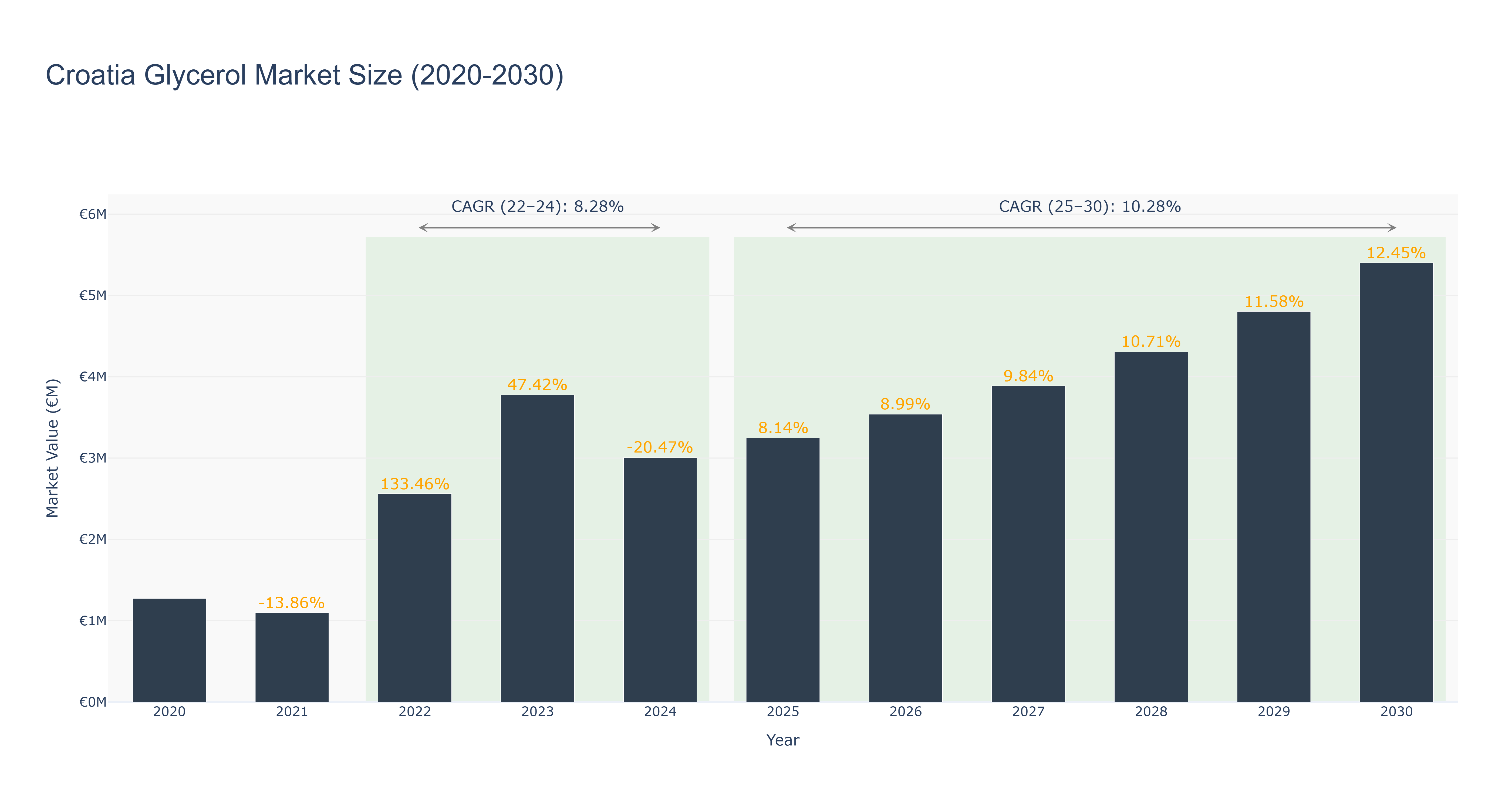
Croatia's Glycerol Market has shown a promising upward trend over the years. The peak market size of €5.40 million is projected for 2030, with a steady increase from €1.27 million in 2020. Notably, the market experienced a significant growth rate of 133.46% in 2022, driven by increased demand for glycerol in various industries. The slight downturn in 2024, with a market size of €3.00 million, was likely influenced by external economic factors. Looking ahead, the market is forecasted to continue its growth trajectory with a CAGR of 10.28% from 2025 to 2030, supported by ongoing investments in sustainable production processes and expanding applications of glycerol in the pharmaceutical and personal care sectors. Recent developments include collaborations with research institutions to enhance product quality and explore new market opportunities.
Croatia Glycerol Market: Production & Trade Performance (2019-2025)
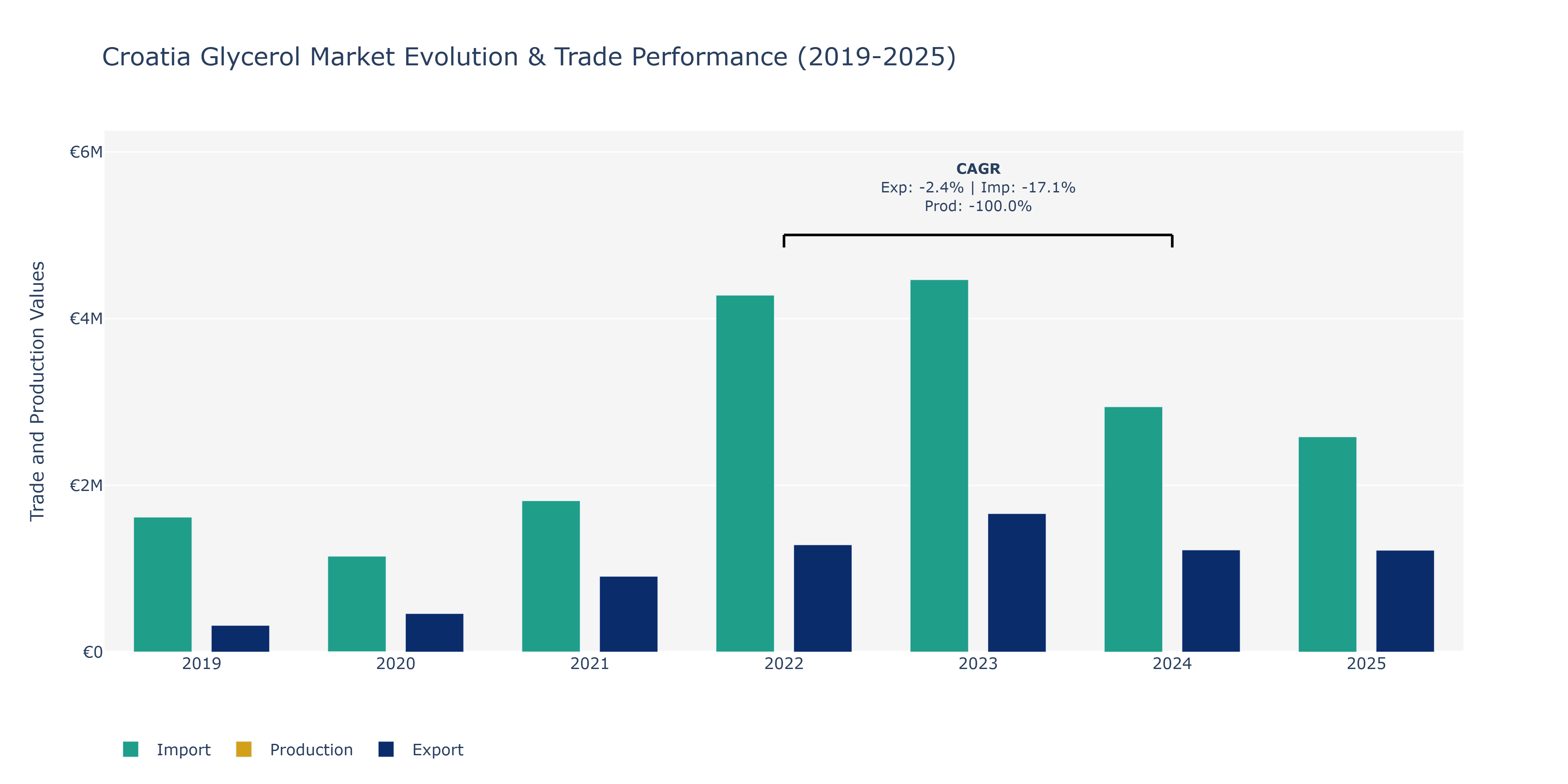
In the Croatia Glycerol Market, exports exhibited a fluctuating trend over the years, starting at €319.24 thousand in 2019, peaking at €1.66 million in 2023, and slightly declining to €1.22 million in 2025. Imports, on the other hand, showed a steady increase from €1.62 million in 2019 to €4.46 million in 2023, before experiencing a slight decrease to €2.58 million in 2025. Production remained stable at €1.75 million in 2019 and 2020, then dropped to €2.00 million in the following years. The fluctuation in exports can be attributed to varying global demand for glycerol-based products, while the rise in imports may indicate increased domestic consumption or supply chain dynamics. The decline in production could be linked to changes in production capacity or technology adoption within the industry, highlighting the need for market players to adapt to evolving market conditions to maintain competitiveness in both domestic and international markets.
Croatia Glycerol Market Overview
Closely related to the glycerin market, the glycerol market in Croatia is influenced by its applications in industrial and consumer products. Pharmaceutical and food sectors primarily drive the demand due to its use as a solvent and sweetener. The market also sees a rise in demand from the personal care industry, where glycerol is favored for its moisturizing properties.
Drivers of the market
The glycerol market in Croatia is driven by its broad applications in sectors such as pharmaceuticals, food and beverages, and cosmetics. The increasing demand for bio-based chemicals and the rise in biodiesel production, where glycerol is a by-product, further contribute to market growth. The trend toward natural and eco-friendly products has also heightened the adoption of glycerol in personal care and cosmetic products.
Challenges of the market
Challenges in the Croatia Glycerol Market include volatility in raw material prices and competition from alternative glycerol sources. Regulatory constraints related to environmental and safety standards can impact production costs. Additionally, fluctuating demand from end-use industries and the need for continuous innovation to meet consumer preferences add to the market`s complexities.
Government Policy of the market
Glycerol, a key industrial chemical, is subject to government regulations regarding its production and use. In Croatia, policies focus on ensuring the safe handling and environmental sustainability of glycerol production. The government also promotes the use of glycerol in various industrial applications, including pharmaceuticals and cosmetics, through incentives for research and development in these sectors.
Key Highlights of the Report:
- Croatia Glycerol Market Outlook
- Market Size of Croatia Glycerol Market, 2024
- Forecast of Croatia Glycerol Market, 2031
- Historical Data and Forecast of Croatia Glycerol Revenues & Volume for the Period 2021-2031
- Croatia Glycerol Market Trend Evolution
- Croatia Glycerol Market Drivers and Challenges
- Croatia Glycerol Price Trends
- Croatia Glycerol Porter`s Five Forces
- Croatia Glycerol Industry Life Cycle
- Historical Data and Forecast of Croatia Glycerol Market Revenues & Volume By Source for the Period 2021-2031
- Historical Data and Forecast of Croatia Glycerol Market Revenues & Volume By Biodiesel for the Period 2021-2031
- Historical Data and Forecast of Croatia Glycerol Market Revenues & Volume By Fatty Alcohols for the Period 2021-2031
- Historical Data and Forecast of Croatia Glycerol Market Revenues & Volume By Fatty Acids for the Period 2021-2031
- Historical Data and Forecast of Croatia Glycerol Market Revenues & Volume By Soap for the Period 2021-2031
- Historical Data and Forecast of Croatia Glycerol Market Revenues & Volume By Type for the Period 2021-2031
- Historical Data and Forecast of Croatia Glycerol Market Revenues & Volume By Crude for the Period 2021-2031
- Historical Data and Forecast of Croatia Glycerol Market Revenues & Volume By Refined for the Period 2021-2031
- Historical Data and Forecast of Croatia Glycerol Market Revenues & Volume By End-use for the Period 2021-2031
- Historical Data and Forecast of Croatia Glycerol Market Revenues & Volume By Food & Beverage for the Period 2021-2031
- Historical Data and Forecast of Croatia Glycerol Market Revenues & Volume By Pharmaceutical for the Period 2021-2031
- Historical Data and Forecast of Croatia Glycerol Market Revenues & Volume By Nutraceutical for the Period 2021-2031
- Historical Data and Forecast of Croatia Glycerol Market Revenues & Volume By Personal Care & Cosmetics for the Period 2021-2031
- Historical Data and Forecast of Croatia Glycerol Market Revenues & Volume By Industrial for the Period 2021-2031
- Historical Data and Forecast of Croatia Glycerol Market Revenues & Volume By Others for the Period 2021-2031
- Croatia Glycerol Import Export Trade Statistics
- Market Opportunity Assessment By Source
- Market Opportunity Assessment By Type
- Market Opportunity Assessment By End-use
- Croatia Glycerol Top Companies Market Share
- Croatia Glycerol Competitive Benchmarking By Technical and Operational Parameters
- Croatia Glycerol Company Profiles
- Croatia Glycerol Key Strategic Recommendations






































