Croatia Industrial Hemp Market Top 5 Importing Countries and Market Competition (HHI) Analysis
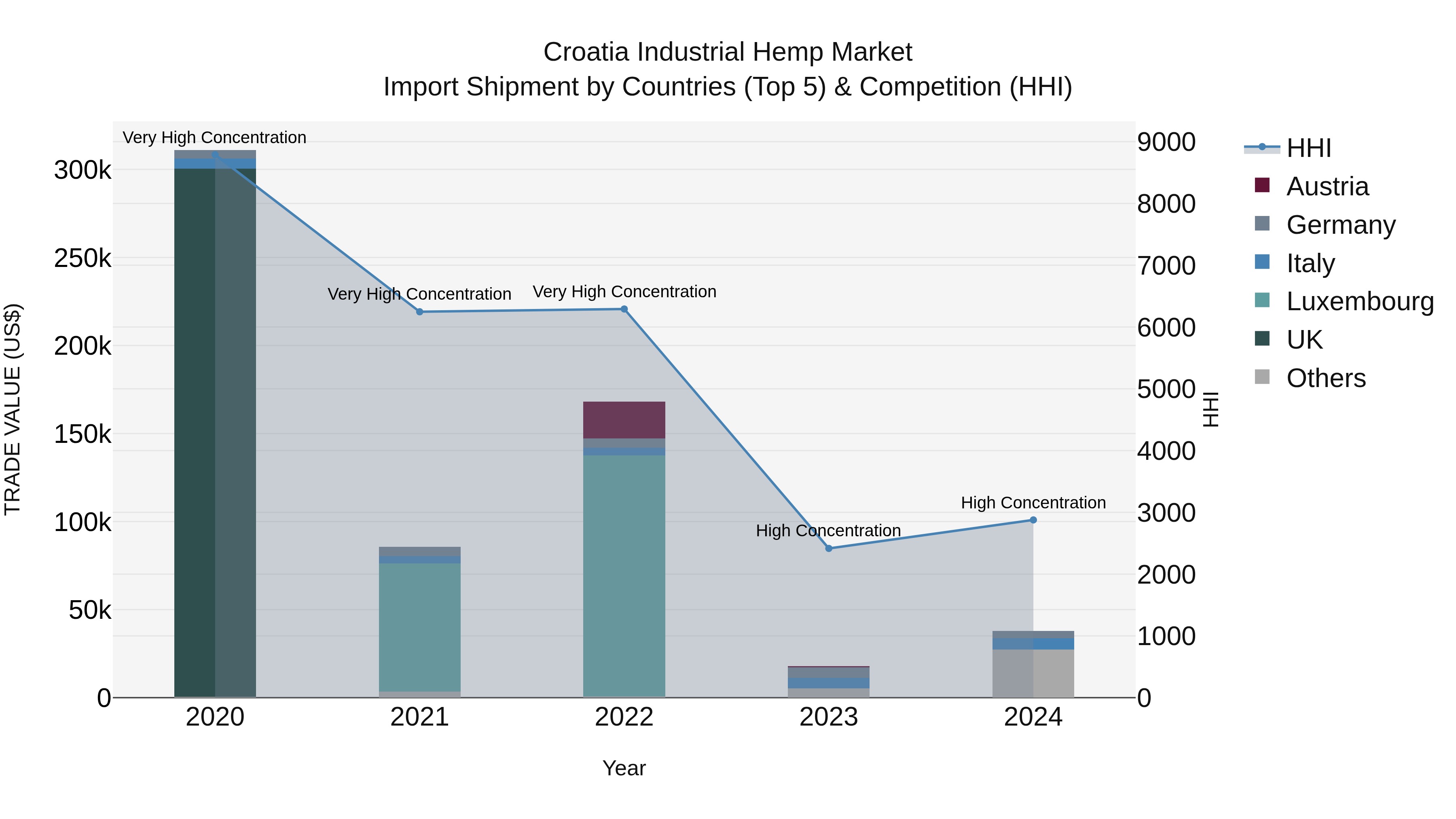
Croatia industrial hemp import market in 2024 continued to see a high concentration of shipments from top exporting countries such as Hungary, Italy, Germany, China, and Czechia. Despite a significant negative compound annual growth rate (CAGR) of -40.93% from 2020 to 2024, there was a remarkable growth spurt in 2024 with a growth rate of 110.74% compared to the previous year. This surge in import shipments signifies a potential shift or expansion within Croatia industrial hemp market, highlighting opportunities for further exploration and development.
Industrial Hemp Market: Croatia vs Top 5 Major Economies in 2027 (Europe)
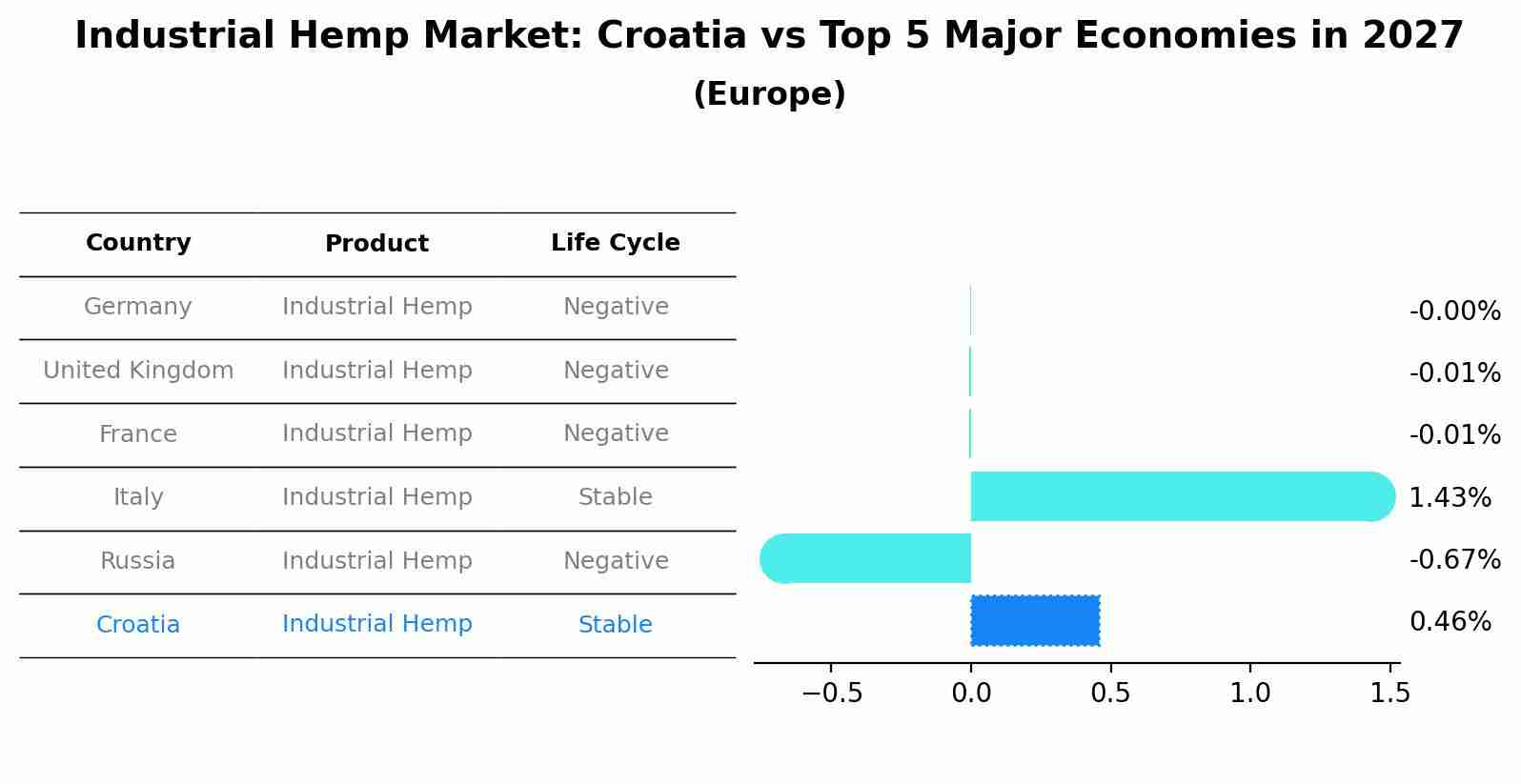
Croatia's Industrial Hemp market is anticipated to experience a stable growth rate of 0.46% by 2027, reflecting trends observed in the largest economy Germany, followed by United Kingdom, France, Italy and Russia.
Croatia Industrial Hemp Market Overview
The industrial hemp market in Croatia is growing due to the versatility of hemp in applications such as textiles, construction materials, and bioplastics. Hemp offers sustainable alternatives to traditional materials, contributing to market expansion. However, challenges include regulatory hurdles and the need for infrastructure to support hemp cultivation and processing.
Drivers of the market
The Croatia Industrial Hemp Market is driven by the growing awareness of hemp`s applications in various industries, including textiles, construction, and pharmaceuticals. The increasing demand for sustainable and eco-friendly materials supports the market. Legalization and regulatory support for industrial hemp cultivation also contribute to the market`s expansion.
Challenges of the market
The Croatia Industrial Hemp Market faces challenges related to regulatory uncertainty and market acceptance. The legal status of industrial hemp can vary, leading to uncertainty for producers and investors. Additionally, gaining market acceptance and establishing a reliable supply chain for hemp-based products requires significant effort. The market also contends with competition from alternative materials and fluctuating demand based on changing consumer preferences and economic conditions.
Government Policy of the market
The Croatian government has been increasingly supportive of the industrial hemp market, recognizing its potential for economic growth and sustainability. Policies include financial support for hemp cultivation and processing, along with research initiatives to explore new applications for hemp-based products. Regulatory frameworks are designed to ensure the quality and safety of industrial hemp products while promoting sustainable agricultural practices.
Key Highlights of the Report:
- Croatia Industrial Hemp Market Outlook
- Market Size of Croatia Industrial Hemp Market, 2024
- Forecast of Croatia Industrial Hemp Market, 2031
- Historical Data and Forecast of Croatia Industrial Hemp Revenues & Volume for the Period 2021-2031
- Croatia Industrial Hemp Market Trend Evolution
- Croatia Industrial Hemp Market Drivers and Challenges
- Croatia Industrial Hemp Price Trends
- Croatia Industrial Hemp Porter`s Five Forces
- Croatia Industrial Hemp Industry Life Cycle
- Historical Data and Forecast of Croatia Industrial Hemp Market Revenues & Volume By Product for the Period 2021-2031
- Historical Data and Forecast of Croatia Industrial Hemp Market Revenues & Volume By Seeds for the Period 2021-2031
- Historical Data and Forecast of Croatia Industrial Hemp Market Revenues & Volume By Fiber for the Period 2021-2031
- Historical Data and Forecast of Croatia Industrial Hemp Market Revenues & Volume By Shives for the Period 2021-2031
- Historical Data and Forecast of Croatia Industrial Hemp Market Revenues & Volume By Application for the Period 2021-2031
- Historical Data and Forecast of Croatia Industrial Hemp Market Revenues & Volume By Animal Care for the Period 2021-2031
- Historical Data and Forecast of Croatia Industrial Hemp Market Revenues & Volume By Textiles for the Period 2021-2031
- Historical Data and Forecast of Croatia Industrial Hemp Market Revenues & Volume By Automotive for the Period 2021-2031
- Historical Data and Forecast of Croatia Industrial Hemp Market Revenues & Volume By Furniture for the Period 2021-2031
- Historical Data and Forecast of Croatia Industrial Hemp Market Revenues & Volume By Food & Beverages for the Period 2021-2031
- Historical Data and Forecast of Croatia Industrial Hemp Market Revenues & Volume By Paper for the Period 2021-2031
- Historical Data and Forecast of Croatia Industrial Hemp Market Revenues & Volume By Construction Materials for the Period 2021-2031
- Historical Data and Forecast of Croatia Industrial Hemp Market Revenues & Volume By Other for the Period 2021-2031
- Croatia Industrial Hemp Import Export Trade Statistics
- Market Opportunity Assessment By Product
- Market Opportunity Assessment By Application
- Croatia Industrial Hemp Top Companies Market Share
- Croatia Industrial Hemp Competitive Benchmarking By Technical and Operational Parameters
- Croatia Industrial Hemp Company Profiles
- Croatia Industrial Hemp Key Strategic Recommendations






































