Croatia Instrument Transformers Market Top 5 Importing Countries and Market Competition (HHI) Analysis
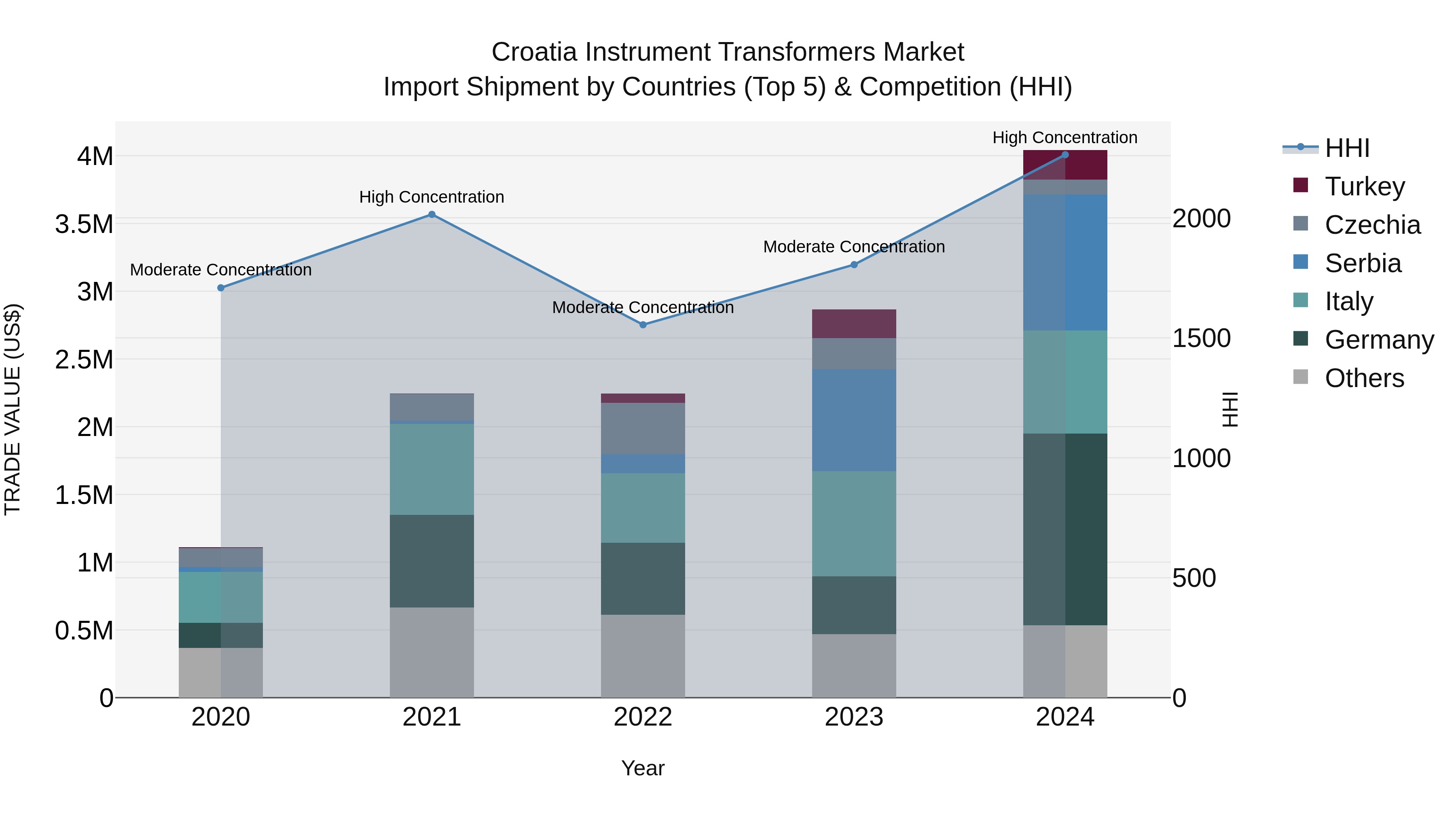
Croatia import shipments of instrument transformers saw a significant increase in concentration levels in 2024, with Germany, Serbia, Italy, Turkey, and Poland emerging as the top exporting countries. The market experienced a high growth rate of 40.98% from 2023 to 2024, contributing to the impressive compound annual growth rate (CAGR) of 38.11% over the period of 2020-2024. This data suggests a dynamic and rapidly evolving market landscape for instrument transformers in Croatia, driven by strong demand and strategic partnerships with key exporting nations.
Croatia Instrument Transformers Market Overview
The instrument transformers market in Croatia includes devices used to measure electrical parameters and ensure accurate readings in power systems. The market is driven by the growth of the energy sector and the need for reliable and precise measurement tools. Innovations in transformer technology, such as smart and digital solutions, are shaping the market. Challenges include managing the costs of high-quality components and meeting regulatory standards.
Drivers of the market
The instrument transformers market in Croatia is driven by the expanding power generation and distribution infrastructure. Instrument transformers are essential for accurate measurement and protection in electrical systems, and their demand increases with the growth in energy production and transmission projects. Technological advancements and the need for reliable and efficient power management solutions also support market expansion.
Challenges of the market
The Croatian instrument transformers market deals with challenges related to technological innovation and regulatory compliance. Instrument transformers are critical for accurate measurement and protection in electrical systems, and the market must continually adapt to advancements in technology and changing industry standards. Additionally, manufacturers face challenges in meeting rigorous safety and performance regulations, which can impact production processes and cost structures.
Government Policy of the market
The instrument transformers market in Croatia is regulated by standards related to electrical safety and performance. The government enforces EU directives on electrical equipment, which include regulations for the design, manufacturing, and testing of instrument transformers. These policies ensure that instrument transformers meet safety and quality standards. Additionally, the Croatian government supports initiatives to improve the efficiency and reliability of electrical infrastructure.
Key Highlights of the Report:
- Croatia Instrument Transformers Market Outlook
- Market Size of Croatia Instrument Transformers Market, 2024
- Forecast of Croatia Instrument Transformers Market, 2031
- Historical Data and Forecast of Croatia Instrument Transformers Revenues & Volume for the Period 2021-2031
- Croatia Instrument Transformers Market Trend Evolution
- Croatia Instrument Transformers Market Drivers and Challenges
- Croatia Instrument Transformers Price Trends
- Croatia Instrument Transformers Porter`s Five Forces
- Croatia Instrument Transformers Industry Life Cycle
- Historical Data and Forecast of Croatia Instrument Transformers Market Revenues & Volume By Type for the Period 2021-2031
- Historical Data and Forecast of Croatia Instrument Transformers Market Revenues & Volume By Current Transformers for the Period 2021-2031
- Historical Data and Forecast of Croatia Instrument Transformers Market Revenues & Volume By Potential Transformers for the Period 2021-2031
- Historical Data and Forecast of Croatia Instrument Transformers Market Revenues & Volume By Combined Instrument Transformers for the Period 2021-2031
- Historical Data and Forecast of Croatia Instrument Transformers Market Revenues & Volume By Voltage for the Period 2021-2031
- Historical Data and Forecast of Croatia Instrument Transformers Market Revenues & Volume By Distribution Voltage for the Period 2021-2031
- Historical Data and Forecast of Croatia Instrument Transformers Market Revenues & Volume By Sub-Transmission Voltage for the Period 2021-2031
- Historical Data and Forecast of Croatia Instrument Transformers Market Revenues & Volume By High Voltage Transmission for the Period 2021-2031
- Historical Data and Forecast of Croatia Instrument Transformers Market Revenues & Volume By Extra High Voltage Transmission for the Period 2021-2031
- Historical Data and Forecast of Croatia Instrument Transformers Market Revenues & Volume By Ultra-High Voltage Transmission for the Period 2021-2031
- Historical Data and Forecast of Croatia Instrument Transformers Market Revenues & Volume By Application for the Period 2021-2031
- Historical Data and Forecast of Croatia Instrument Transformers Market Revenues & Volume By Transformer and Circuit Breaker Bushing for the Period 2021-2031
- Historical Data and Forecast of Croatia Instrument Transformers Market Revenues & Volume By Switchgear Assemblies for the Period 2021-2031
- Historical Data and Forecast of Croatia Instrument Transformers Market Revenues & Volume By Relaying for the Period 2021-2031
- Historical Data and Forecast of Croatia Instrument Transformers Market Revenues & Volume By Metering and Protection for the Period 2021-2031
- Historical Data and Forecast of Croatia Instrument Transformers Market Revenues & Volume By End-User for the Period 2021-2031
- Historical Data and Forecast of Croatia Instrument Transformers Market Revenues & Volume By Power Utilities for the Period 2021-2031
- Historical Data and Forecast of Croatia Instrument Transformers Market Revenues & Volume By Power Generation for the Period 2021-2031
- Historical Data and Forecast of Croatia Instrument Transformers Market Revenues & Volume By Railways and Metros for the Period 2021-2031
- Historical Data and Forecast of Croatia Instrument Transformers Market Revenues & Volume By Industries and OEMs for the Period 2021-2031
- Croatia Instrument Transformers Import Export Trade Statistics
- Market Opportunity Assessment By Type
- Market Opportunity Assessment By Voltage
- Market Opportunity Assessment By Application
- Market Opportunity Assessment By End-User
- Croatia Instrument Transformers Top Companies Market Share
- Croatia Instrument Transformers Competitive Benchmarking By Technical and Operational Parameters
- Croatia Instrument Transformers Company Profiles
- Croatia Instrument Transformers Key Strategic Recommendations






































