Croatia Microcrystalline Cellulose Market Size Growth Rate
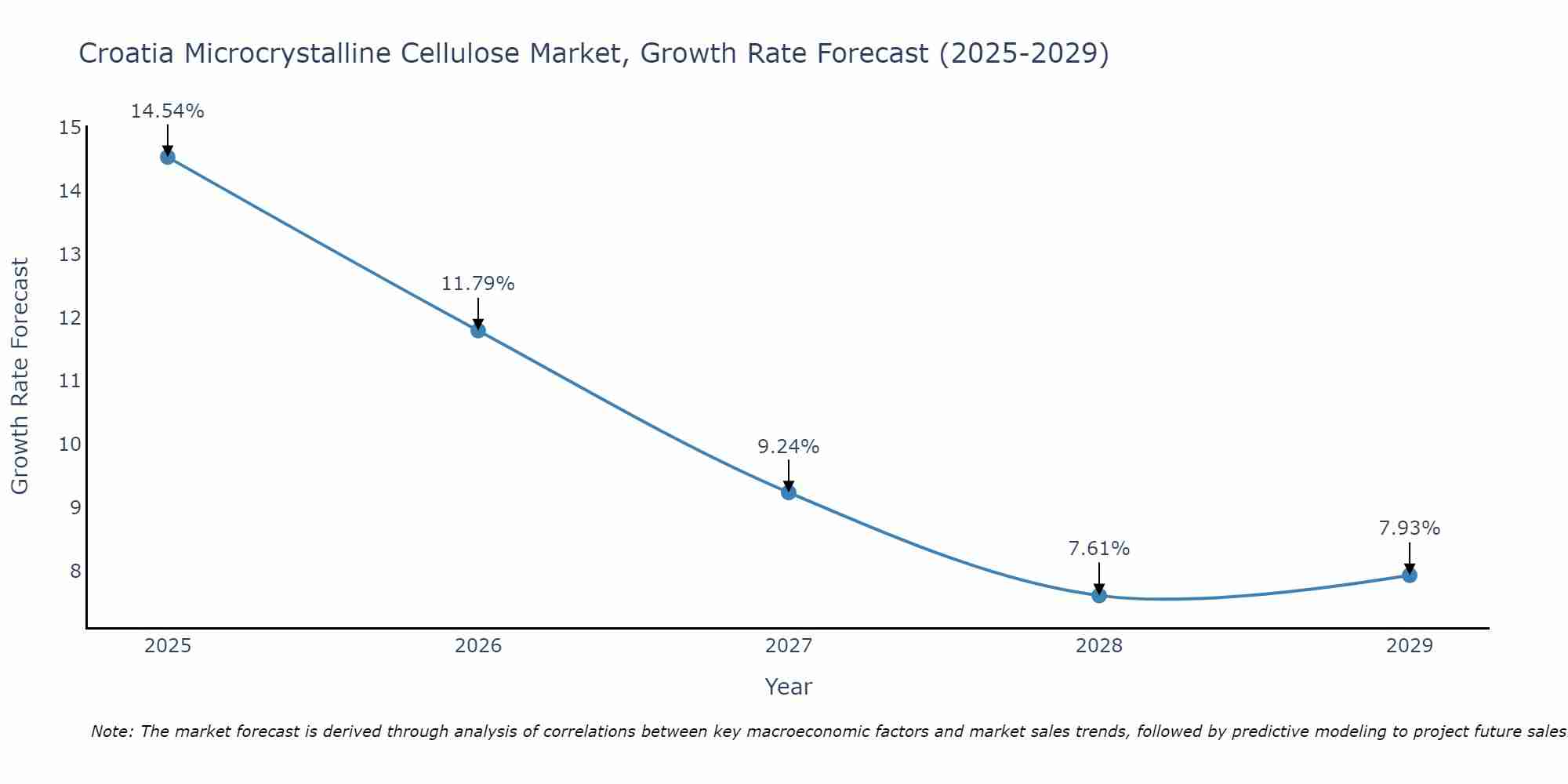
The Croatia Microcrystalline Cellulose Market is projected to witness mixed growth rate patterns during 2025 to 2029. Starting high at 14.54% in 2025, the market steadily declines to 7.93% by 2029.
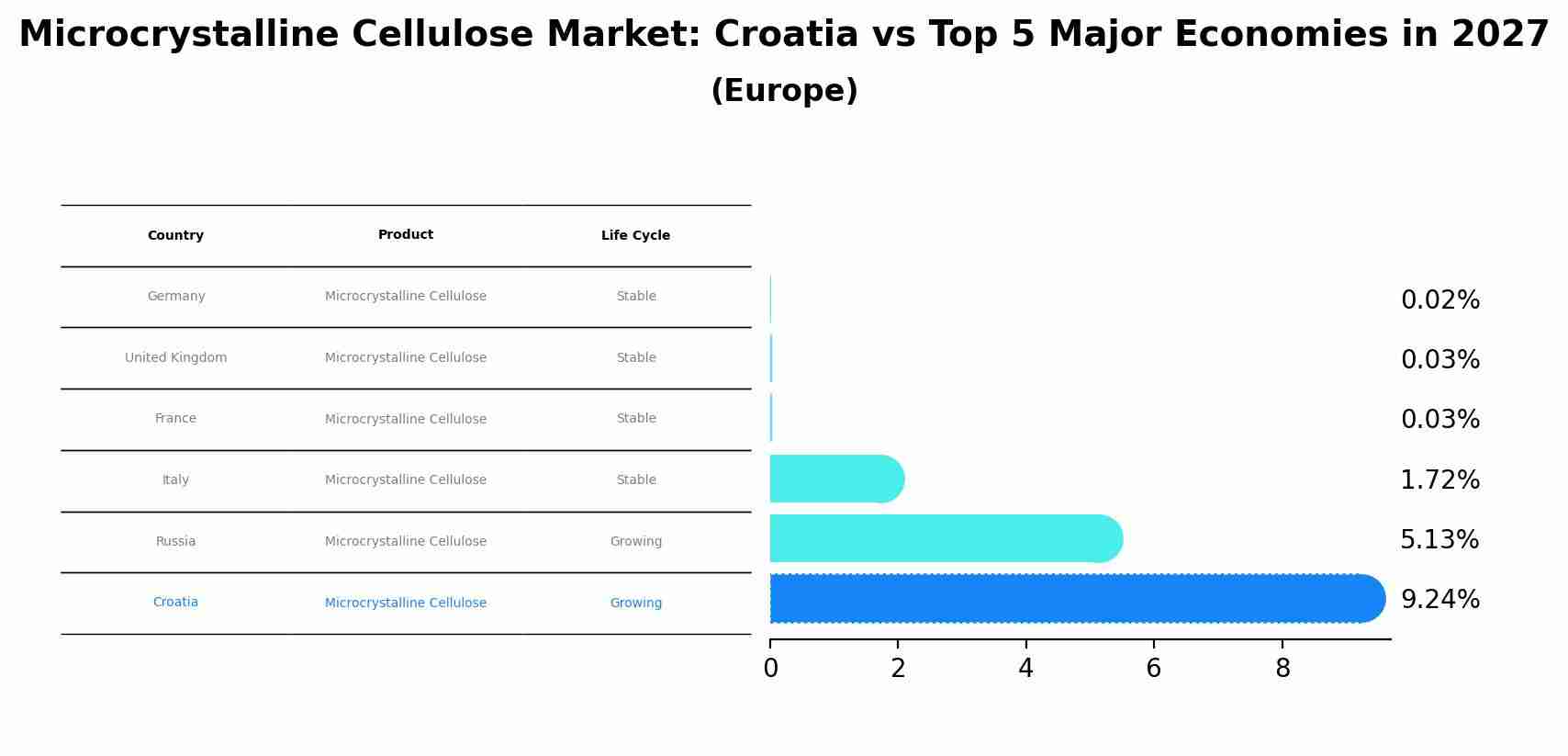
Microcrystalline Cellulose Market: Croatia vs Top 5 Major Economies in 2027 (Europe)
Croatia's Microcrystalline Cellulose market is anticipated to experience a growing growth rate of 9.24% by 2027, reflecting trends observed in the largest economy Germany, followed by United Kingdom, France, Italy and Russia.
Croatia Microcrystalline Cellulose Market Overview
Croatias microcrystalline cellulose market serves the pharmaceutical, food, and cosmetics industries as a versatile excipient, stabilizer, and bulking agent. Its properties, such as high compressibility and stability, make it an essential ingredient in tablet formulations, food products, and personal care items.
Drivers of the market
The Croatian microcrystalline cellulose (MCC) market is influenced by the increasing demand for MCC in the pharmaceutical, food, and cosmetic industries. MCC is a versatile ingredient used as a binder, filler, and stabilizer in various products. The growth of the pharmaceutical and food industries, driven by the need for high-quality and effective excipients, supports the demand for MCC. Additionally, advancements in MCC production technologies and the expanding applications of MCC in personal care products contribute to market growth.
Challenges of the market
The microcrystalline cellulose market faces challenges related to the production and application of cellulose used in pharmaceuticals, food products, and other industries. Ensuring consistent quality and managing production costs are significant factors. The market must navigate regulatory requirements for safety and efficacy and deal with competition from alternative cellulose products. Technological advancements in cellulose production and effective supply chain management are crucial for maintaining market position.
Government Policy of the market
In Croatia, the microcrystalline cellulose market is influenced by policies related to the pharmaceutical and food industries. Regulations promoting the use of natural and sustainable ingredients support the demand for microcrystalline cellulose. Additionally, policies on product safety and quality control are critical for its application in various products.
Key Highlights of the Report:
- Croatia Microcrystalline Cellulose Market Outlook
- Market Size of Croatia Microcrystalline Cellulose Market, 2024
- Forecast of Croatia Microcrystalline Cellulose Market, 2031
- Historical Data and Forecast of Croatia Microcrystalline Cellulose Revenues & Volume for the Period 2021-2031
- Croatia Microcrystalline Cellulose Market Trend Evolution
- Croatia Microcrystalline Cellulose Market Drivers and Challenges
- Croatia Microcrystalline Cellulose Price Trends
- Croatia Microcrystalline Cellulose Porter`s Five Forces
- Croatia Microcrystalline Cellulose Industry Life Cycle
- Historical Data and Forecast of Croatia Microcrystalline Cellulose Market Revenues & Volume By Source Type for the Period 2021-2031
- Historical Data and Forecast of Croatia Microcrystalline Cellulose Market Revenues & Volume By Non-Wood Based for the Period 2021-2031
- Historical Data and Forecast of Croatia Microcrystalline Cellulose Market Revenues & Volume By Wood-Based for the Period 2021-2031
- Historical Data and Forecast of Croatia Microcrystalline Cellulose Market Revenues & Volume By End-use for the Period 2021-2031
- Historical Data and Forecast of Croatia Microcrystalline Cellulose Market Revenues & Volume By Binder/Diluent for the Period 2021-2031
- Historical Data and Forecast of Croatia Microcrystalline Cellulose Market Revenues & Volume By Bulking agent for the Period 2021-2031
- Historical Data and Forecast of Croatia Microcrystalline Cellulose Market Revenues & Volume By Emulsifiers for the Period 2021-2031
- Historical Data and Forecast of Croatia Microcrystalline Cellulose Market Revenues & Volume By Stabilizer for the Period 2021-2031
- Historical Data and Forecast of Croatia Microcrystalline Cellulose Market Revenues & Volume By Anti-Caking Agent for the Period 2021-2031
- Historical Data and Forecast of Croatia Microcrystalline Cellulose Market Revenues & Volume By Others for the Period 2021-2031
- Historical Data and Forecast of Croatia Microcrystalline Cellulose Market Revenues & Volume By Application for the Period 2021-2031
- Historical Data and Forecast of Croatia Microcrystalline Cellulose Market Revenues & Volume By Pharmaceutical for the Period 2021-2031
- Historical Data and Forecast of Croatia Microcrystalline Cellulose Market Revenues & Volume By Food & Beverage for the Period 2021-2031
- Historical Data and Forecast of Croatia Microcrystalline Cellulose Market Revenues & Volume By Cosmetics & Personal Care for the Period 2021-2031
- Historical Data and Forecast of Croatia Microcrystalline Cellulose Market Revenues & Volume By Paints & coatings for the Period 2021-2031
- Historical Data and Forecast of Croatia Microcrystalline Cellulose Market Revenues & Volume By Others for the Period 2021-2031
- Croatia Microcrystalline Cellulose Import Export Trade Statistics
- Market Opportunity Assessment By Source Type
- Market Opportunity Assessment By End-use
- Market Opportunity Assessment By Application
- Croatia Microcrystalline Cellulose Top Companies Market Share
- Croatia Microcrystalline Cellulose Competitive Benchmarking By Technical and Operational Parameters
- Croatia Microcrystalline Cellulose Company Profiles
- Croatia Microcrystalline Cellulose Key Strategic Recommendations






































