Croatia Modular Kitchen Market Top 5 Importing Countries and Market Competition (HHI) Analysis
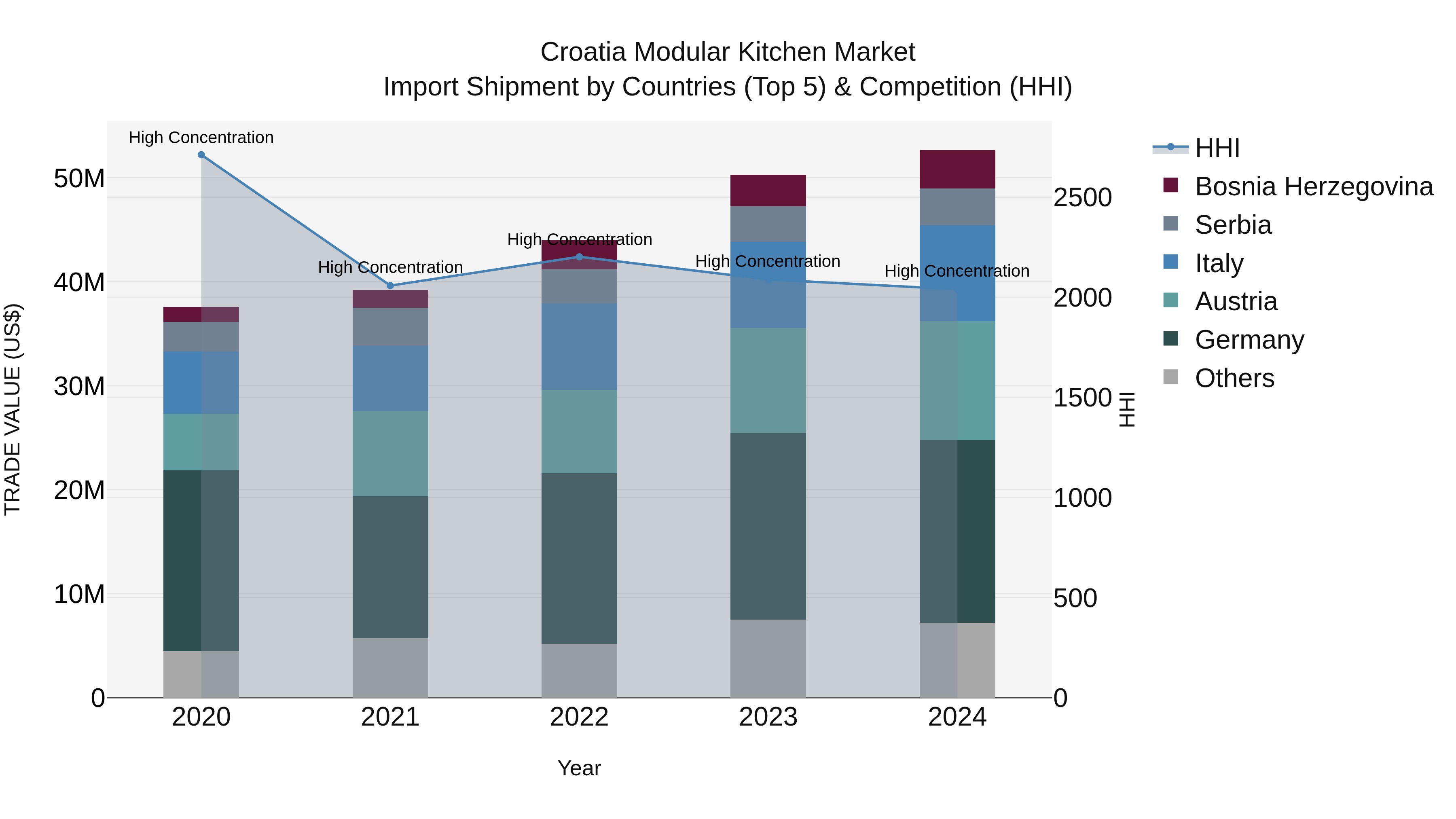
Croatia continues to see a steady increase in modular kitchen import shipments, with top exporting countries such as Germany, Austria, Italy, Bosnia Herzegovina, and Serbia contributing significantly. The high Herfindahl-Hirschman Index (HHI) indicates a concentrated market in 2024, potentially leading to competitive dynamics. The impressive Compound Annual Growth Rate (CAGR) of 8.8% from 2020 to 2024 highlights sustained market expansion, while the growth rate of 4.7% from 2023 to 2024 signals continued momentum in the industry. Croatia modular kitchen market presents opportunities for both domestic and international players to capitalize on this growth trend.
Croatia Modular Kitchen Market Overview
The modular kitchen market includes customizable kitchen units and components designed for efficient use of space and style. In Croatia, this market is driven by consumer preferences for modern, functional kitchen solutions and advancements in design and manufacturing.
Drivers of the market
The modular kitchen market in Croatia is influenced by the growing demand for functional and aesthetically pleasing kitchen solutions. Modular kitchens offer customizable and space-efficient designs, enhancing kitchen usability and organization. The rise in home renovations, advancements in kitchen design technology, and the focus on modern living spaces support market growth.
Challenges of the market
In Croatia, the modular kitchen market encounters challenges related to managing the cost of modular kitchen systems and ensuring their design and functionality meet consumer needs. Companies must address issues related to product customization and integration with existing kitchen layouts. Additionally, competition from traditional kitchen solutions and the need for continuous design innovation create significant challenges.
Government Policy of the market
The Croatian government regulates the modular kitchen market to ensure product quality, safety, and environmental compliance. Policies include guidelines for the design, production, and installation of modular kitchens. The government supports innovation in kitchen design and provides incentives for sustainable and user-friendly solutions.
Key Highlights of the Report:
- Croatia Modular Kitchen Market Outlook
- Market Size of Croatia Modular Kitchen Market, 2024
- Forecast of Croatia Modular Kitchen Market, 2031
- Historical Data and Forecast of Croatia Modular Kitchen Revenues & Volume for the Period 2021-2031
- Croatia Modular Kitchen Market Trend Evolution
- Croatia Modular Kitchen Market Drivers and Challenges
- Croatia Modular Kitchen Price Trends
- Croatia Modular Kitchen Porter`s Five Forces
- Croatia Modular Kitchen Industry Life Cycle
- Historical Data and Forecast of Croatia Modular Kitchen Market Revenues & Volume By Product for the Period 2021-2031
- Historical Data and Forecast of Croatia Modular Kitchen Market Revenues & Volume By Floor Cabinet & Wall Cabinets for the Period 2021-2031
- Historical Data and Forecast of Croatia Modular Kitchen Market Revenues & Volume By Tall Storage Cabinets for the Period 2021-2031
- Historical Data and Forecast of Croatia Modular Kitchen Market Revenues & Volume By Others for the Period 2021-2031
- Historical Data and Forecast of Croatia Modular Kitchen Market Revenues & Volume By End-User for the Period 2021-2031
- Historical Data and Forecast of Croatia Modular Kitchen Market Revenues & Volume By Residential for the Period 2021-2031
- Historical Data and Forecast of Croatia Modular Kitchen Market Revenues & Volume By Commercial for the Period 2021-2031
- Historical Data and Forecast of Croatia Modular Kitchen Market Revenues & Volume By Distribution Channel for the Period 2021-2031
- Historical Data and Forecast of Croatia Modular Kitchen Market Revenues & Volume By Offline (Contractors, Builders, and Others) for the Period 2021-2031
- Historical Data and Forecast of Croatia Modular Kitchen Market Revenues & Volume By Online for the Period 2021-2031
- Croatia Modular Kitchen Import Export Trade Statistics
- Market Opportunity Assessment By Product
- Market Opportunity Assessment By End-User
- Market Opportunity Assessment By Distribution Channel
- Croatia Modular Kitchen Top Companies Market Share
- Croatia Modular Kitchen Competitive Benchmarking By Technical and Operational Parameters
- Croatia Modular Kitchen Company Profiles
- Croatia Modular Kitchen Key Strategic Recommendations






































