Croatia Nickel Market Size (2020-2030)
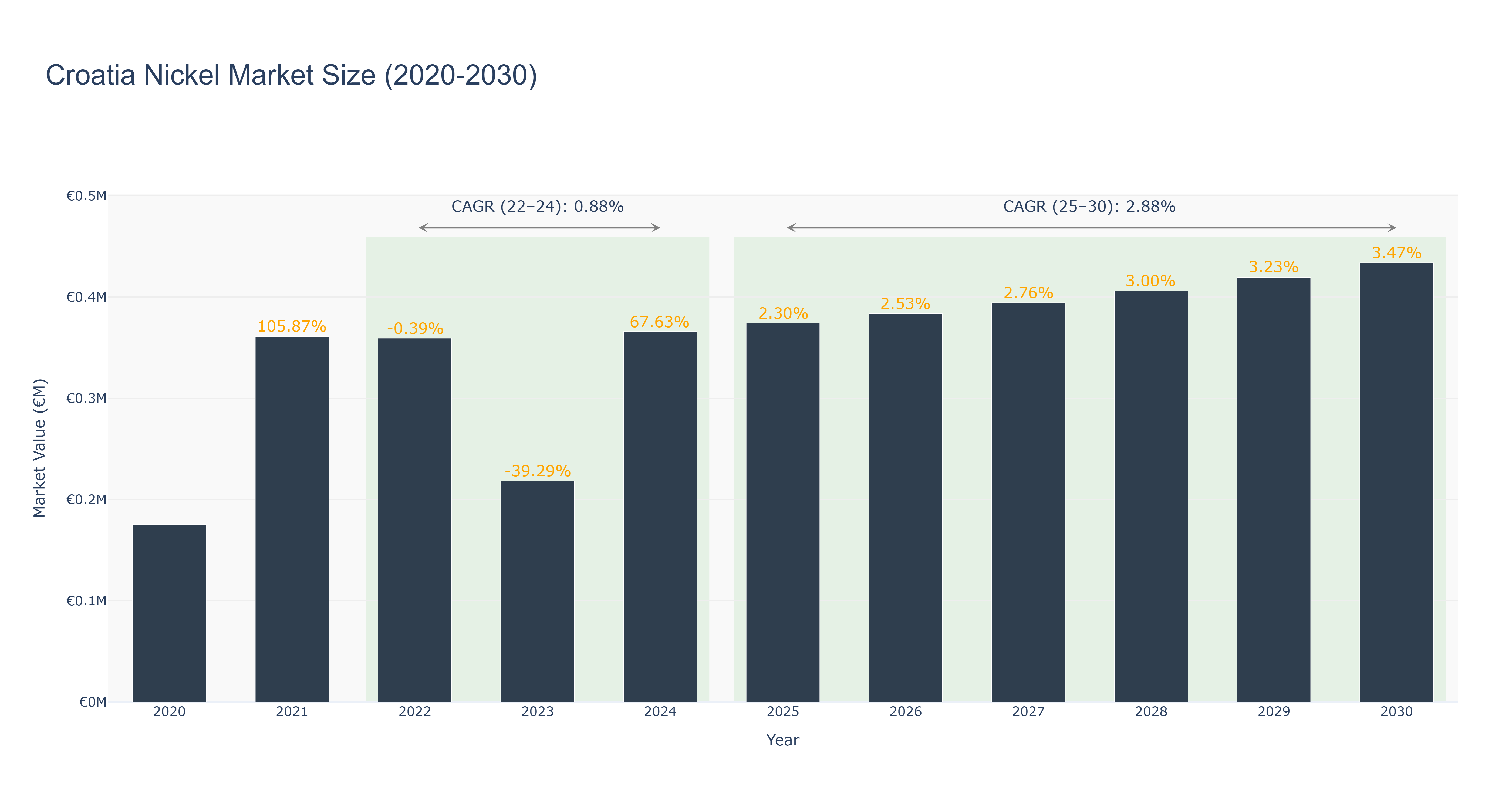
Croatia's Nickel Market has shown a fluctuating trend in recent years. The market peaked in 2024 with a size of €0.37 million before experiencing a slight decline in 2025. However, from 2026 to 2030, the market is forecasted to steadily grow, reaching €0.43 million in 2030 with a CAGR of 3.47%. The market faced a significant drop in 2023 due to external economic factors impacting demand, but recovered swiftly in the following years driven by increased industrial activities and technological advancements. Looking ahead, Croatia's Nickel Market is poised for further growth, with upcoming projects focusing on sustainable mining practices and expanding market reach to meet the rising demand for nickel in the electric vehicle sector. These developments are expected to drive market expansion and solidify Croatia's position in the global nickel market.
Croatia Nickel Market: Production & Trade Performance (2019-2025)
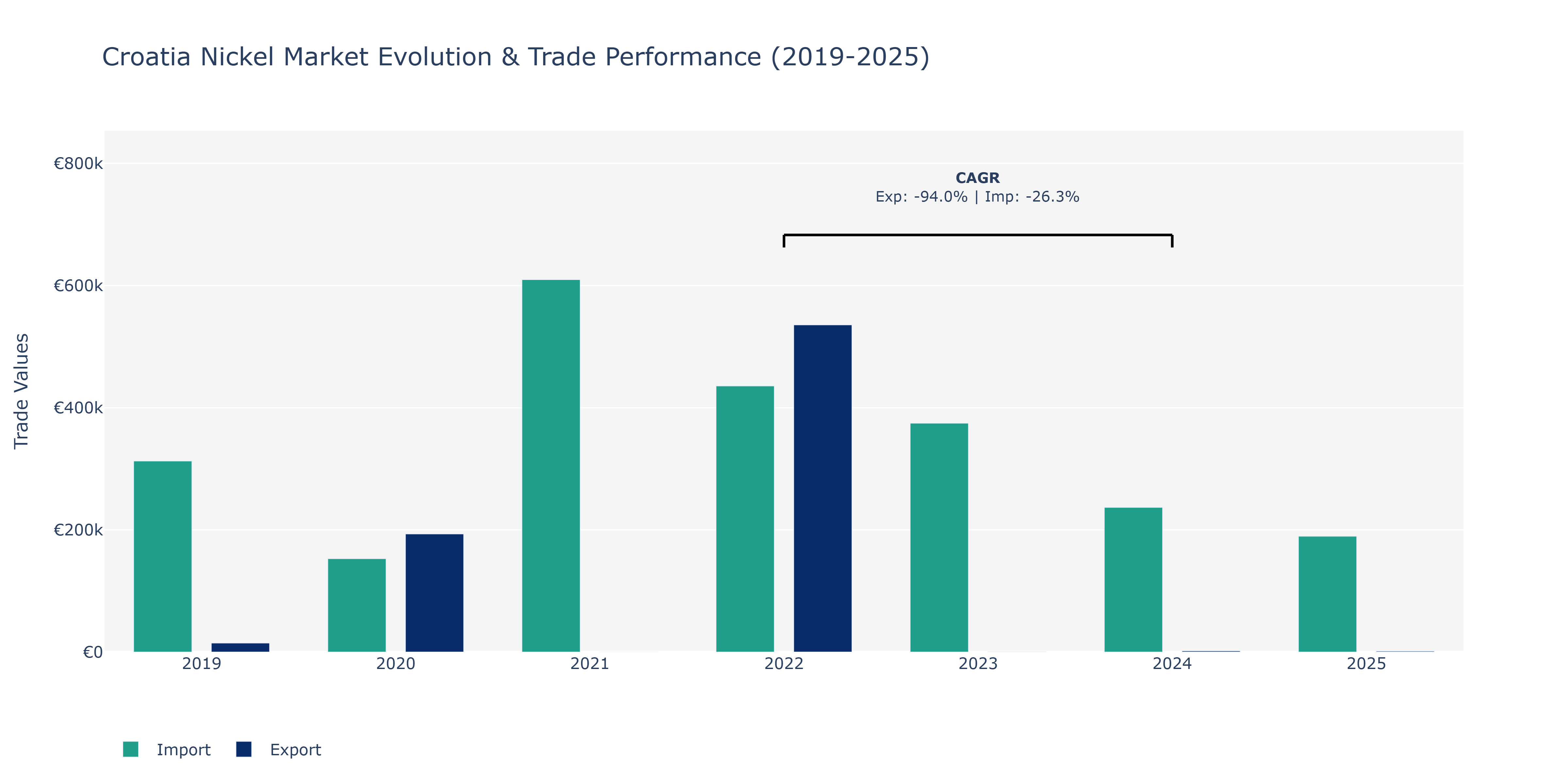
The Croatia Nickel Market witnessed notable fluctuations in both exports and imports from 2019 to 2025. In 2019, exports stood at €14.68 thousand, significantly lower than imports at €312.73 thousand, suggesting a trade imbalance. The year 2020 saw a substantial increase in exports to €193.39 thousand, while imports decreased to €152.78 thousand, indicating a shift in trade dynamics. However, in 2021, imports surged to €609.77 thousand, showcasing a heightened demand for nickel in Croatia. The year 2022 witnessed a decrease in both exports and imports, with exports at €535.63 thousand and imports at €435.65 thousand. By 2023, exports dropped to €392 thousand, rebounding slightly in 2024 to €1.91 thousand. Interestingly, in 2025, exports decreased to €1.43 thousand, while imports also declined to €189.61 thousand. The market experienced a substantial negative CAGR in exports from 2022 to 2024, possibly due to global market conditions impacting Croatia's nickel industry. The fluctuations in imports can be attributed to varying domestic demand, global price trends, and geopolitical factors influencing trade patterns in the nickel market.
Key Highlights of the Report:
- Croatia Nickel Market Outlook
- Market Size of Croatia Nickel Market, 2025
- Forecast of Croatia Nickel Market, 2032
- Historical Data and Forecast of Croatia Nickel Revenues & Volume for the Period 2022 - 2032F
- Croatia Nickel Market Trend Evolution
- Croatia Nickel Market Drivers and Challenges
- Croatia Nickel Price Trends
- Croatia Nickel Porter`s Five Forces
- Croatia Nickel Industry Life Cycle
- Historical Data and Forecast of Croatia Nickel Market Revenues & Volume By Applications for the Period 2022 - 2032F
- Historical Data and Forecast of Croatia Nickel Market Revenues & Volume By Stainless Steel for the Period 2022 - 2032F
- Historical Data and Forecast of Croatia Nickel Market Revenues & Volume By Super Magnets for the Period 2022 - 2032F
- Historical Data and Forecast of Croatia Nickel Market Revenues & Volume By Electroplating Chemicals for the Period 2022 - 2032F
- Historical Data and Forecast of Croatia Nickel Market Revenues & Volume By Rechargeable Batteries for the Period 2022 - 2032F
- Historical Data and Forecast of Croatia Nickel Market Revenues & Volume By Others for the Period 2022 - 2032F
- Croatia Nickel Import Export Trade Statistics
- Market Opportunity Assessment By Applications
- Croatia Nickel Top Companies Market Share
- Croatia Nickel Competitive Benchmarking By Technical and Operational Parameters
- Croatia Nickel Company Profiles
- Croatia Nickel Key Strategic Recommendations






































