Croatia Potash Fertilizers Market Top 5 Importing Countries and Market Competition (HHI) Analysis
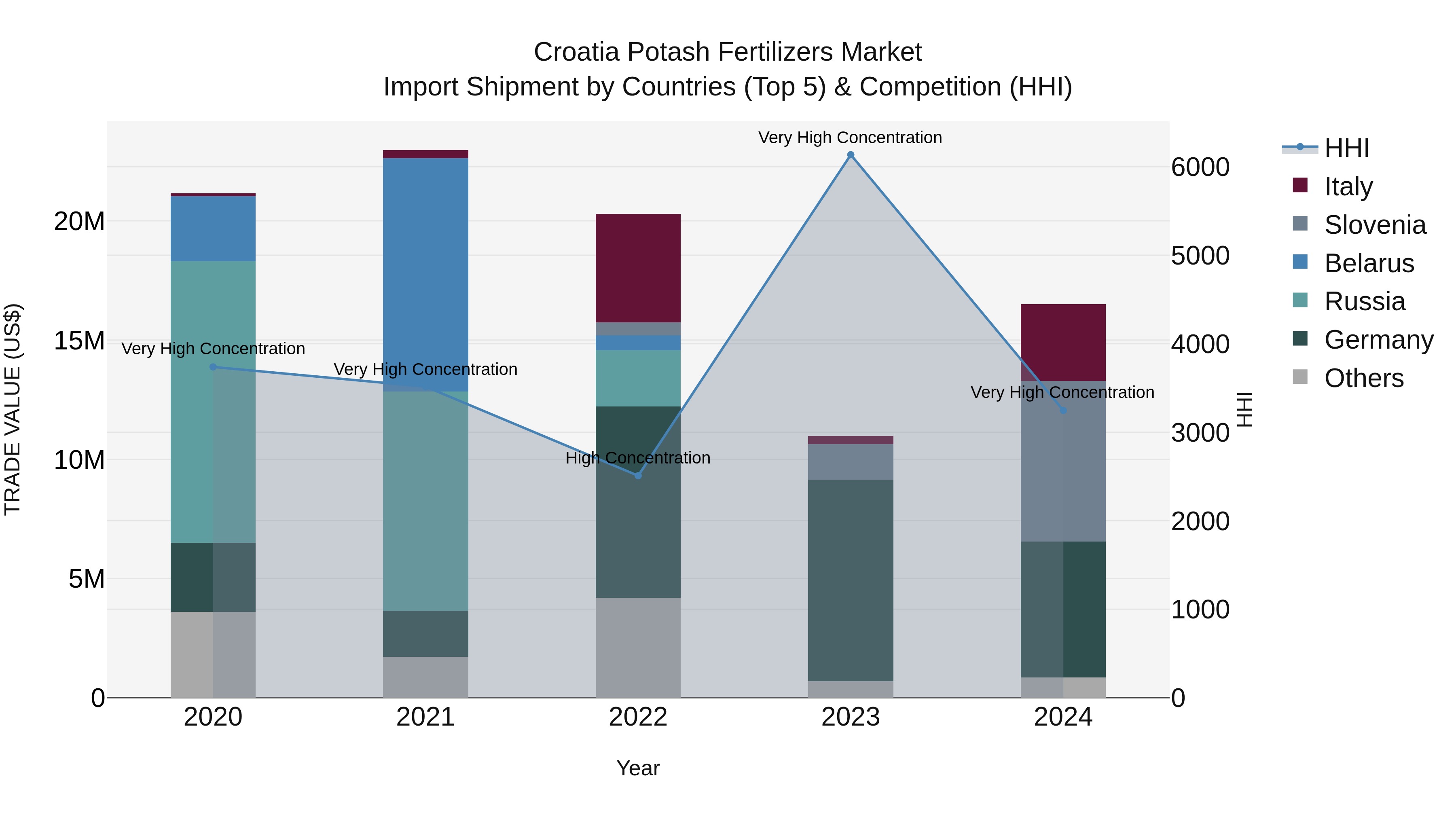
Croatia continues to heavily rely on imports of potash fertilizers, with Slovenia, Germany, Italy, Austria, and Czechia as the primary exporting countries in 2024. The market remains highly concentrated, indicating limited competition. Despite a negative Compound Annual Growth Rate (CAGR) from 2020 to 2024, there was a notable growth spike of 50.45% from 2023 to 2024. These trends suggest a dynamic market environment with potential shifts in supply dynamics and pricing strategies impacting the Croatian agricultural sector.
Potash Fertilizers Market: Croatia vs Top 5 Major Economies in 2027 (Europe)
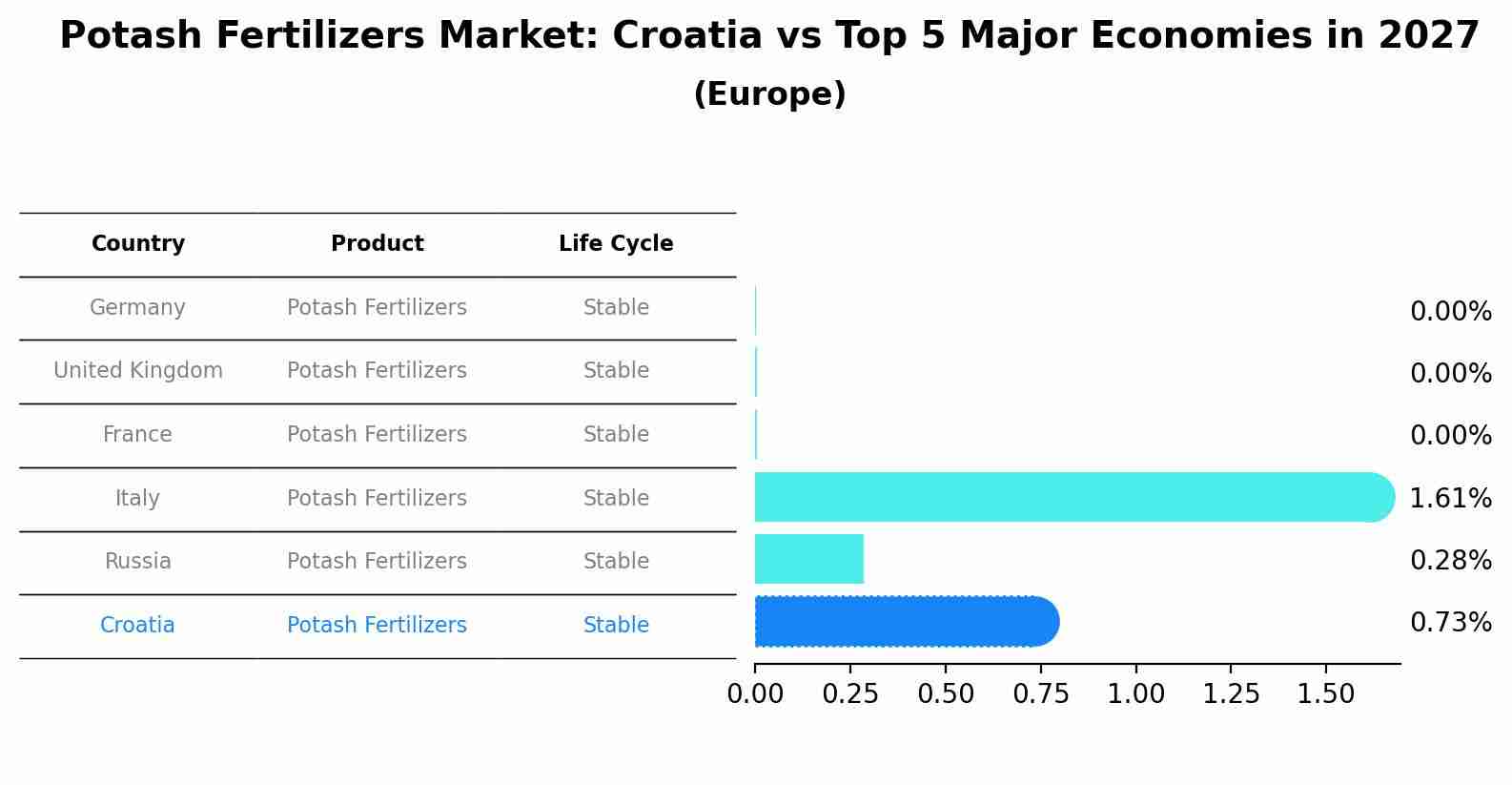
In the Europe region, the Potash Fertilizers market in Croatia is projected to expand at a stable growth rate of 0.73% by 2027. The largest economy is Germany, followed by United Kingdom, France, Italy and Russia.
Croatia Potash Fertilizers Market Overview
The Croatia Potash Fertilizers Market plays a crucial role in the agricultural sector, providing essential nutrients that enhance crop yield and quality. Potash fertilizers, rich in potassium, are vital for plant growth and are widely used in the cultivation of crops such as cereals, fruits, and vegetables. The market is driven by the demand for sustainable farming practices and the need to improve soil fertility.
Drivers of the market
The potash fertilizers market is driven by the need to improve crop yields and soil health in agriculture. Potash is a key nutrient for plant growth, and its use enhances crop quality and resistance to diseases. The growth of global agriculture, increasing demand for food, and advancements in fertilizer technology support market expansion.
Challenges of the market
In Croatia, the potash fertilizers market encounters challenges such as managing fluctuations in raw material prices and ensuring the effectiveness of fertilizers. Companies must address regulatory requirements and environmental concerns related to fertilizer production and application. Additionally, competition from alternative fertilizers and the need for innovation in fertilizer formulations impact the market.
Government Policy of the market
The Croatian government regulates the potash fertilizers market with a focus on environmental sustainability and agricultural efficiency. Policies are designed to ensure that potash fertilizers meet safety and quality standards, minimizing environmental impact. The government supports research and development in efficient and eco-friendly fertilizer technologies, and provides incentives for sustainable agricultural practices.
Key Highlights of the Report:
- Croatia Potash Fertilizers Market Outlook
- Market Size of Croatia Potash Fertilizers Market, 2024
- Forecast of Croatia Potash Fertilizers Market, 2031
- Historical Data and Forecast of Croatia Potash Fertilizers Revenues & Volume for the Period 2021-2031
- Croatia Potash Fertilizers Market Trend Evolution
- Croatia Potash Fertilizers Market Drivers and Challenges
- Croatia Potash Fertilizers Price Trends
- Croatia Potash Fertilizers Porter`s Five Forces
- Croatia Potash Fertilizers Industry Life Cycle
- Historical Data and Forecast of Croatia Potash Fertilizers Market Revenues & Volume By Type for the Period 2021-2031
- Historical Data and Forecast of Croatia Potash Fertilizers Market Revenues & Volume By Muriate of Potash for the Period 2021-2031
- Historical Data and Forecast of Croatia Potash Fertilizers Market Revenues & Volume By Sulfate of Potash for the Period 2021-2031
- Historical Data and Forecast of Croatia Potash Fertilizers Market Revenues & Volume By Other Types for the Period 2021-2031
- Historical Data and Forecast of Croatia Potash Fertilizers Market Revenues & Volume By Application for the Period 2021-2031
- Historical Data and Forecast of Croatia Potash Fertilizers Market Revenues & Volume By Grains and Cereals for the Period 2021-2031
- Historical Data and Forecast of Croatia Potash Fertilizers Market Revenues & Volume By Pulses and Oilseeds for the Period 2021-2031
- Historical Data and Forecast of Croatia Potash Fertilizers Market Revenues & Volume By Commercial Crops for the Period 2021-2031
- Historical Data and Forecast of Croatia Potash Fertilizers Market Revenues & Volume By Fruits and Vegetables for the Period 2021-2031
- Historical Data and Forecast of Croatia Potash Fertilizers Market Revenues & Volume By Other Applications for the Period 2021-2031
- Croatia Potash Fertilizers Import Export Trade Statistics
- Market Opportunity Assessment By Type
- Market Opportunity Assessment By Application
- Croatia Potash Fertilizers Top Companies Market Share
- Croatia Potash Fertilizers Competitive Benchmarking By Technical and Operational Parameters
- Croatia Potash Fertilizers Company Profiles
- Croatia Potash Fertilizers Key Strategic Recommendations






































