Croatia Sodium Cyanide Market Size (2020-2030)
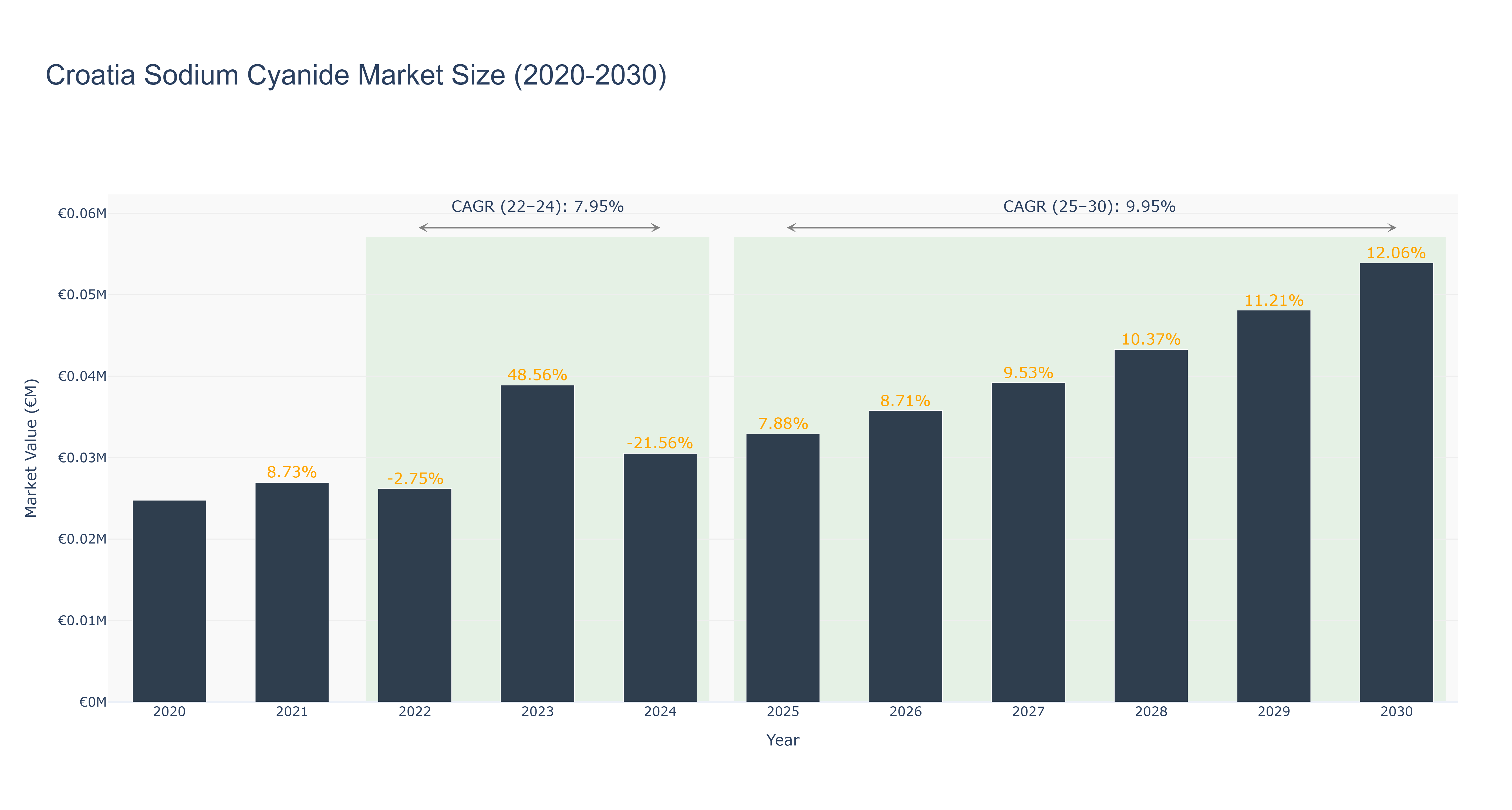
Croatia Sodium Cyanide Market has shown a fluctuating trend in recent years. The market peaked at €0.04 million in 2023, driven by a substantial growth rate of 48.56%. However, it experienced a decline in 2024, dropping to €0.03 million due to a negative growth rate of -21.56%. From 2025 to 2030, the market is forecasted to grow steadily, with a Compound Annual Growth Rate (CAGR) of 9.95% between 2025-2030. The market's growth can be attributed to increasing industrial applications and demand for sodium cyanide in various sectors. Looking ahead, Croatia is set to implement stricter environmental regulations in the chemical industry, which could impact market dynamics and drive innovation towards more sustainable practices. Recent developments in the market include collaborations between key players to enhance production efficiency and reduce environmental impact. Additionally, upcoming projects focus on research and development of alternative chemicals to sodium cyanide, aligning with the industry's sustainability goals.
Croatia Sodium Cyanide Market: Production & Trade Performance (2019-2025)
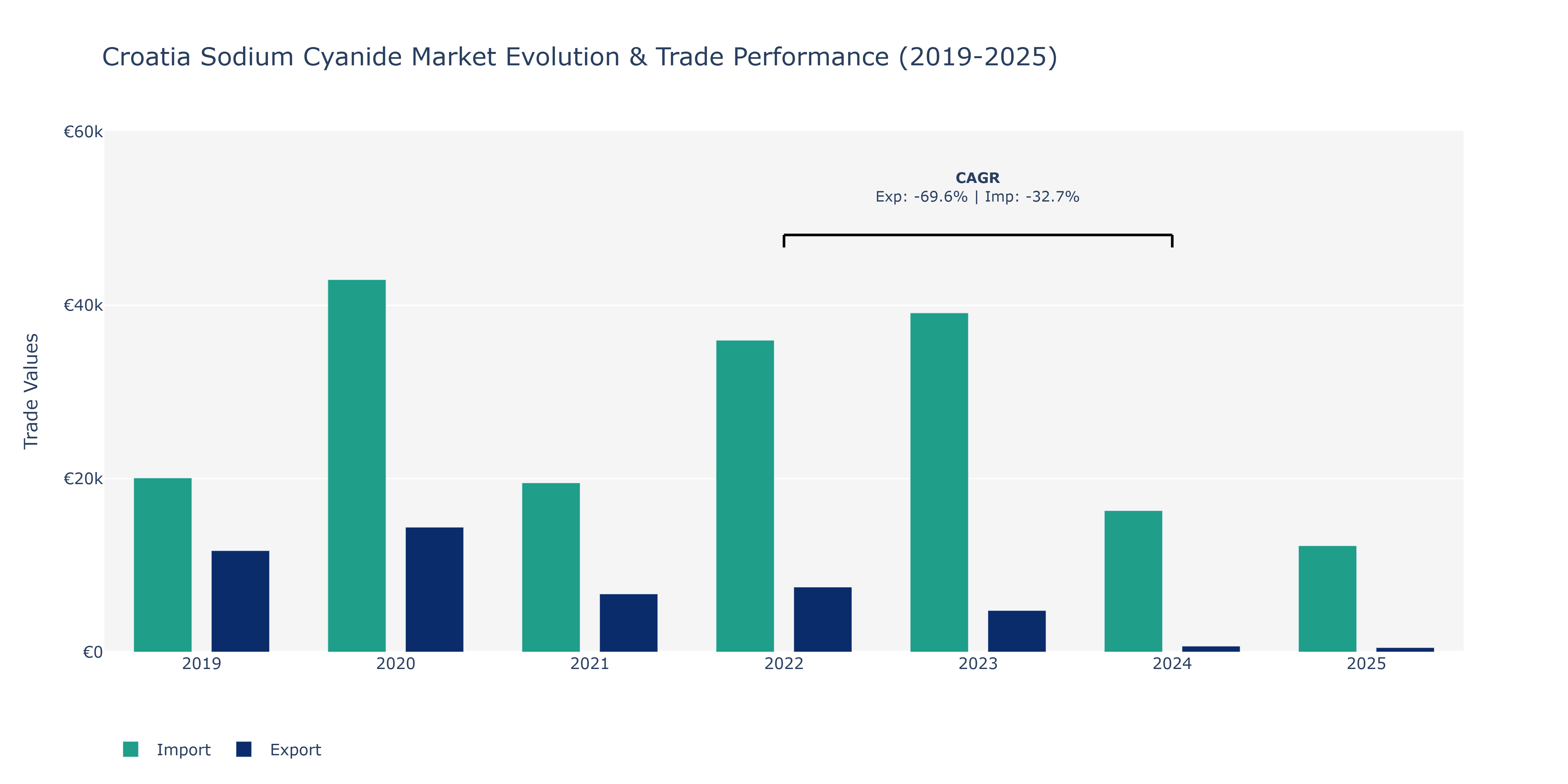
In the Croatia Sodium Cyanide Market, exports and imports displayed distinct trends over the years. In 2019, exports were valued at €11.7 thousand, rising significantly to €14.41 thousand in 2020, marking a peak point. However, a substantial decline ensued in 2021, with exports plummeting to €6.71 thousand, and this downward trend continued in 2022 and 2023, reaching €4.79 thousand and €0.692 billion, respectively. Imports, on the other hand, surged from €20.08 thousand in 2019 to €42.96 thousand in 2020, peaking in the same year. A notable decrease transpired in 2021 to €19.52 thousand, followed by a slight increase in 2022 to €35.97 thousand before stabilizing around €16.31 thousand in 2024. The decline in exports could be attributed to shifts in global demand for sodium cyanide, possibly influenced by changing environmental regulations or alternative technologies. Conversely, the fluctuation in imports might reflect varying domestic production capacities or changes in international trade partnerships within the chemicals industry.
Key Highlights of the Report:
- Croatia Sodium cyanide Market Outlook
- Market Size of Croatia Sodium cyanide Market, 2024
- Forecast of Croatia Sodium cyanide Market, 2031
- Historical Data and Forecast of Croatia Sodium cyanide Revenues & Volume for the Period 2021-2031
- Croatia Sodium cyanide Market Trend Evolution
- Croatia Sodium cyanide Market Drivers and Challenges
- Croatia Sodium cyanide Price Trends
- Croatia Sodium cyanide Porter`s Five Forces
- Croatia Sodium cyanide Industry Life Cycle
- Historical Data and Forecast of Croatia Sodium cyanide Market Revenues & Volume By Type for the Period 2021-2031
- Historical Data and Forecast of Croatia Sodium cyanide Market Revenues & Volume By Solid for the Period 2021-2031
- Historical Data and Forecast of Croatia Sodium cyanide Market Revenues & Volume By Liquid for the Period 2021-2031
- Historical Data and Forecast of Croatia Sodium cyanide Market Revenues & Volume By End-users for the Period 2021-2031
- Historical Data and Forecast of Croatia Sodium cyanide Market Revenues & Volume By Chemical for the Period 2021-2031
- Historical Data and Forecast of Croatia Sodium cyanide Market Revenues & Volume By Commercial for the Period 2021-2031
- Historical Data and Forecast of Croatia Sodium cyanide Market Revenues & Volume By Pharmaceutical for the Period 2021-2031
- Historical Data and Forecast of Croatia Sodium cyanide Market Revenues & Volume By Others for the Period 2021-2031
- Croatia Sodium cyanide Import Export Trade Statistics
- Market Opportunity Assessment By Type
- Market Opportunity Assessment By End-users
- Croatia Sodium cyanide Top Companies Market Share
- Croatia Sodium cyanide Competitive Benchmarking By Technical and Operational Parameters
- Croatia Sodium cyanide Company Profiles
- Croatia Sodium cyanide Key Strategic Recommendations






































