Croatia Tensile Testing Equipment Market Size (2020-2030)
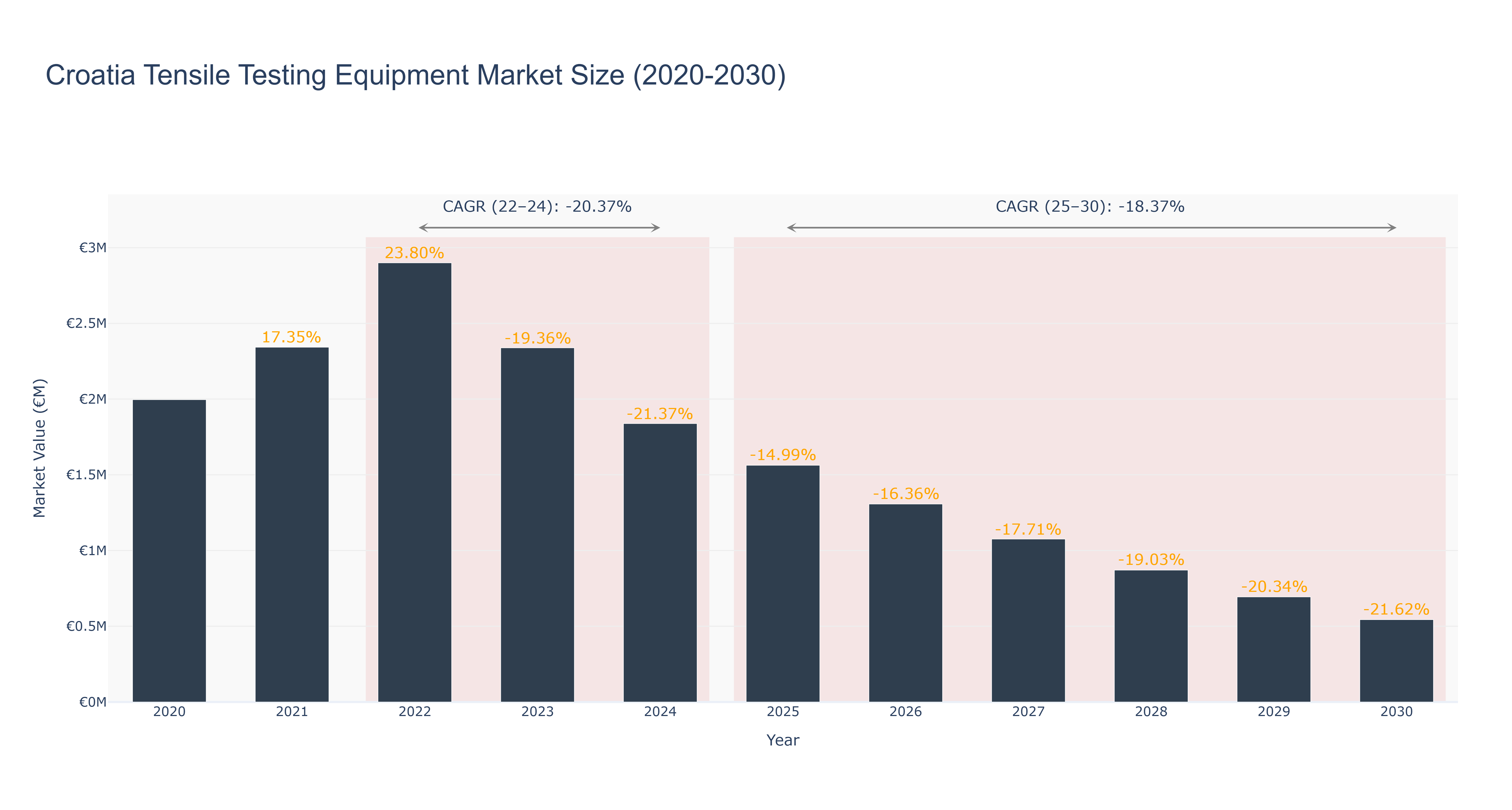
Croatia Tensile Testing Equipment Market has experienced a downward trend in market size over the years. The peak market size of €2.90 million was observed in 2022, followed by a decline to €1.54 million in 2025. The market is forecasted to continue shrinking, with an expected size of €0.54 million by 2030. The CAGR values reflect this negative trend, with a decline of -20.37% from 2022 to 2024 and -18.37% from 2025 to 2030. The market's downturn can be attributed to various factors such as economic instability, technological advancements leading to reduced demand, and changing consumer preferences. Despite the challenging market conditions, upcoming infrastructure projects in Croatia are expected to drive demand for testing equipment, offering potential growth opportunities for market players in the future.
Croatia Tensile Testing Equipment Market: Production & Trade Performance (2019-2025)
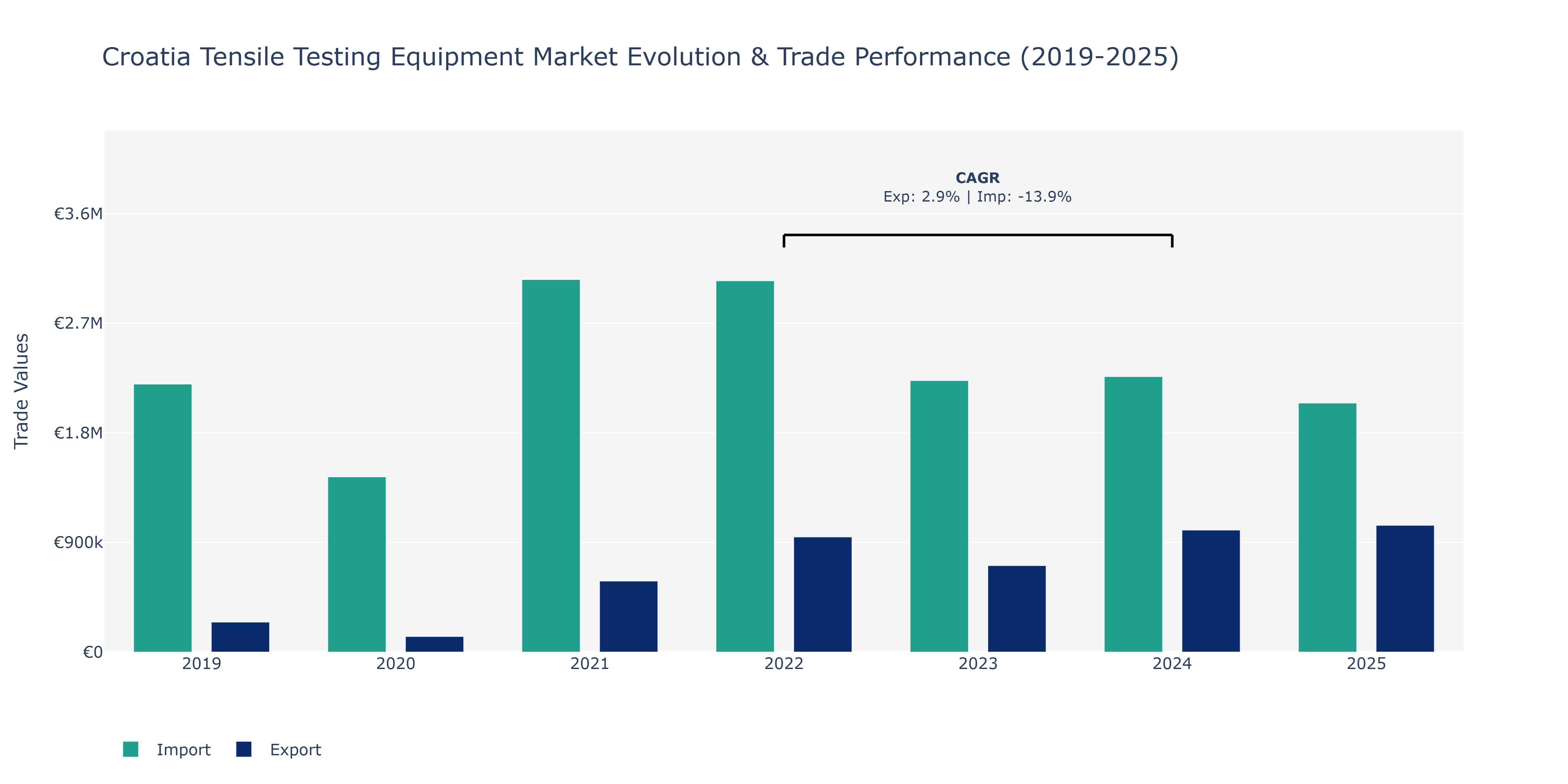
In the Croatia Tensile Testing Equipment Market, exports showcased a fluctuating pattern over the years. Starting at €245.75 thousand in 2019, there was a significant drop to €127.43 thousand in 2020, followed by a sharp increase to €583.04 thousand in 2021. Subsequently, exports peaked at €945.25 thousand in 2022 before experiencing a decline to €709.76 thousand in 2023, then recovering slightly to €1.0 million in 2024, and finally reaching €1.04 million in 2025. On the other hand, imports followed a more stable trajectory, increasing consistently from €2.2 million in 2019 to €3.06 million in 2021, with a minor decline in 2022 to €3.05 million. Imports then fluctuated around the €2.2 million mark between 2023 and 2025. These export fluctuations may be attributed to shifts in global demand for testing equipment, technological advancements, and evolving trade agreements impacting market dynamics. The stable import trend suggests a consistent need for foreign products to support Croatia's industrial activities in this sector.
Key Highlights of the Report:
- Croatia Tensile Testing Equipment Market Outlook
- Market Size of Croatia Tensile Testing Equipment Market, 2025
- Forecast of Croatia Tensile Testing Equipment Market, 2032
- Historical Data and Forecast of Croatia Tensile Testing Equipment Revenues & Volume for the Period 2022 - 2032F
- Croatia Tensile Testing Equipment Market Trend Evolution
- Croatia Tensile Testing Equipment Market Drivers and Challenges
- Croatia Tensile Testing Equipment Price Trends
- Croatia Tensile Testing Equipment Porter`s Five Forces
- Croatia Tensile Testing Equipment Industry Life Cycle
- Historical Data and Forecast of Croatia Tensile Testing Equipment Market Revenues & Volume By Equipment Type for the Period 2022 - 2032F
- Historical Data and Forecast of Croatia Tensile Testing Equipment Market Revenues & Volume By Universal Testing Machine for the Period 2022 - 2032F
- Historical Data and Forecast of Croatia Tensile Testing Equipment Market Revenues & Volume By Hydraulic for the Period 2022 - 2032F
- Historical Data and Forecast of Croatia Tensile Testing Equipment Market Revenues & Volume By Electromechanical for the Period 2022 - 2032F
- Historical Data and Forecast of Croatia Tensile Testing Equipment Market Revenues & Volume By Others for the Period 2022 - 2032F
- Historical Data and Forecast of Croatia Tensile Testing Equipment Market Revenues & Volume By End-User Industry for the Period 2022 - 2032F
- Historical Data and Forecast of Croatia Tensile Testing Equipment Market Revenues & Volume By Industrial Manufacturing for the Period 2022 - 2032F
- Historical Data and Forecast of Croatia Tensile Testing Equipment Market Revenues & Volume By Automotive for the Period 2022 - 2032F
- Historical Data and Forecast of Croatia Tensile Testing Equipment Market Revenues & Volume By Construction for the Period 2022 - 2032F
- Historical Data and Forecast of Croatia Tensile Testing Equipment Market Revenues & Volume By Others for the Period 2022 - 2032F
- Croatia Tensile Testing Equipment Import Export Trade Statistics
- Market Opportunity Assessment By Equipment Type
- Market Opportunity Assessment By End-User Industry
- Croatia Tensile Testing Equipment Top Companies Market Share
- Croatia Tensile Testing Equipment Competitive Benchmarking By Technical and Operational Parameters
- Croatia Tensile Testing Equipment Company Profiles
- Croatia Tensile Testing Equipment Key Strategic Recommendations






































