Croatia Voice Coils Market Size (2020-2030)
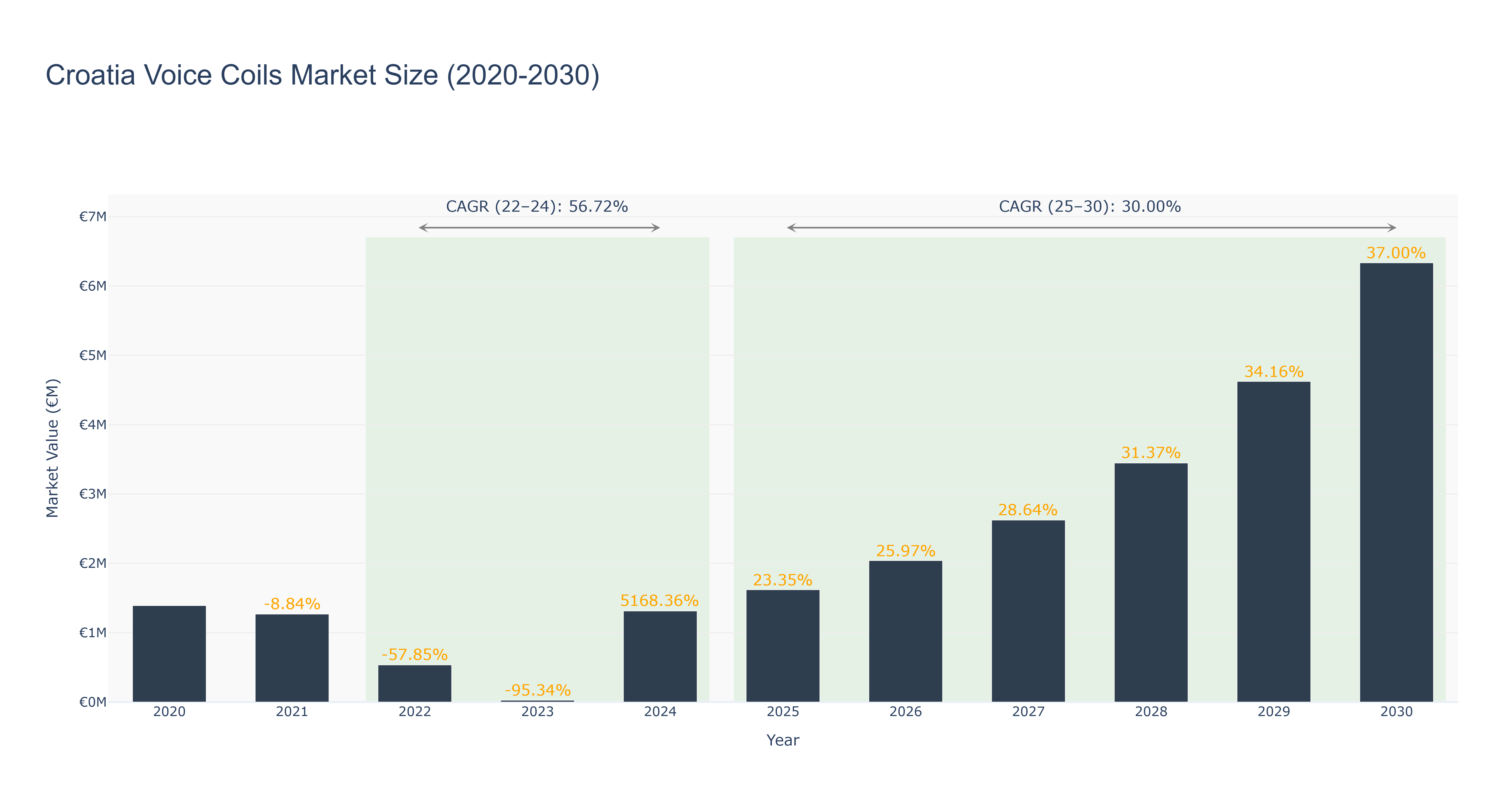
Croatia Voice Coils Market has shown a fluctuating trend over the years. The market reached its peak in 2030 with a size of €6.33 million. From 2020 to 2024, the market size varied significantly, starting at €1.39 million in 2020, dropping to €0.02 million in 2023, before experiencing a remarkable surge to €1.31 million in 2024. The forecasted market size from 2025 to 2030 is expected to continue growing steadily, with a Compound Annual Growth Rate (CAGR) of 30.0% between 2025 and 2030. The market saw a sharp decline in 2023 due to economic downturn, but the subsequent growth was driven by technological advancements and increased demand for voice coil applications. Looking ahead, Croatia is set to invest in renewable energy projects, which will likely boost the demand for voice coils in various applications, further driving market growth.
Croatia Voice Coils Market: Production & Trade Performance (2019-2025)
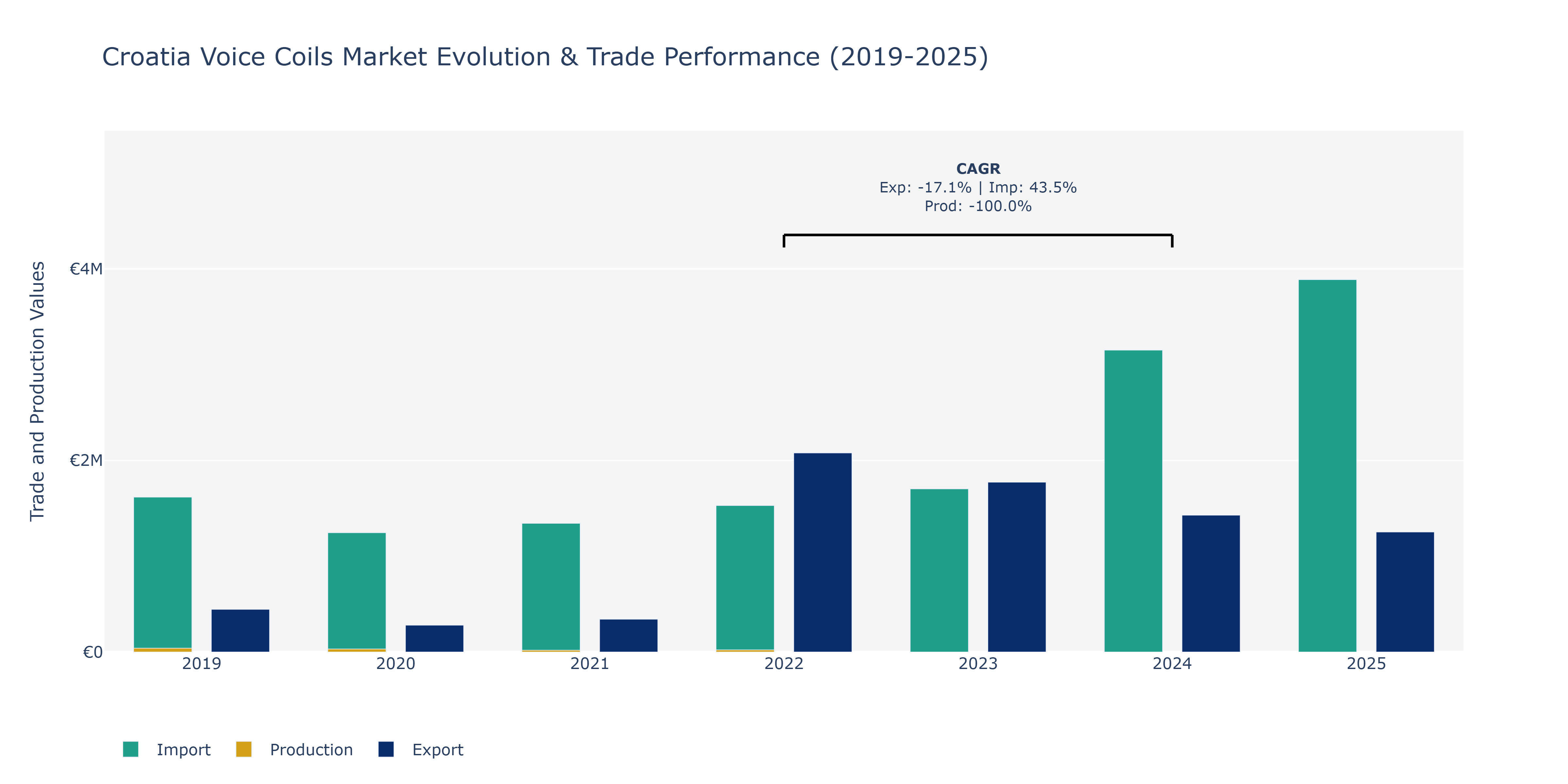
In the Croatia Voice Coils Market, exports experienced a notable decline from €445.92 thousand in 2019 to €1.25 million in 2025, with a peak in 2022 at €2.08 million. This fluctuation may be attributed to shifts in global demand for voice coils, possibly influenced by changes in technology trends or variations in international trade agreements. Conversely, imports displayed a consistent upward trend, rising steadily from €1.62 million in 2019 to €3.89 million in 2025, marking a peak in 2024 at €3.15 million. Such growth in imports could be linked to the need for raw materials or specialized components required for voice coil production within Croatia. Production levels, on the other hand, saw a sharp decline from €40.20 million in 2019 to €19.00 million in 2021, remaining constant thereafter. This significant decrease might be a result of internal factors such as operational challenges or changes in manufacturing processes affecting output efficiency. To adapt to the changing market dynamics, stakeholders in the Croatia Voice Coils Market could focus on enhancing domestic production capabilities, improving export competitiveness through product innovation, and closely monitoring global trade policies impacting imports.
Key Highlights of the Report:
- Croatia Voice Coils Market Outlook
- Market Size of Croatia Voice Coils Market, 2025
- Forecast of Croatia Voice Coils Market, 2032
- Historical Data and Forecast of Croatia Voice Coils Revenues & Volume for the Period 2022 - 2032F
- Croatia Voice Coils Market Trend Evolution
- Croatia Voice Coils Market Drivers and Challenges
- Croatia Voice Coils Price Trends
- Croatia Voice Coils Porter`s Five Forces
- Croatia Voice Coils Industry Life Cycle
- Historical Data and Forecast of Croatia Voice Coils Market Revenues & Volume By Type for the Period 2022 - 2032F
- Historical Data and Forecast of Croatia Voice Coils Market Revenues & Volume By Single Voice Coils (SVC) for the Period 2022 - 2032F
- Historical Data and Forecast of Croatia Voice Coils Market Revenues & Volume By Dual Voice Coils (DVC) for the Period 2022 - 2032F
- Historical Data and Forecast of Croatia Voice Coils Market Revenues & Volume By Application for the Period 2022 - 2032F
- Historical Data and Forecast of Croatia Voice Coils Market Revenues & Volume By Speakers for the Period 2022 - 2032F
- Historical Data and Forecast of Croatia Voice Coils Market Revenues & Volume By Headset for the Period 2022 - 2032F
- Historical Data and Forecast of Croatia Voice Coils Market Revenues & Volume By Other for the Period 2022 - 2032F
- Croatia Voice Coils Import Export Trade Statistics
- Market Opportunity Assessment By Type
- Market Opportunity Assessment By Application
- Croatia Voice Coils Top Companies Market Share
- Croatia Voice Coils Competitive Benchmarking By Technical and Operational Parameters
- Croatia Voice Coils Company Profiles
- Croatia Voice Coils Key Strategic Recommendations






































