Croatia White Chocolate Market Size (2020-2030)
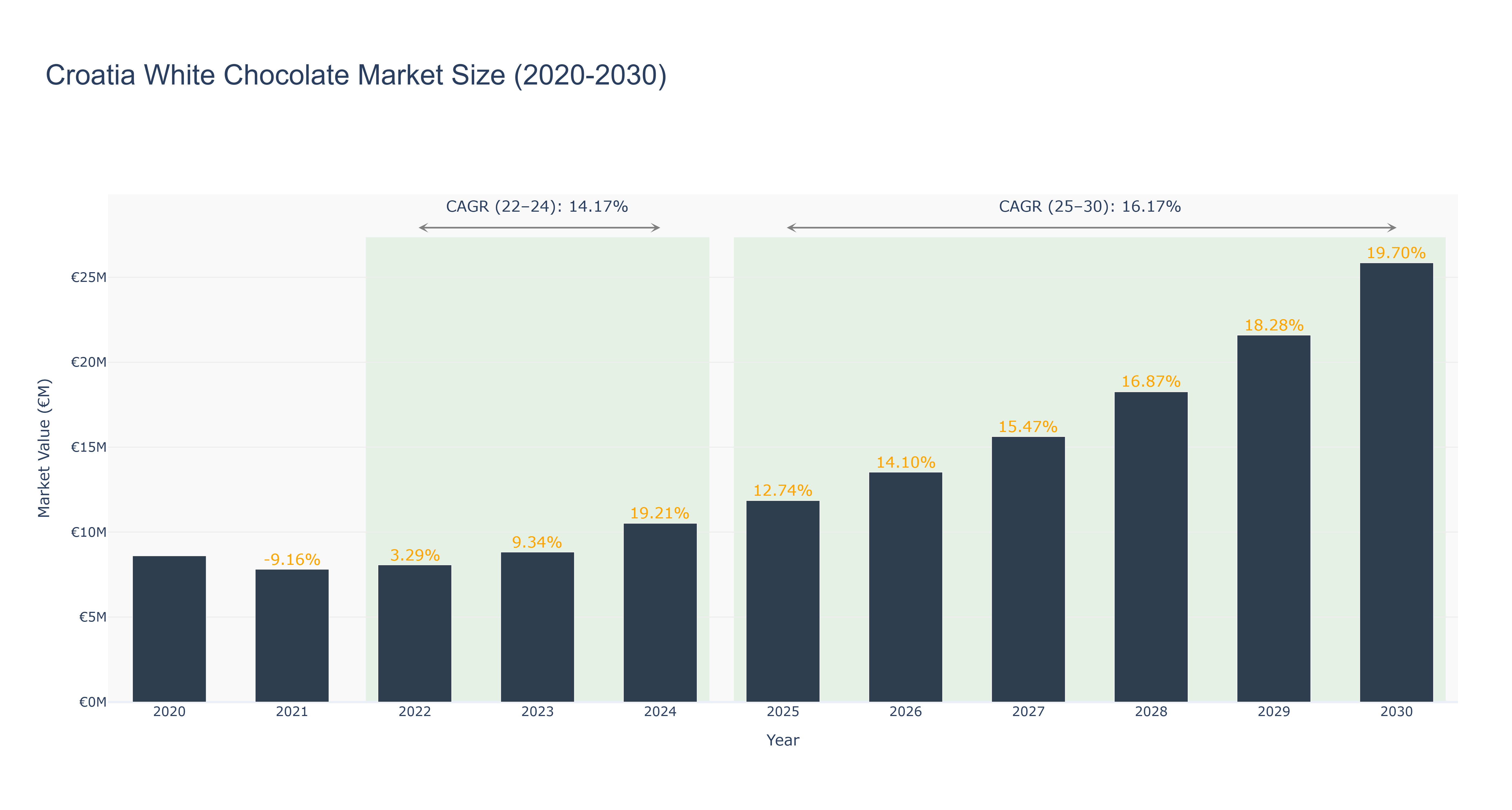
The Croatia White Chocolate Market experienced fluctuations between 2020 and 2024, peaking at €8.60 million in 2020, followed by a decline to €7.81 million in 2021, a modest recovery to €8.07 million in 2022, and a notable increase to €10.52 million in 2024, reflecting a robust CAGR of 14.17% during this actual period. The forecasted outlook from 2025 to 2030 indicates continued growth, with market size projected to reach €25.85 million by 2030, representing a CAGR of 16.17%. Driving this growth are increasing consumer preferences for premium confectionery, innovative product offerings, and marketing strategies targeting health-conscious demographics. Additionally, the anticipated rise in disposable income and investment in product development should further bolster market expansion. As the market matures, companies may focus on sustainability and ethical sourcing, aligning with global trends that prioritize environmental responsibility.
Croatia White Chocolate Market: Production & Trade Performance (2019-2025)
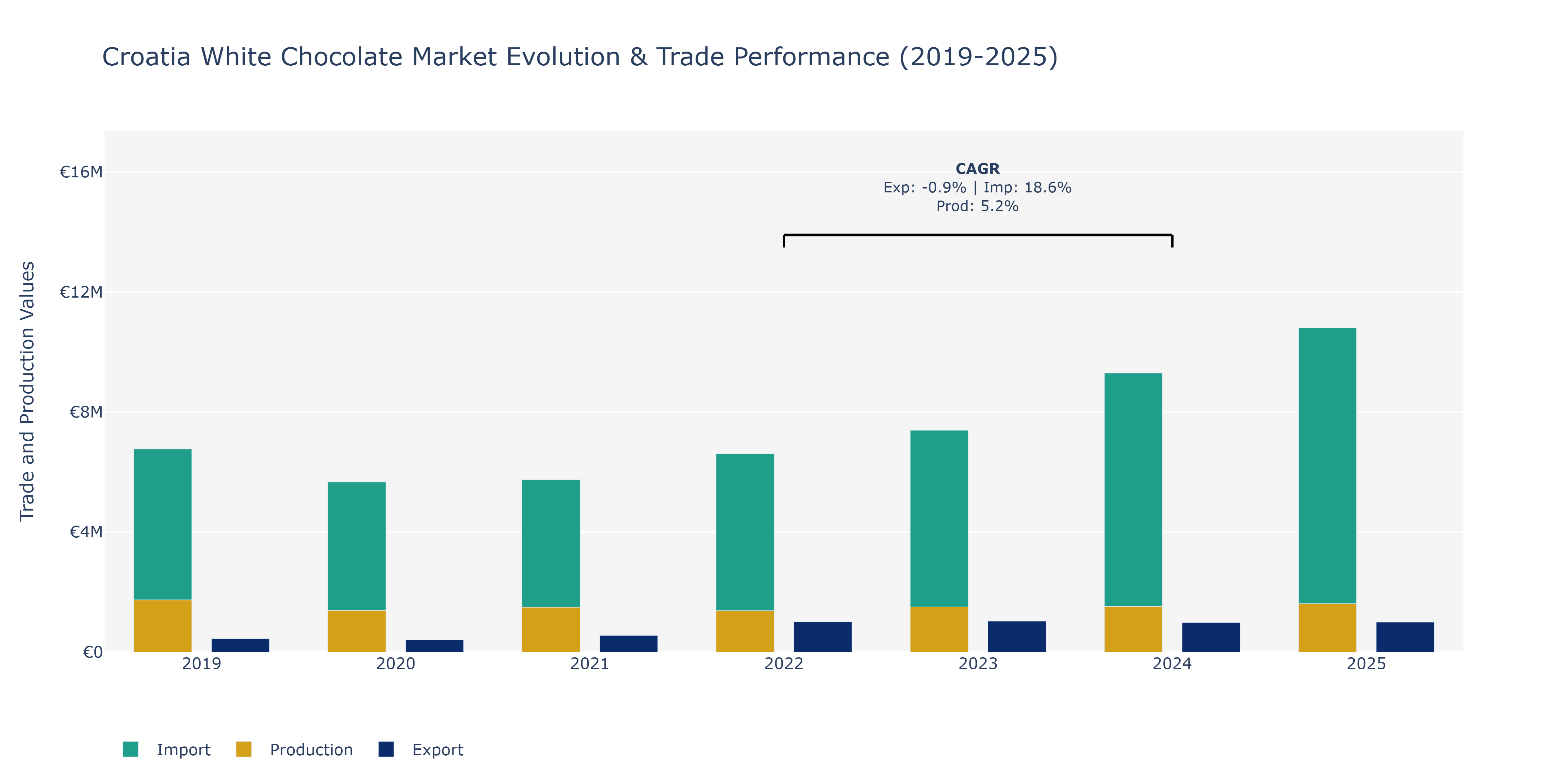
The Croatia White Chocolate Market witnessed varying trends in exports, imports, and production over the years. In 2019, exports stood at €448.13 thousand, showing a subsequent decrease to €402.32 thousand in 2020 before rebounding to €557.22 thousand in 2021. The peak export value was observed in 2025 at €997.6 thousand, reflecting a notable upward trajectory. Conversely, imports showed a consistent increase from €6.77 million in 2019 to €10.8 million in 2025, with a significant growth rate particularly between 2022 and 2024. Production value fluctuated, with a peak in 2025 at €1.61 billion after a dip in 2020. These fluctuations could be attributed to changing consumer preferences towards premium white chocolate, global economic conditions impacting trade dynamics, and technological advancements in production processes enhancing efficiency and output. The surge in imports could be driven by the demand for high-quality ingredients and finished products in the confectionery industry, aligning with the increasing trend of indulgence and premiumization in the chocolate market.
Key Highlights of the Report:
- Croatia White Chocolate Market Outlook
- Market Size of Croatia White Chocolate Market, 2025
- Forecast of Croatia White Chocolate Market, 2032
- Historical Data and Forecast of Croatia White Chocolate Revenues & Volume for the Period 2022 - 2032
- Croatia White Chocolate Market Trend Evolution
- Croatia White Chocolate Market Drivers and Challenges
- Croatia White Chocolate Price Trends
- Croatia White Chocolate Porter's Five Forces
- Croatia White Chocolate Industry Life Cycle
- Historical Data and Forecast of Croatia White Chocolate Market Revenues & Volume By Type for the Period 2022 - 2032
- Historical Data and Forecast of Croatia White Chocolate Market Revenues & Volume By Conventional White Chocolate for the Period 2022 - 2032
- Historical Data and Forecast of Croatia White Chocolate Market Revenues & Volume By Organic White Chocolate for the Period 2022 - 2032
- Historical Data and Forecast of Croatia White Chocolate Market Revenues & Volume By Application for the Period 2022 - 2032
- Historical Data and Forecast of Croatia White Chocolate Market Revenues & Volume By Food & Beverages for the Period 2022 - 2032
- Historical Data and Forecast of Croatia White Chocolate Market Revenues & Volume By Pharmaceuticals for the Period 2022 - 2032
- Historical Data and Forecast of Croatia White Chocolate Market Revenues & Volume By Cosmetics for the Period 2022 - 2032
- Historical Data and Forecast of Croatia White Chocolate Market Revenues & Volume By Other for the Period 2022 - 2032
- Croatia White Chocolate Import Export Trade Statistics
- Market Opportunity Assessment By Type
- Market Opportunity Assessment By Application
- Croatia White Chocolate Top Companies Market Share
- Croatia White Chocolate Competitive Benchmarking By Technical and Operational Parameters
- Croatia White Chocolate Company Profiles
- Croatia White Chocolate Key Strategic Recommendations






































