Croatia Wood Pellets Market Top 5 Importing Countries and Market Competition (HHI) Analysis
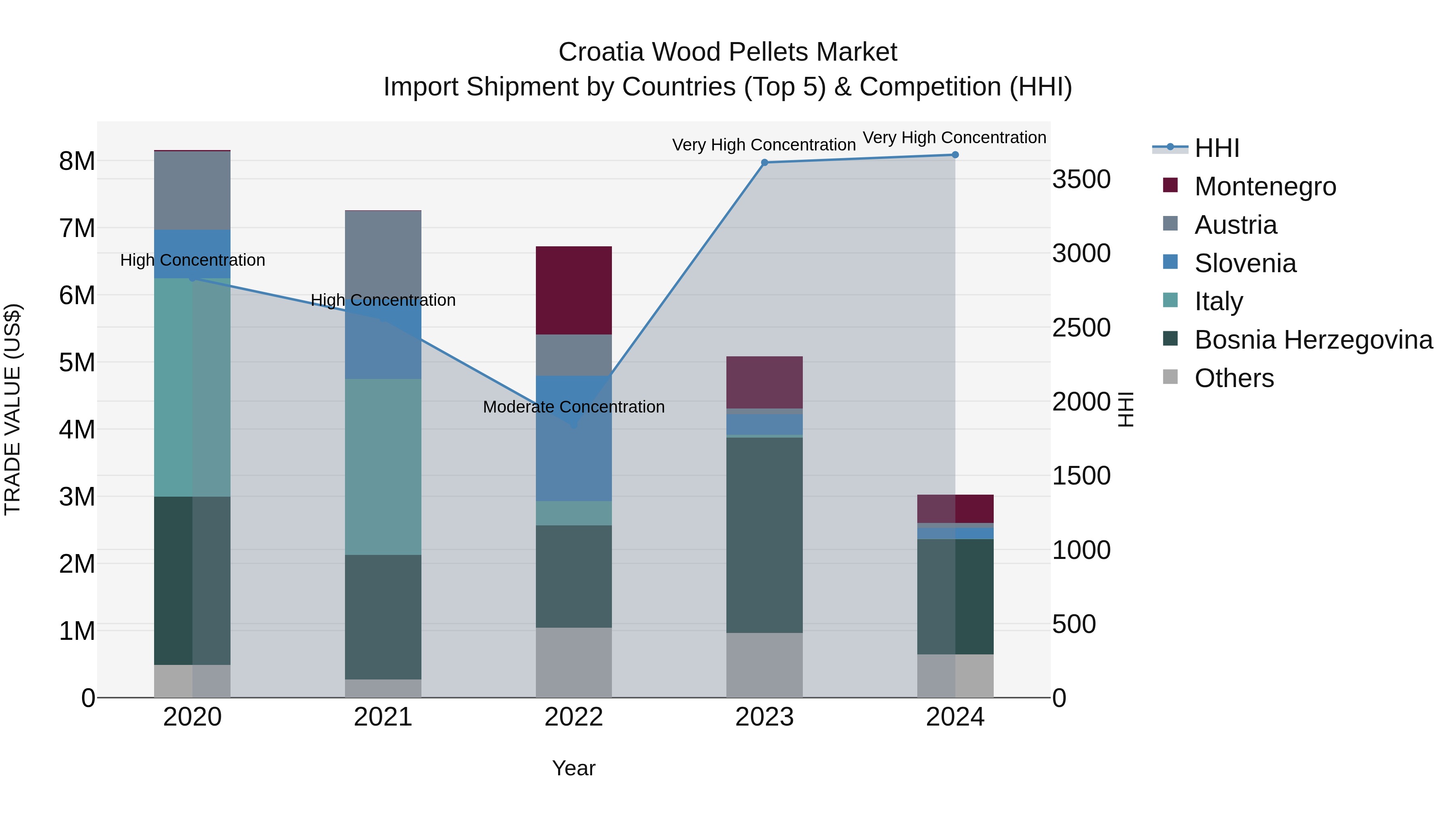
Despite a decline in the growth rate of Croatia wood pellets imports in 2024, the market continues to be dominated by a few key exporting countries, with Bosnia Herzegovina, Montenegro, Serbia, Slovenia, and Germany leading the pack. The high Herfindahl-Hirschman Index (HHI) indicates a significant level of market concentration. The negative Compound Annual Growth Rate (CAGR) from 2020 to 2024 highlights challenges in the industry, while the sharp decline in growth rate from 2023 to 2024 suggests a recent downturn. Monitoring these trends can provide valuable insights for stakeholders in the wood pellets import market.
Croatia Wood Pellets Market Overview
Croatias wood pellets market is expanding as the demand for renewable energy sources grows. Wood pellets are used as a biofuel for heating and power generation, offering an environmentally friendly alternative to fossil fuels. The countrys abundant forest resources and growing awareness of sustainable energy practices are supporting this markets growth.
Drivers of the market
The growing emphasis on renewable energy and the need for cost-efficient heating solutions are the main drivers of the wood pellets market in Croatia. Increasing adoption of wood pellets for residential heating, along with favorable government policies promoting biomass energy, supports market growth.
Challenges of the market
The wood pellets market in Croatia is impacted by fluctuating raw material prices, particularly for wood waste and sawdust. The market also faces competition from alternative energy sources, such as natural gas and solar power. Additionally, the need for continuous innovation to improve pellet efficiency and meet environmental standards adds to production costs.
Government Policy of the market
Croatias policies support the wood pellets market as part of its commitment to renewable energy and sustainable heating solutions. The government offers financial incentives for the production and use of wood pellets, aiming to promote their adoption as a cleaner alternative to traditional fossil fuels.
Key Highlights of the Report:
- Croatia Wood Pellets Market Outlook
- Market Size of Croatia Wood Pellets Market, 2024
- Forecast of Croatia Wood Pellets Market, 2031
- Historical Data and Forecast of Croatia Wood Pellets Revenues & Volume for the Period 2021-2031
- Croatia Wood Pellets Market Trend Evolution
- Croatia Wood Pellets Market Drivers and Challenges
- Croatia Wood Pellets Price Trends
- Croatia Wood Pellets Porter`s Five Forces
- Croatia Wood Pellets Industry Life Cycle
- Historical Data and Forecast of Croatia Wood Pellets Market Revenues & Volume By Types for the Period 2021-2031
- Historical Data and Forecast of Croatia Wood Pellets Market Revenues & Volume By Hardwood for the Period 2021-2031
- Historical Data and Forecast of Croatia Wood Pellets Market Revenues & Volume By Softwood for the Period 2021-2031
- Historical Data and Forecast of Croatia Wood Pellets Market Revenues & Volume By Applications for the Period 2021-2031
- Historical Data and Forecast of Croatia Wood Pellets Market Revenues & Volume By Power Plants for the Period 2021-2031
- Historical Data and Forecast of Croatia Wood Pellets Market Revenues & Volume By Residential Heating for the Period 2021-2031
- Historical Data and Forecast of Croatia Wood Pellets Market Revenues & Volume By Commercial Heating for the Period 2021-2031
- Historical Data and Forecast of Croatia Wood Pellets Market Revenues & Volume By Combined Heat and Power (CHP) for the Period 2021-2031
- Croatia Wood Pellets Import Export Trade Statistics
- Market Opportunity Assessment By Types
- Market Opportunity Assessment By Applications
- Croatia Wood Pellets Top Companies Market Share
- Croatia Wood Pellets Competitive Benchmarking By Technical and Operational Parameters
- Croatia Wood Pellets Company Profiles
- Croatia Wood Pellets Key Strategic Recommendations






































