Cyprus Airborne 3D Radar Market Size (2020-2030)
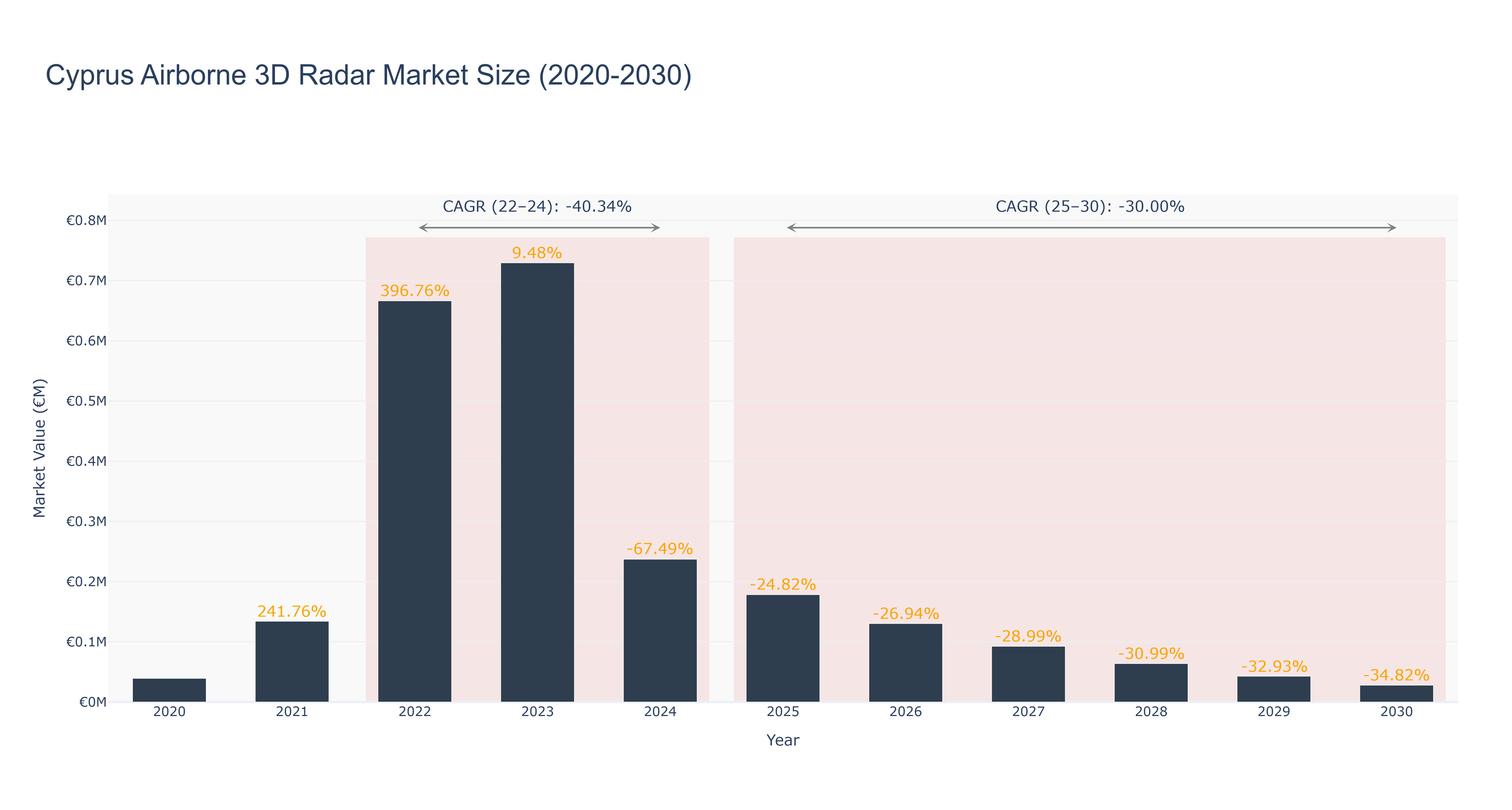
Cyprus Airborne 3D Radar Market experienced a peak market size of €0.73 million in 2023, with a significant decline to €0.24 million in 2024. The market is forecasted to continue shrinking, reaching €0.03 million in 2030, with a CAGR of -30.0% from 2025 to 2030. The decline in market size can be attributed to technological advancements leading to cost reductions, driving down prices for radar systems. However, the market is expected to stabilize in the future with increased demand for radar systems in defense and surveillance applications. Recent developments in the market include collaborations with defense agencies to enhance radar capabilities and expand into new geographical regions. Future projects include the development of advanced radar systems with improved accuracy and range, positioning Cyprus as a key player in the global radar market.
Cyprus Airborne 3D Radar Market: Production & Trade Performance (2019-2025)
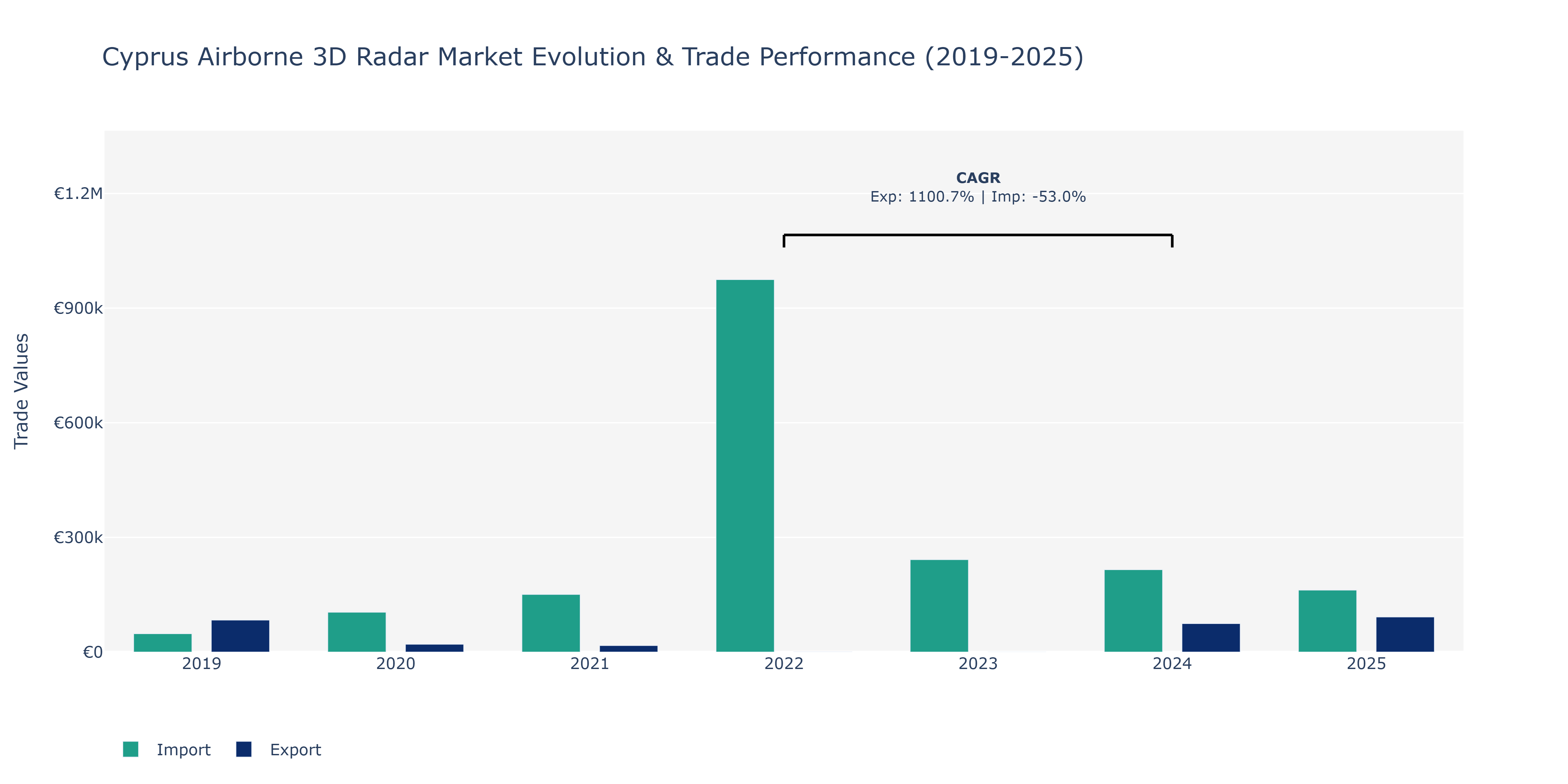
Between 2019 and 2025, the Cyprus Airborne 3D Radar Market experienced notable shifts in both exports and imports. In 2019, exports stood at €83.61 thousand, declining sharply to €20.38 thousand in 2020 before dropping further to €16.98 thousand in 2021. However, a significant recovery occurred in 2022, with exports rebounding to €0.52 million. This recovery trend continued, reaching a peak of €91.76 thousand in 2025, showcasing a substantial overall increase. Conversely, imports followed a different trajectory. Starting at €47.99 thousand in 2019, they surged to €104.09 thousand in 2020, peaking at €974.71 thousand in 2022, before gradually declining to €161.99 thousand in 2025. These fluctuations may be attributed to various factors, such as changes in defense spending, technological advancements driving demand for radar systems, and geopolitical developments impacting trade dynamics within the region.
Key Highlights of the Report:
- Cyprus Airborne 3d Radar Market Outlook
- Market Size of Cyprus Airborne 3d Radar Market, 2024
- Forecast of Cyprus Airborne 3d Radar Market, 2031
- Historical Data and Forecast of Cyprus Airborne 3d Radar Revenues & Volume for the Period 2021-2031
- Cyprus Airborne 3d Radar Market Trend Evolution
- Cyprus Airborne 3d Radar Market Drivers and Challenges
- Cyprus Airborne 3d Radar Price Trends
- Cyprus Airborne 3d Radar Porter's Five Forces
- Cyprus Airborne 3d Radar Industry Life Cycle
- Historical Data and Forecast of Cyprus Airborne 3d Radar Market Revenues & Volume By Type for the Period 2021-2031
- Historical Data and Forecast of Cyprus Airborne 3d Radar Market Revenues & Volume By Synthetic Aperture Radar (SAR) for the Period 2021-2031
- Historical Data and Forecast of Cyprus Airborne 3d Radar Market Revenues & Volume By Inverse Synthetic Aperture Radar (ISAR) for the Period 2021-2031
- Historical Data and Forecast of Cyprus Airborne 3d Radar Market Revenues & Volume By Application for the Period 2021-2031
- Historical Data and Forecast of Cyprus Airborne 3d Radar Market Revenues & Volume By Military for the Period 2021-2031
- Historical Data and Forecast of Cyprus Airborne 3d Radar Market Revenues & Volume By Civilian for the Period 2021-2031
- Cyprus Airborne 3d Radar Import Export Trade Statistics
- Market Opportunity Assessment By Type
- Market Opportunity Assessment By Application
- Cyprus Airborne 3d Radar Top Companies Market Share
- Cyprus Airborne 3d Radar Competitive Benchmarking By Technical and Operational Parameters
- Cyprus Airborne 3d Radar Company Profiles
- Cyprus Airborne 3d Radar Key Strategic Recommendations






































