Cyprus Carbonated Beverages Market Import Shipment by Countries (Top 5) & Competition (HHI)
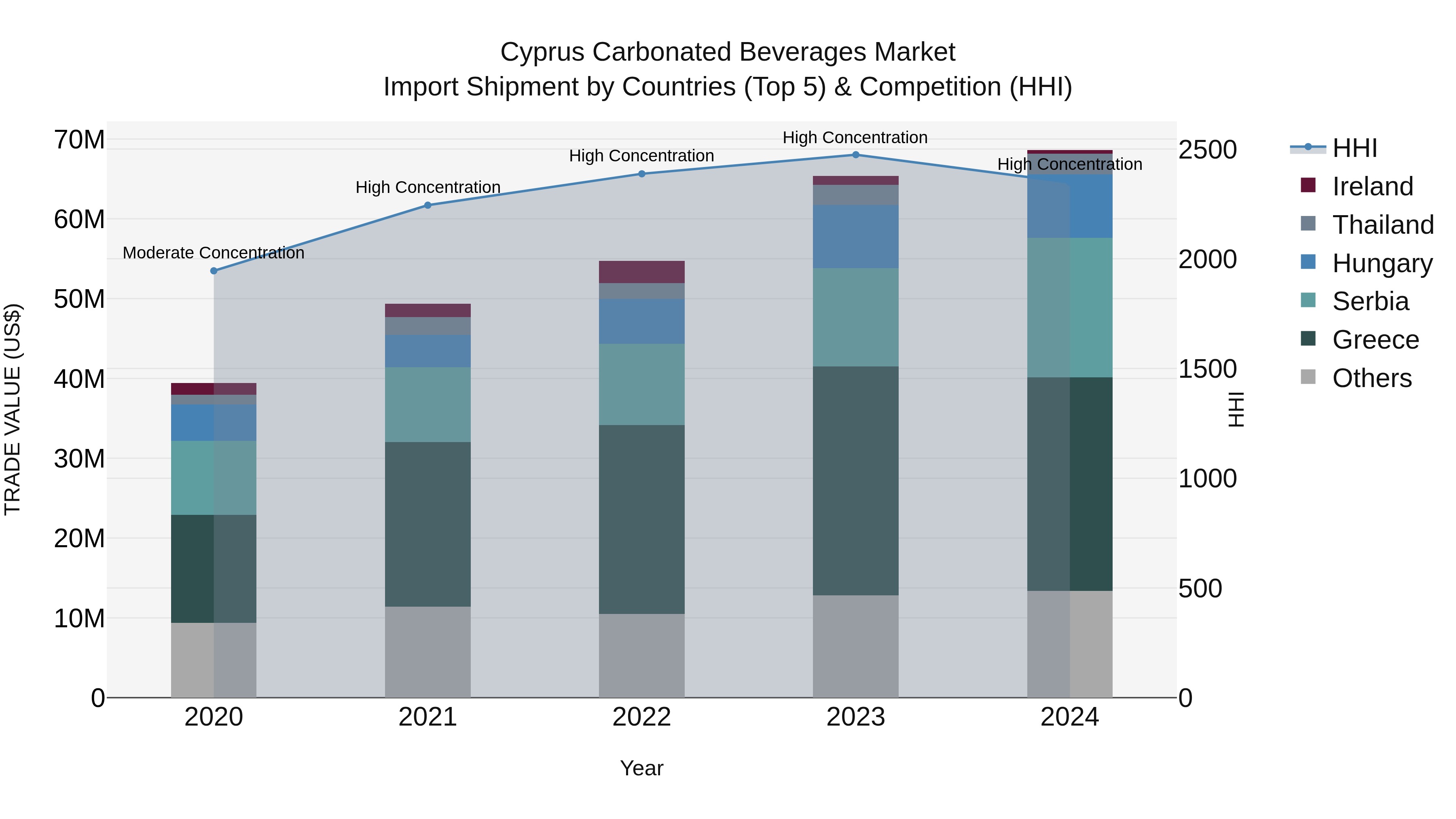
The Cyprus carbonated beverages market continues to see strong growth, with a notable increase in import shipments from top exporting countries such as Greece, Serbia, Hungary, Thailand, and the UK in 2024. The market remains highly concentrated, as indicated by the high Herfindahl-Hirschman Index (HHI) in 2024. The compound annual growth rate (CAGR) from 2020 to 2024 stands at an impressive 14.87%, showcasing the increasing demand for carbonated beverages in Cyprus. Additionally, the growth rate from 2023 to 2024 is a healthy 4.9%, indicating sustained momentum in the market.
Carbonated Beverages Market: Cyprus vs Top 5 Major Economies in 2027 (Europe)
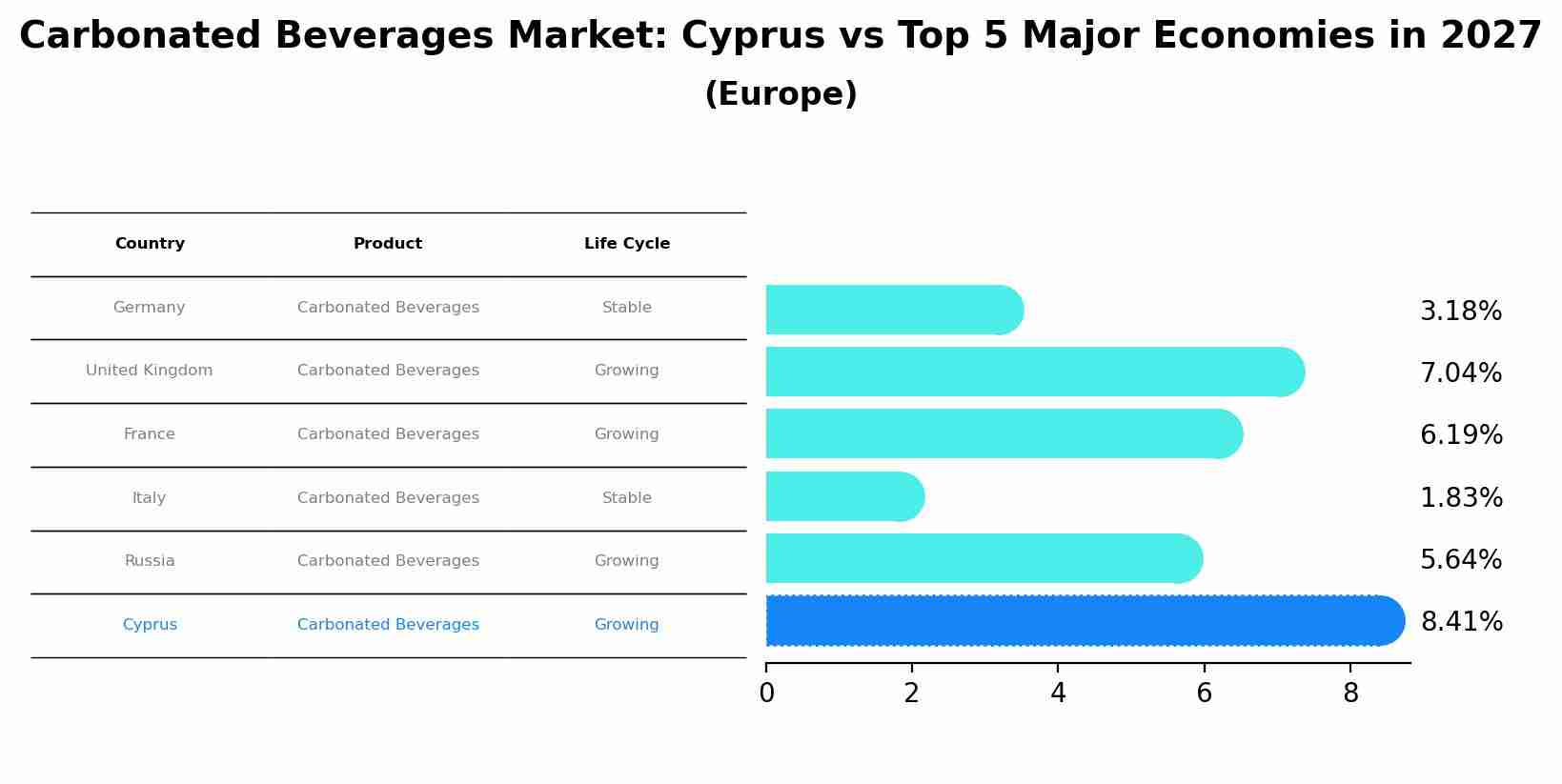
By 2027, the Carbonated Beverages market in Cyprus is anticipated to reach a growth rate of 8.41%, as part of an increasingly competitive Europe region, where Germany remains at the forefront, supported by United Kingdom, France, Italy and Russia, driving innovations and market adoption across sectors.
Cyprus Carbonated Beverages Market Overview
The carbonated beverages market in Cyprus is thriving, with soft drinks, sparkling water, and energy drinks being popular among consumers. Health-conscious trends are also influencing the market, with an increasing number of low-sugar and sugar-free options being introduced to cater to changing consumer preferences.
Drivers of the market
The carbonated beverages market in Cyprus is propelled by increasing consumer demand for soft drinks, flavored sodas, and sparkling water. As lifestyles become more fast-paced, the convenience and refreshing appeal of carbonated beverages are contributing to market growth, with a focus on innovative flavors and healthier alternatives.
Challenges of the market
In Cyprus, the carbonated beverages market faces challenges from increasing health concerns over sugar consumption. Shifting consumer preferences towards healthier alternatives also pose a threat to the traditional carbonated drinks market.
Government Policy of the market
The carbonated beverages market in Cyprus is shaped by government regulations related to food safety and health. The government enforces EU directives on food additives, labeling, and marketing of beverages. In addition, health policies aimed at reducing sugar consumption have led to a shift in consumer preferences, encouraging manufacturers to offer healthier options.
Key Highlights of the Report:
- Cyprus Carbonated Beverages Market Outlook
- Market Size of Cyprus Carbonated Beverages Market, 2024
- Forecast of Cyprus Carbonated Beverages Market, 2031
- Historical Data and Forecast of Cyprus Carbonated Beverages Revenues & Volume for the Period 2021-2031
- Cyprus Carbonated Beverages Market Trend Evolution
- Cyprus Carbonated Beverages Market Drivers and Challenges
- Cyprus Carbonated Beverages Price Trends
- Cyprus Carbonated Beverages Porter`s Five Forces
- Cyprus Carbonated Beverages Industry Life Cycle
- Historical Data and Forecast of Cyprus Carbonated Beverages Market Revenues & Volume By Product Types for the Period 2021-2031
- Historical Data and Forecast of Cyprus Carbonated Beverages Market Revenues & Volume By Soft Drinks for the Period 2021-2031
- Historical Data and Forecast of Cyprus Carbonated Beverages Market Revenues & Volume By Carbonated Water for the Period 2021-2031
- Historical Data and Forecast of Cyprus Carbonated Beverages Market Revenues & Volume By Sports & Energy Drinks for the Period 2021-2031
- Historical Data and Forecast of Cyprus Carbonated Beverages Market Revenues & Volume By Others for the Period 2021-2031
- Historical Data and Forecast of Cyprus Carbonated Beverages Market Revenues & Volume By Flavour for the Period 2021-2031
- Historical Data and Forecast of Cyprus Carbonated Beverages Market Revenues & Volume By Cola for the Period 2021-2031
- Historical Data and Forecast of Cyprus Carbonated Beverages Market Revenues & Volume By Fruit Based for the Period 2021-2031
- Historical Data and Forecast of Cyprus Carbonated Beverages Market Revenues & Volume By Others for the Period 2021-2031
- Historical Data and Forecast of Cyprus Carbonated Beverages Market Revenues & Volume By Distribution Channel for the Period 2021-2031
- Historical Data and Forecast of Cyprus Carbonated Beverages Market Revenues & Volume By Hypermarkets & Supermarkets for the Period 2021-2031
- Historical Data and Forecast of Cyprus Carbonated Beverages Market Revenues & Volume By Convenience Stores for the Period 2021-2031
- Historical Data and Forecast of Cyprus Carbonated Beverages Market Revenues & Volume By Food Service Outlets for the Period 2021-2031
- Historical Data and Forecast of Cyprus Carbonated Beverages Market Revenues & Volume By Transport Terminals for the Period 2021-2031
- Historical Data and Forecast of Cyprus Carbonated Beverages Market Revenues & Volume By Online Stores & D2C for the Period 2021-2031
- Cyprus Carbonated Beverages Import Export Trade Statistics
- Market Opportunity Assessment By Product Types
- Market Opportunity Assessment By Flavour
- Market Opportunity Assessment By Distribution Channel
- Cyprus Carbonated Beverages Top Companies Market Share
- Cyprus Carbonated Beverages Competitive Benchmarking By Technical and Operational Parameters
- Cyprus Carbonated Beverages Company Profiles
- Cyprus Carbonated Beverages Key Strategic Recommendations






































