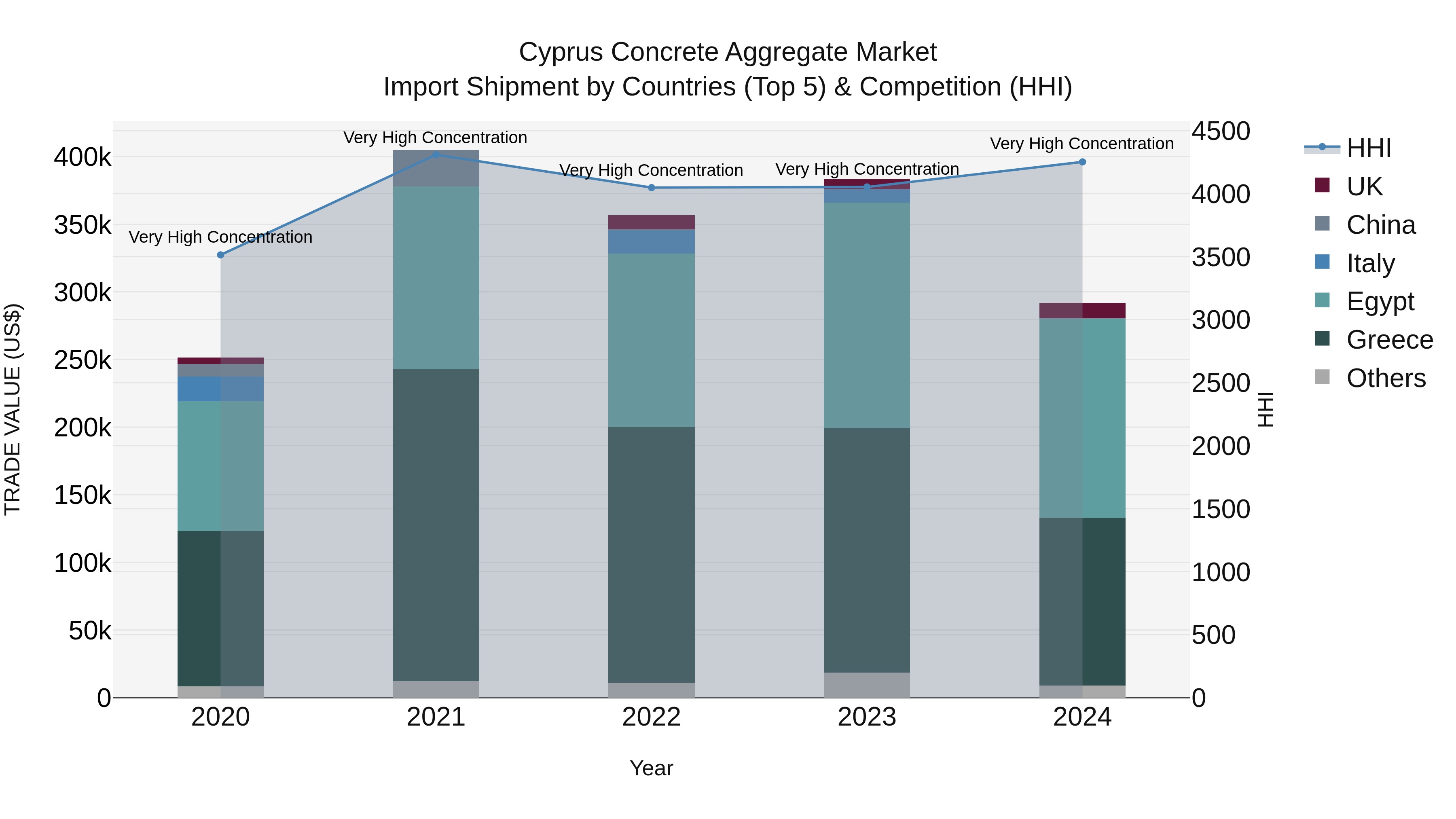
Cyprus Concrete Aggregate Market Import Shipment by Countries (Top 5) & Competition (HHI)
In 2024, Cyprus continued to rely on concrete aggregate imports, with key suppliers being Egypt, Greece, UK, Turkey, and Belgium. The market showed high concentration levels with a stable HHI. Despite a positive CAGR of 3.78% from 2020 to 2024, there was a concerning decline in growth rate from 2023 to 2024 at -23.88%. This suggests a potential shift or challenge in the market dynamics that importers and industry players should closely monitor for strategic decision-making.
Key Highlights of the Report:
- Cyprus Concrete Aggregate Market Outlook
- Market Size of Cyprus Concrete Aggregate Market, 2024
- Forecast of Cyprus Concrete Aggregate Market, 2031
- Historical Data and Forecast of Cyprus Concrete Aggregate Revenues & Volume for the Period 2021-2031
- Cyprus Concrete Aggregate Market Trend Evolution
- Cyprus Concrete Aggregate Market Drivers and Challenges
- Cyprus Concrete Aggregate Price Trends
- Cyprus Concrete Aggregate Porter`s Five Forces
- Cyprus Concrete Aggregate Industry Life Cycle
- Historical Data and Forecast of Cyprus Concrete Aggregate Market Revenues & Volume By Production for the Period 2021-2031
- Historical Data and Forecast of Cyprus Concrete Aggregate Market Revenues & Volume By Natural for the Period 2021-2031
- Historical Data and Forecast of Cyprus Concrete Aggregate Market Revenues & Volume By Artificial for the Period 2021-2031
- Historical Data and Forecast of Cyprus Concrete Aggregate Market Revenues & Volume By Processed for the Period 2021-2031
- Historical Data and Forecast of Cyprus Concrete Aggregate Market Revenues & Volume By Glass Ceramics for the Period 2021-2031
- Historical Data and Forecast of Cyprus Concrete Aggregate Market Revenues & Volume By Manufactured Marbles for the Period 2021-2031
- Historical Data and Forecast of Cyprus Concrete Aggregate Market Revenues & Volume By Bulk Density for the Period 2021-2031
- Historical Data and Forecast of Cyprus Concrete Aggregate Market Revenues & Volume By ASTM C33 for the Period 2021-2031
- Historical Data and Forecast of Cyprus Concrete Aggregate Market Revenues & Volume By mechanical properties for the Period 2021-2031
- Historical Data and Forecast of Cyprus Concrete Aggregate Market Revenues & Volume By Abrasive power for the Period 2021-2031
- Historical Data and Forecast of Cyprus Concrete Aggregate Market Revenues & Volume By Particle Size for the Period 2021-2031
- Historical Data and Forecast of Cyprus Concrete Aggregate Market Revenues & Volume By Fine Aggregates for the Period 2021-2031
- Historical Data and Forecast of Cyprus Concrete Aggregate Market Revenues & Volume By Coarse Aggregate for the Period 2021-2031
- Cyprus Concrete Aggregate Import Export Trade Statistics
- Market Opportunity Assessment By Production
- Market Opportunity Assessment By Bulk Density
- Market Opportunity Assessment By mechanical properties
- Market Opportunity Assessment By Particle Size
- Cyprus Concrete Aggregate Top Companies Market Share
- Cyprus Concrete Aggregate Competitive Benchmarking By Technical and Operational Parameters
- Cyprus Concrete Aggregate Company Profiles
- Cyprus Concrete Aggregate Key Strategic Recommendations






































