Cyprus Construction Glass Market Size Growth Rate
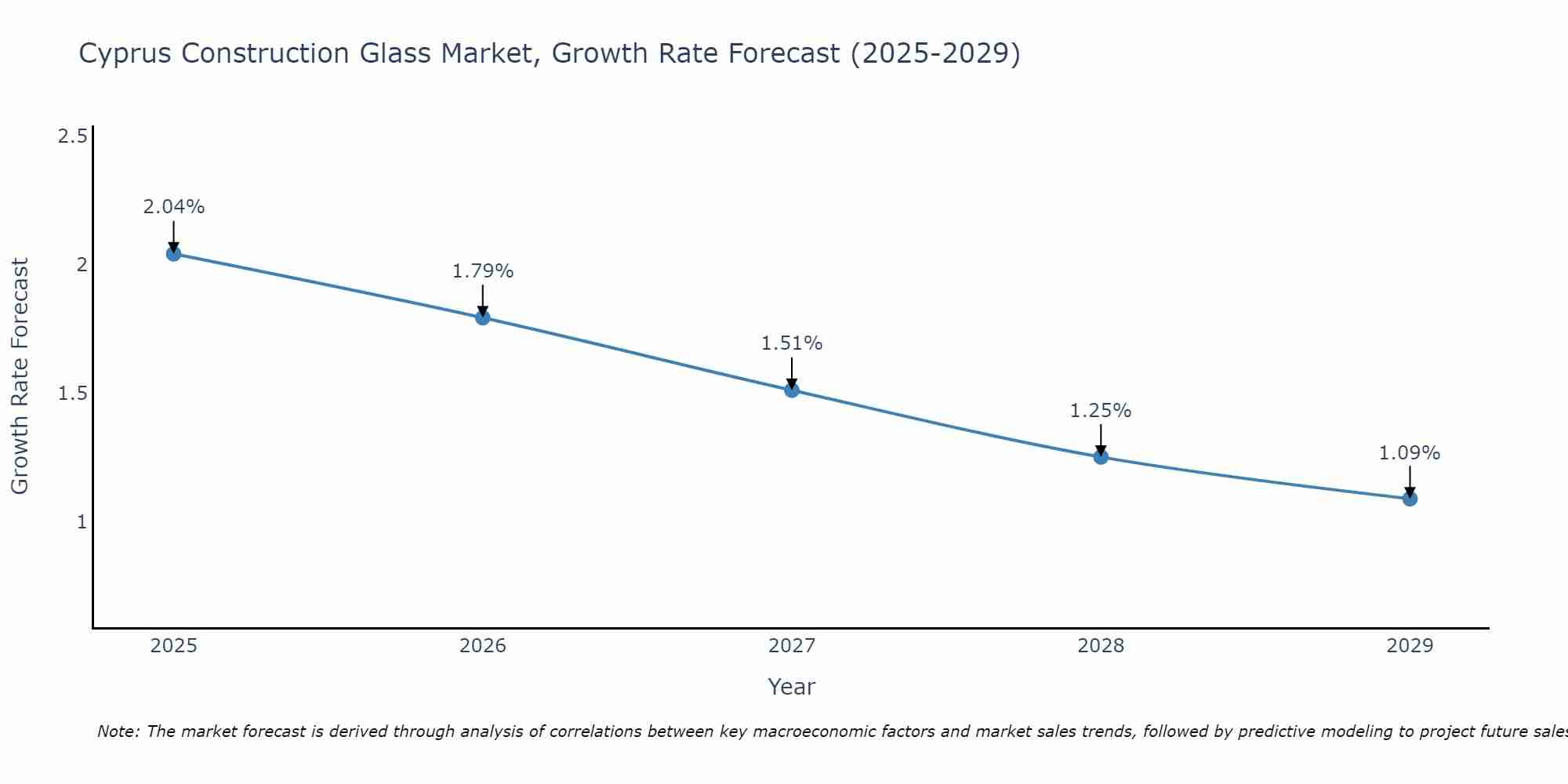
The Cyprus Construction Glass Market could see a tapering of growth rates over 2025 to 2029. Although the growth rate starts strong at 2.04% in 2025, it steadily loses momentum, ending at 1.09% by 2029.
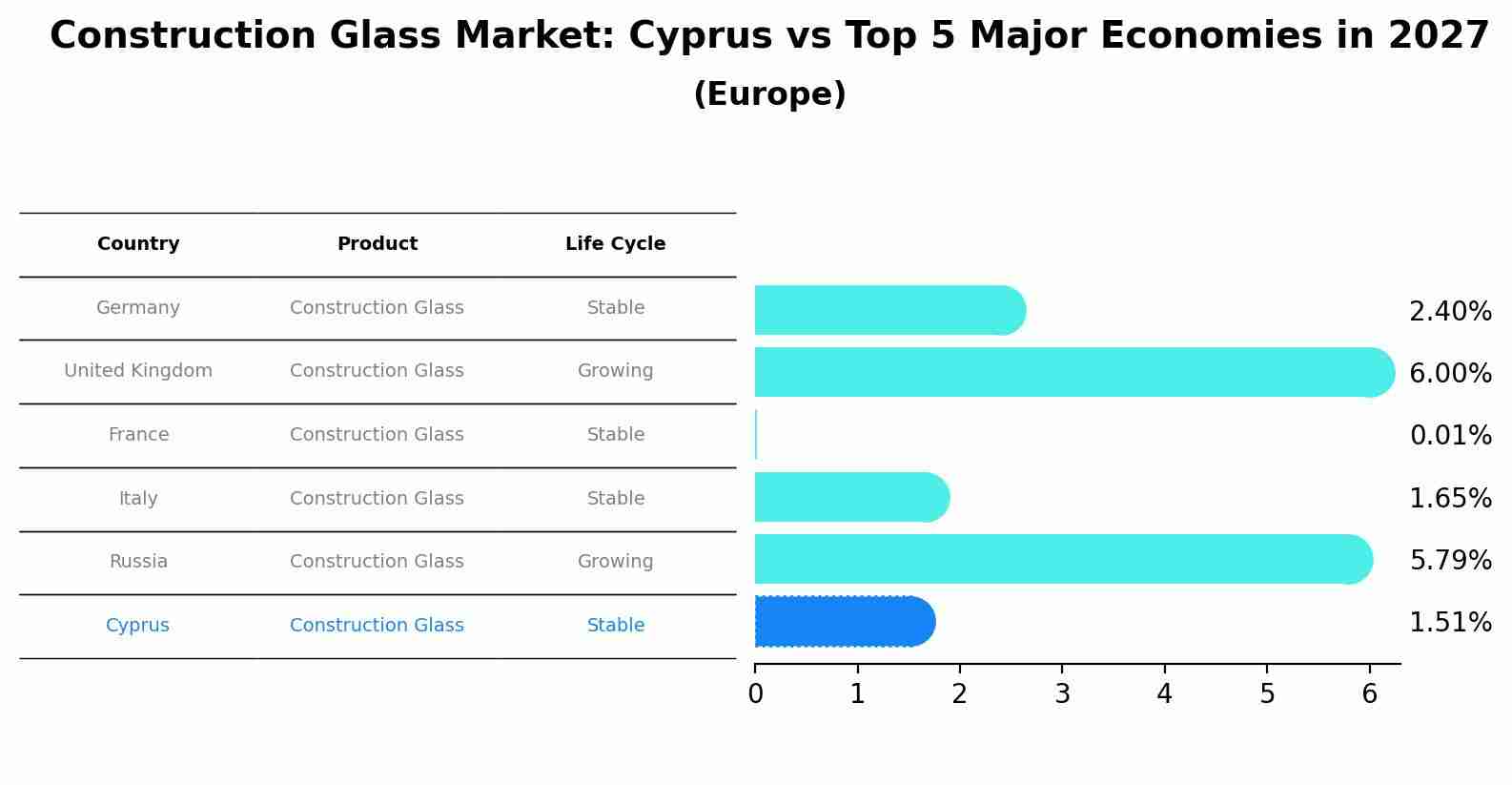
Construction Glass Market: Cyprus vs Top 5 Major Economies in 2027 (Europe)
By 2027, Cyprus's Construction Glass market is forecasted to achieve a stable growth rate of 1.51%, with Germany leading the Europe region, followed by United Kingdom, France, Italy and Russia.
Cyprus Construction Glass Market Overview
The construction glass market in Cyprus is witnessing growth driven by the rising demand for energy-efficient and aesthetically appealing building materials. Glass is increasingly used in commercial and residential buildings for windows, facades, and partitions, offering benefits such as natural light and thermal insulation. The trend towards green building practices is encouraging the adoption of advanced glazing technologies, including low-emissivity and solar control glass. As architectural designs evolve, the construction glass market is expected to expand, reflecting the increasing emphasis on sustainability and design in the construction sector.
Drivers of the market
The construction glass market in Cyprus is driven by the increasing demand for energy-efficient and aesthetically appealing building materials. As the construction industry seeks to enhance the design and functionality of structures, the use of glass in facades, windows, and partitions is becoming more prevalent. The growing focus on sustainable building practices and energy efficiency is also influencing market growth, as manufacturers are developing advanced glass solutions that minimize heat gain and improve insulation. Additionally, advancements in glass processing technologies are enabling the production of innovative glass products that meet the evolving needs of architects and builders.
Challenges of the market
The Construction Glass market in Cyprus faces challenges related to increasing competition from alternative building materials, which can impact demand for glass products. Additionally, fluctuating raw material prices can create uncertainty for manufacturers, affecting production costs and pricing strategies. Limited awareness among architects and builders about the benefits of advanced glass technologies, such as energy efficiency and aesthetics, may also hinder market growth. The market`s small size may restrict investment opportunities for innovation, making it challenging for companies to develop new glass solutions.
Government Policy of the market
Energy efficiency initiatives from the government drive the demand for construction glass. Subsidies for green building projects and compliance with EU energy-saving directives boost the market for advanced construction glass solutions.
Key Highlights of the Report:
- Cyprus Construction Glass Market Outlook
- Market Size of Cyprus Construction Glass Market, 2024
- Forecast of Cyprus Construction Glass Market, 2031
- Historical Data and Forecast of Cyprus Construction Glass Revenues & Volume for the Period 2021-2031
- Cyprus Construction Glass Market Trend Evolution
- Cyprus Construction Glass Market Drivers and Challenges
- Cyprus Construction Glass Price Trends
- Cyprus Construction Glass Porter`s Five Forces
- Cyprus Construction Glass Industry Life Cycle
- Historical Data and Forecast of Cyprus Construction Glass Market Revenues & Volume By Chemical Composition for the Period 2021-2031
- Historical Data and Forecast of Cyprus Construction Glass Market Revenues & Volume By Soda-lime for the Period 2021-2031
- Historical Data and Forecast of Cyprus Construction Glass Market Revenues & Volume By Potash-lime for the Period 2021-2031
- Historical Data and Forecast of Cyprus Construction Glass Market Revenues & Volume By Potash-lead for the Period 2021-2031
- Historical Data and Forecast of Cyprus Construction Glass Market Revenues & Volume By Type for the Period 2021-2031
- Historical Data and Forecast of Cyprus Construction Glass Market Revenues & Volume By Low-e Glass for the Period 2021-2031
- Historical Data and Forecast of Cyprus Construction Glass Market Revenues & Volume By Special Glass for the Period 2021-2031
- Historical Data and Forecast of Cyprus Construction Glass Market Revenues & Volume By Manufacturing Process for the Period 2021-2031
- Historical Data and Forecast of Cyprus Construction Glass Market Revenues & Volume By Float Process for the Period 2021-2031
- Historical Data and Forecast of Cyprus Construction Glass Market Revenues & Volume By Rolled/sheet Process for the Period 2021-2031
- Historical Data and Forecast of Cyprus Construction Glass Market Revenues & Volume By Application for the Period 2021-2031
- Historical Data and Forecast of Cyprus Construction Glass Market Revenues & Volume By Residential for the Period 2021-2031
- Historical Data and Forecast of Cyprus Construction Glass Market Revenues & Volume By Commercial for the Period 2021-2031
- Historical Data and Forecast of Cyprus Construction Glass Market Revenues & Volume By Others for the Period 2021-2031
- Cyprus Construction Glass Import Export Trade Statistics
- Market Opportunity Assessment By Chemical Composition
- Market Opportunity Assessment By Type
- Market Opportunity Assessment By Manufacturing Process
- Market Opportunity Assessment By Application
- Cyprus Construction Glass Top Companies Market Share
- Cyprus Construction Glass Competitive Benchmarking By Technical and Operational Parameters
- Cyprus Construction Glass Company Profiles
- Cyprus Construction Glass Key Strategic Recommendations






































