Cyprus Converter Transformer Market Size (2020-2030)
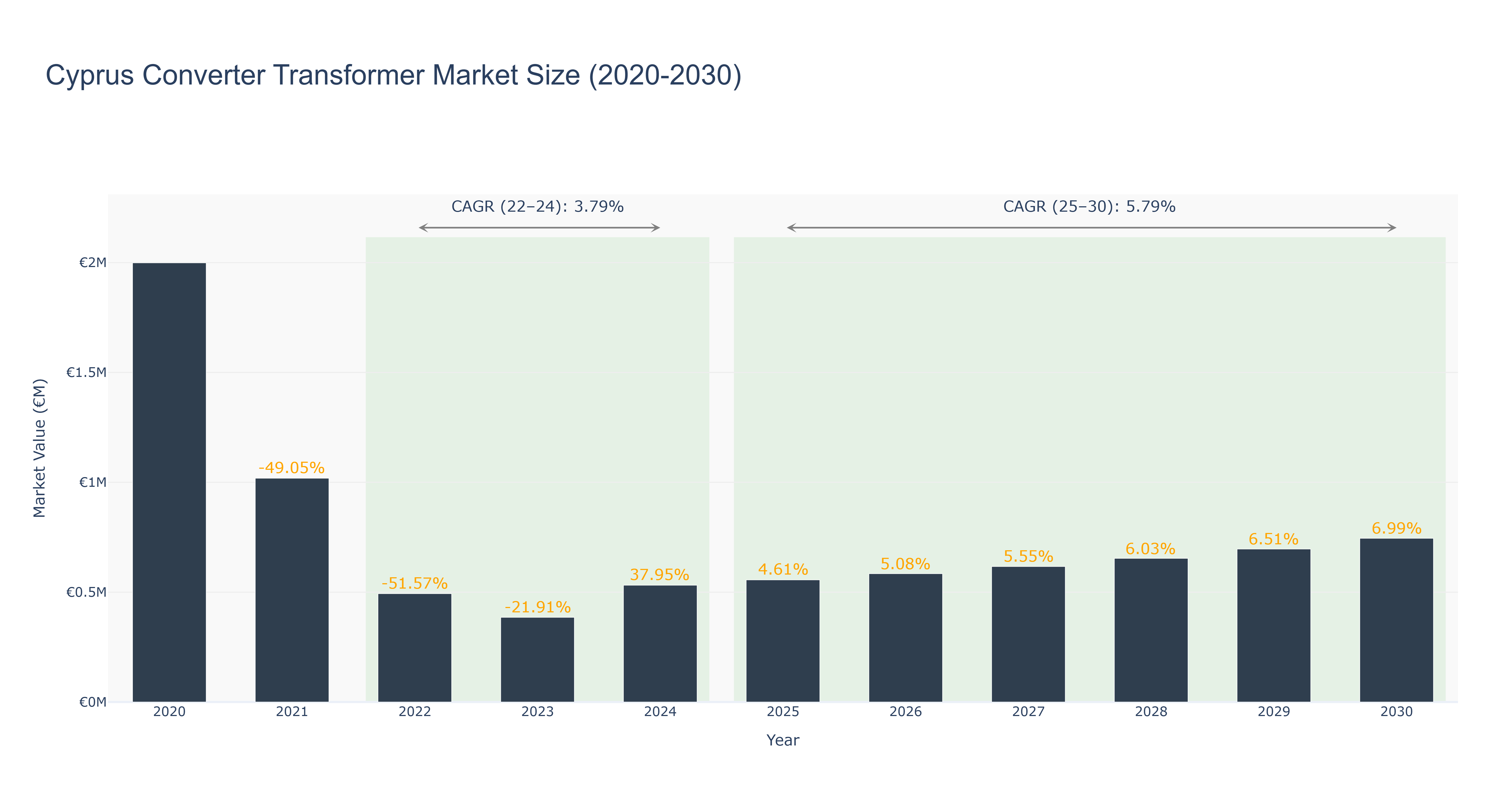
Cyprus Converter Transformer Market has seen a significant decline in market size from €2.00 million in 2020 to €0.39 million in 2022, primarily driven by a sharp negative growth rate. However, from 2024 onwards, the market has shown a positive trend, with the market size reaching €0.75 million in 2030. The CAGR for the period 2022-24 stands at 3.79%, while for 2025-30, it is projected to be 5.79%. The initial downturn can be attributed to market adjustments and external economic factors, while the subsequent growth reflects industry stabilization and increased demand for converter transformers. Looking ahead, recent developments in renewable energy projects in Cyprus are set to drive the demand for converter transformers, indicating a positive outlook for the market in the near future.
Cyprus Converter Transformer Market: Production & Trade Performance (2019-2025)
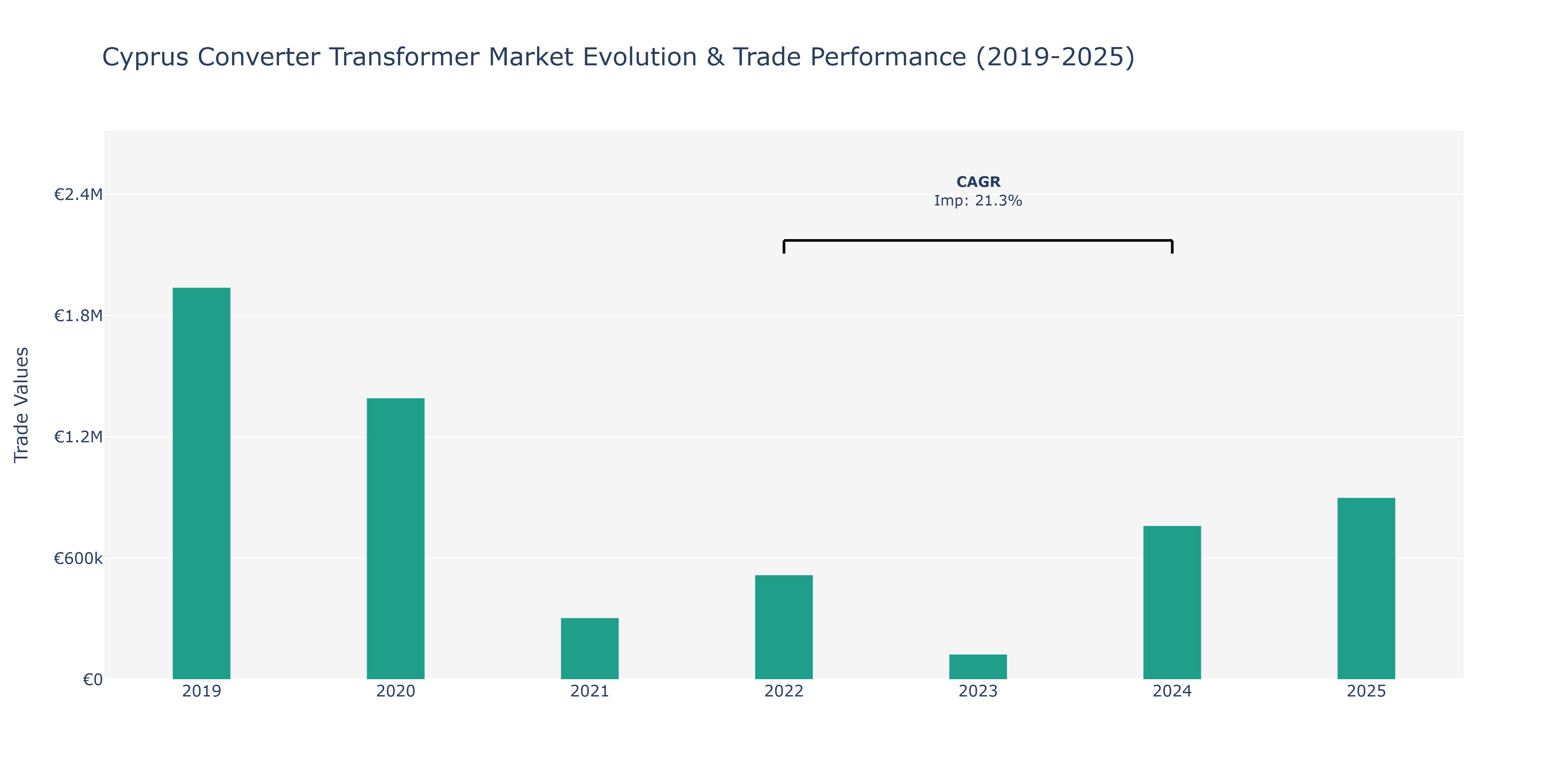
Imports in the Cyprus Converter Transformer Market showed volatility from 2019 to 2025. Starting at €1.94 million in 2019, imports decreased to €1.39 million in 2020, possibly due to global economic disruptions. However, in 2021, imports significantly dropped to €305.0 thousand, reflecting potential shifts in demand or supply chain challenges. A notable recovery was observed in 2022, with imports increasing to €517.16 thousand, marking a turnaround in market dynamics. The peak point was reached in 2024 at €760.82 thousand, showcasing a positive trajectory possibly influenced by infrastructure projects or modernization initiatives. The year 2025 sustained this growth trend, with imports hitting €899.55 thousand. The steady CAGR of 21.29% from 2022 to 2024 suggests increasing demand for converter transformers driven by renewable energy integration and grid modernization efforts in Cyprus.
Cyprus Converter Transformer Market Overview
The converter transformer market in Cyprus is essential for facilitating efficient power conversion in various applications, including renewable energy and industrial processes. Converter transformers play a critical role in converting alternating current (AC) to direct current (DC) and vice versa, enabling effective power transmission. The increasing focus on renewable energy sources and the need for efficient power distribution are driving demand for converter transformers. As the energy landscape evolves, this market is expected to expand, providing advanced solutions for power management.
Drivers of the market
The converter transformer market in Cyprus is driven by the increasing demand for renewable energy integration and grid modernization. These transformers play a crucial role in high-voltage direct current (HVDC) transmission systems, facilitating the efficient transmission of electricity over long distances.
Challenges of the market
The Converter Transformer market in Cyprus faces challenges related to fluctuating demand from the energy sector, which can impact production stability. The limited scale of the market may restrict manufacturers` ability to invest in advanced technologies and R&D, making it difficult to innovate. Additionally, competition from imported transformers can exert downward pressure on pricing, further complicating market dynamics. Regulatory challenges and the need for compliance with international standards also add complexity to the operational environment.
Government Policy of the market
Government support for energy infrastructure, particularly renewable energy projects, drives demand for converter transformers. Cyprus adheres to EU energy efficiency and environmental standards, which shape market trends.
Key Highlights of the Report:
- Cyprus Converter Transformer Market Outlook
- Market Size of Cyprus Converter Transformer Market, 2024
- Forecast of Cyprus Converter Transformer Market, 2031
- Historical Data and Forecast of Cyprus Converter Transformer Revenues & Volume for the Period 2021-2031
- Cyprus Converter Transformer Market Trend Evolution
- Cyprus Converter Transformer Market Drivers and Challenges
- Cyprus Converter Transformer Price Trends
- Cyprus Converter Transformer Porter`s Five Forces
- Cyprus Converter Transformer Industry Life Cycle
- Historical Data and Forecast of Cyprus Converter Transformer Market Revenues & Volume By Configuration for the Period 2021-2031
- Historical Data and Forecast of Cyprus Converter Transformer Market Revenues & Volume By Back-to-Back for the Period 2021-2031
- Historical Data and Forecast of Cyprus Converter Transformer Market Revenues & Volume By Monopolar for the Period 2021-2031
- Historical Data and Forecast of Cyprus Converter Transformer Market Revenues & Volume By Bipolar for the Period 2021-2031
- Historical Data and Forecast of Cyprus Converter Transformer Market Revenues & Volume By Multi-terminal for the Period 2021-2031
- Historical Data and Forecast of Cyprus Converter Transformer Market Revenues & Volume By Application for the Period 2021-2031
- Historical Data and Forecast of Cyprus Converter Transformer Market Revenues & Volume By Windfarms for the Period 2021-2031
- Historical Data and Forecast of Cyprus Converter Transformer Market Revenues & Volume By Oil & Gas for the Period 2021-2031
- Historical Data and Forecast of Cyprus Converter Transformer Market Revenues & Volume By Grid interconnections for the Period 2021-2031
- Cyprus Converter Transformer Import Export Trade Statistics
- Market Opportunity Assessment By Configuration
- Market Opportunity Assessment By Application
- Cyprus Converter Transformer Top Companies Market Share
- Cyprus Converter Transformer Competitive Benchmarking By Technical and Operational Parameters
- Cyprus Converter Transformer Company Profiles
- Cyprus Converter Transformer Key Strategic Recommendations






































