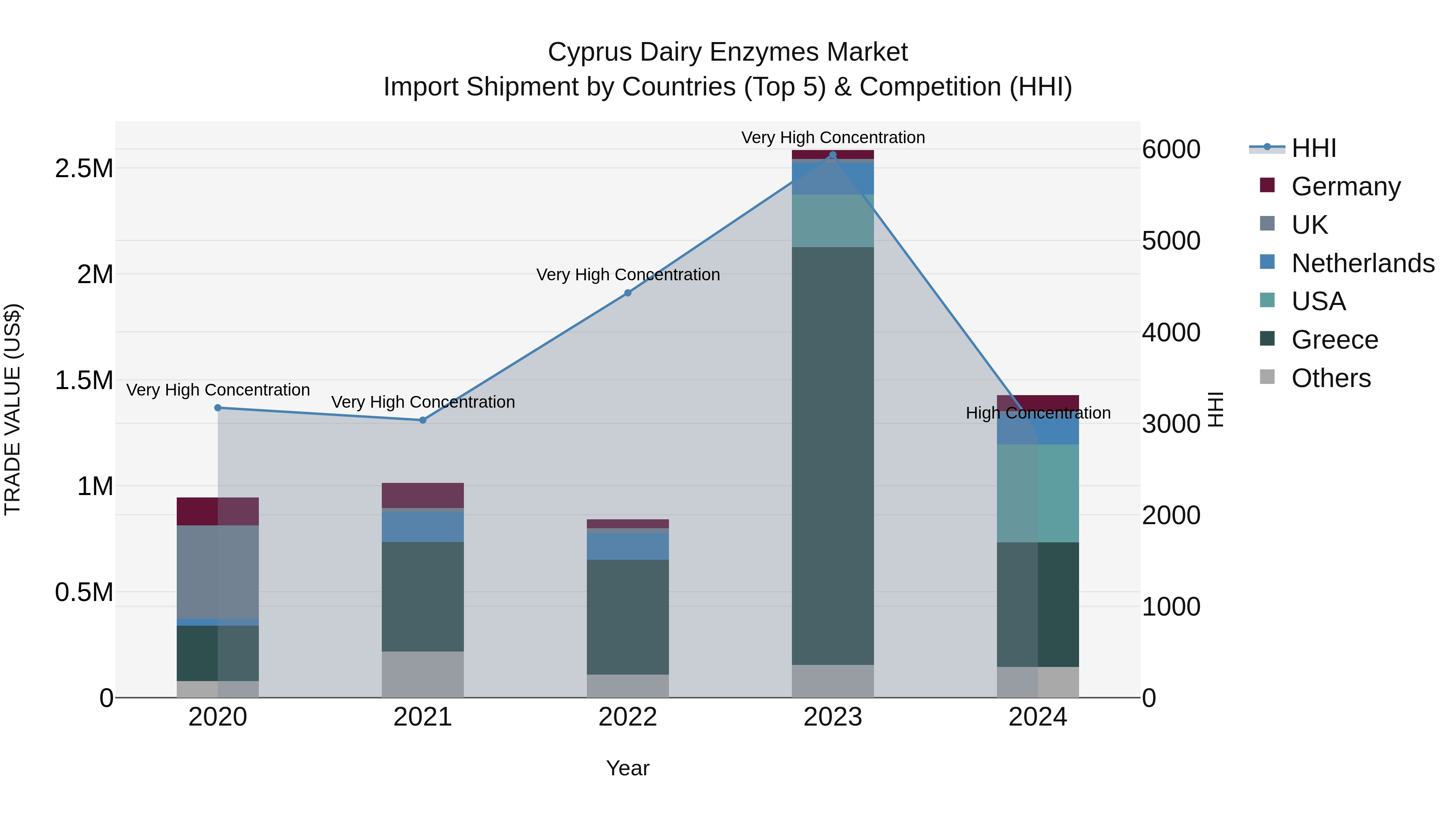
Cyprus Dairy Enzymes Market Import Shipment by Countries (Top 5) & Competition (HHI)
In 2024, Cyprus continued to rely on imports of dairy enzymes, with top exporters being Greece, USA, Netherlands, Belgium, and Germany. The market witnessed a shift in market concentration from very high in 2023 to high in 2024, indicating a more competitive landscape. Despite a negative growth rate of -44.76% in 2024, the compound annual growth rate (CAGR) from 2020-24 stood at a healthy 10.84%, suggesting long-term growth potential in the Cyprus dairy enzymes market. This changing dynamic calls for a strategic approach to market entry and expansion for both current and potential exporters.
Cyprus Dairy Enzymes Market Overview
The Cyprus dairy enzymes market is expanding due to the growing dairy industry and increasing demand for processed dairy products. Dairy enzymes play a crucial role in improving product texture, flavor, and shelf life, catering to the preferences of the local population as well as exports. With health-conscious consumers demanding lactose-free and low-fat options, enzyme innovation is becoming pivotal. The market is also supported by advancements in biotechnology and enzyme formulations, which enhance production efficiency.
Drivers of the market
The Cyprus dairy enzymes market is primarily driven by the increasing demand for cheese, yogurt, and other dairy products. As consumers become more health-conscious, there is a growing interest in products containing natural enzymes that enhance flavor and improve digestibility. Additionally, technological advancements in enzyme production and application in dairy processing are fueling market growth, enabling manufacturers to produce high-quality dairy products that meet evolving consumer preferences.
Challenges of the market
The Cyprus dairy enzymes market faces several challenges, primarily related to regulatory compliance and product quality assurance. Stricter regulations imposed by health authorities necessitate thorough testing and certification of enzymes used in dairy processing. Moreover, the demand for high-quality enzymes that enhance product consistency and nutritional value can strain manufacturers, as they need to invest in advanced technologies and skilled personnel. Additionally, competition from synthetic alternatives presents a challenge, as dairy producers may opt for cost-effective solutions over natural enzymes.
Government Policy of the market
The Cyprus government has implemented supportive policies aimed at enhancing the dairy sector, particularly in enzyme usage. These policies include research grants for developing innovative dairy products and training programs for local farmers to optimize enzyme applications in production. Additionally, regulations are in place to ensure the quality and safety of dairy enzymes, which helps maintain consumer trust and compliance with European Union standards.
Key Highlights of the Report:
- Cyprus Dairy Enzymes Market Outlook
- Market Size of Cyprus Dairy Enzymes Market, 2024
- Forecast of Cyprus Dairy Enzymes Market, 2031
- Historical Data and Forecast of Cyprus Dairy Enzymes Revenues & Volume for the Period 2021-2031
- Cyprus Dairy Enzymes Market Trend Evolution
- Cyprus Dairy Enzymes Market Drivers and Challenges
- Cyprus Dairy Enzymes Price Trends
- Cyprus Dairy Enzymes Porter`s Five Forces
- Cyprus Dairy Enzymes Industry Life Cycle
- Historical Data and Forecast of Cyprus Dairy Enzymes Market Revenues & Volume By Type for the Period 2021-2031
- Historical Data and Forecast of Cyprus Dairy Enzymes Market Revenues & Volume By Lactase for the Period 2021-2031
- Historical Data and Forecast of Cyprus Dairy Enzymes Market Revenues & Volume By Chymosin for the Period 2021-2031
- Historical Data and Forecast of Cyprus Dairy Enzymes Market Revenues & Volume By Microbial Rennet for the Period 2021-2031
- Historical Data and Forecast of Cyprus Dairy Enzymes Market Revenues & Volume By Lipase for the Period 2021-2031
- Historical Data and Forecast of Cyprus Dairy Enzymes Market Revenues & Volume By Application for the Period 2021-2031
- Historical Data and Forecast of Cyprus Dairy Enzymes Market Revenues & Volume By Milk for the Period 2021-2031
- Historical Data and Forecast of Cyprus Dairy Enzymes Market Revenues & Volume By Cheese for the Period 2021-2031
- Historical Data and Forecast of Cyprus Dairy Enzymes Market Revenues & Volume By Ice Cream & Desserts for the Period 2021-2031
- Historical Data and Forecast of Cyprus Dairy Enzymes Market Revenues & Volume By Yogurt for the Period 2021-2031
- Historical Data and Forecast of Cyprus Dairy Enzymes Market Revenues & Volume By Whey for the Period 2021-2031
- Historical Data and Forecast of Cyprus Dairy Enzymes Market Revenues & Volume By Infant Formula for the Period 2021-2031
- Historical Data and Forecast of Cyprus Dairy Enzymes Market Revenues & Volume By Source for the Period 2021-2031
- Historical Data and Forecast of Cyprus Dairy Enzymes Market Revenues & Volume By Plant for the Period 2021-2031
- Historical Data and Forecast of Cyprus Dairy Enzymes Market Revenues & Volume By Animal & Microorganism for the Period 2021-2031
- Cyprus Dairy Enzymes Import Export Trade Statistics
- Market Opportunity Assessment By Type
- Market Opportunity Assessment By Application
- Market Opportunity Assessment By Source
- Cyprus Dairy Enzymes Top Companies Market Share
- Cyprus Dairy Enzymes Competitive Benchmarking By Technical and Operational Parameters
- Cyprus Dairy Enzymes Company Profiles
- Cyprus Dairy Enzymes Key Strategic Recommendations






































