Cyprus Glycerol Market Size (2020-2030)
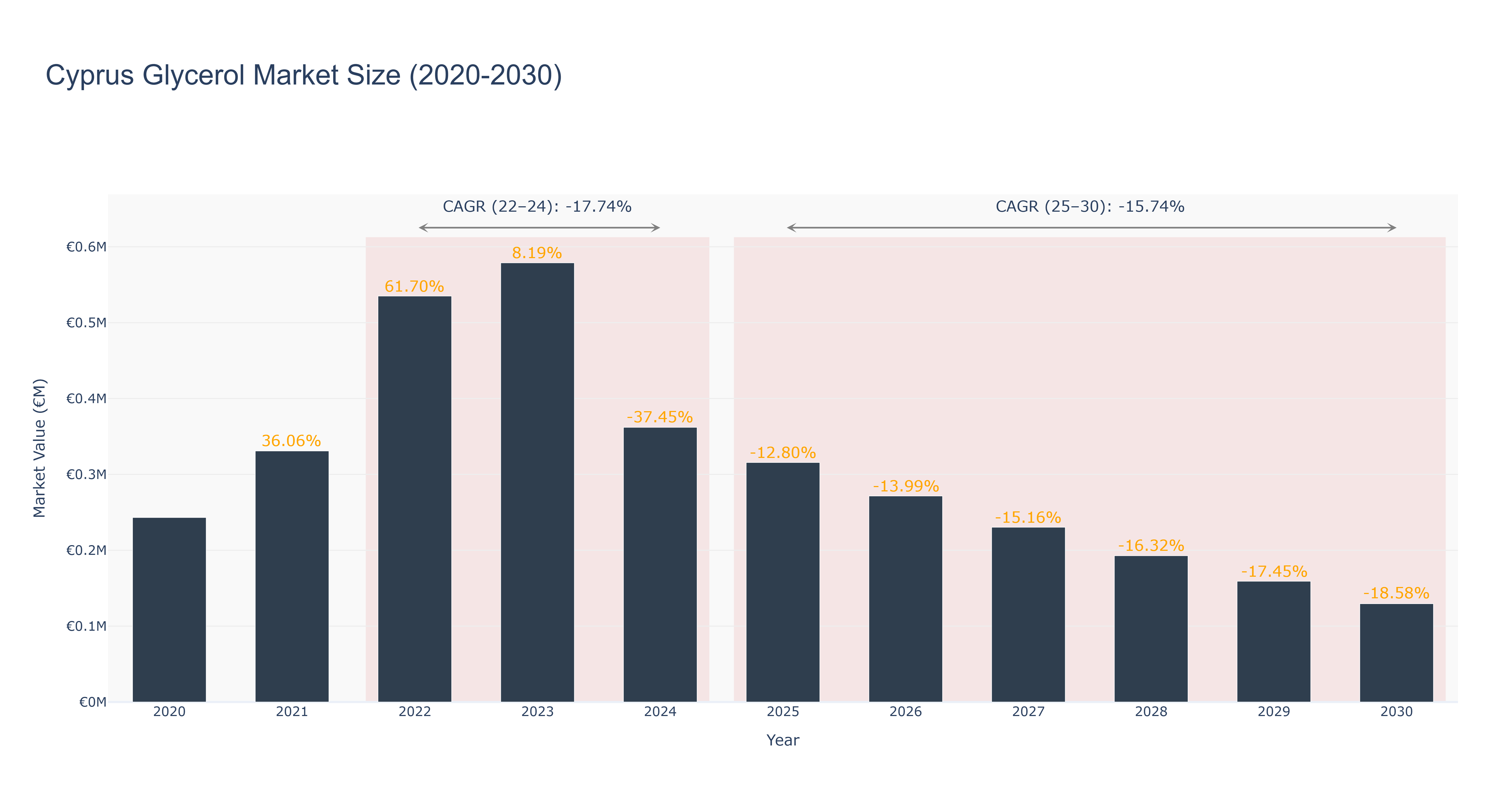
Cyprus Glycerol Market has seen a fluctuating trend in recent years. The market peaked at €0.58 million in 2023, followed by a sharp decline to €0.36 million in 2024. The forecasted market size is expected to decrease further to €0.13 million by 2030, with a CAGR of -15.74% from 2025 to 2030. The market's downfall can be attributed to factors such as changing consumer preferences, economic uncertainties, and regulatory challenges. However, ongoing efforts to enhance production efficiency and explore new applications are expected to drive growth in the coming years. In line with these developments, Cyprus is set to launch a sustainability initiative in the glycerol industry, focusing on renewable sourcing and eco-friendly production methods to boost market competitiveness.
Cyprus Glycerol Market: Production & Trade Performance (2019-2025)
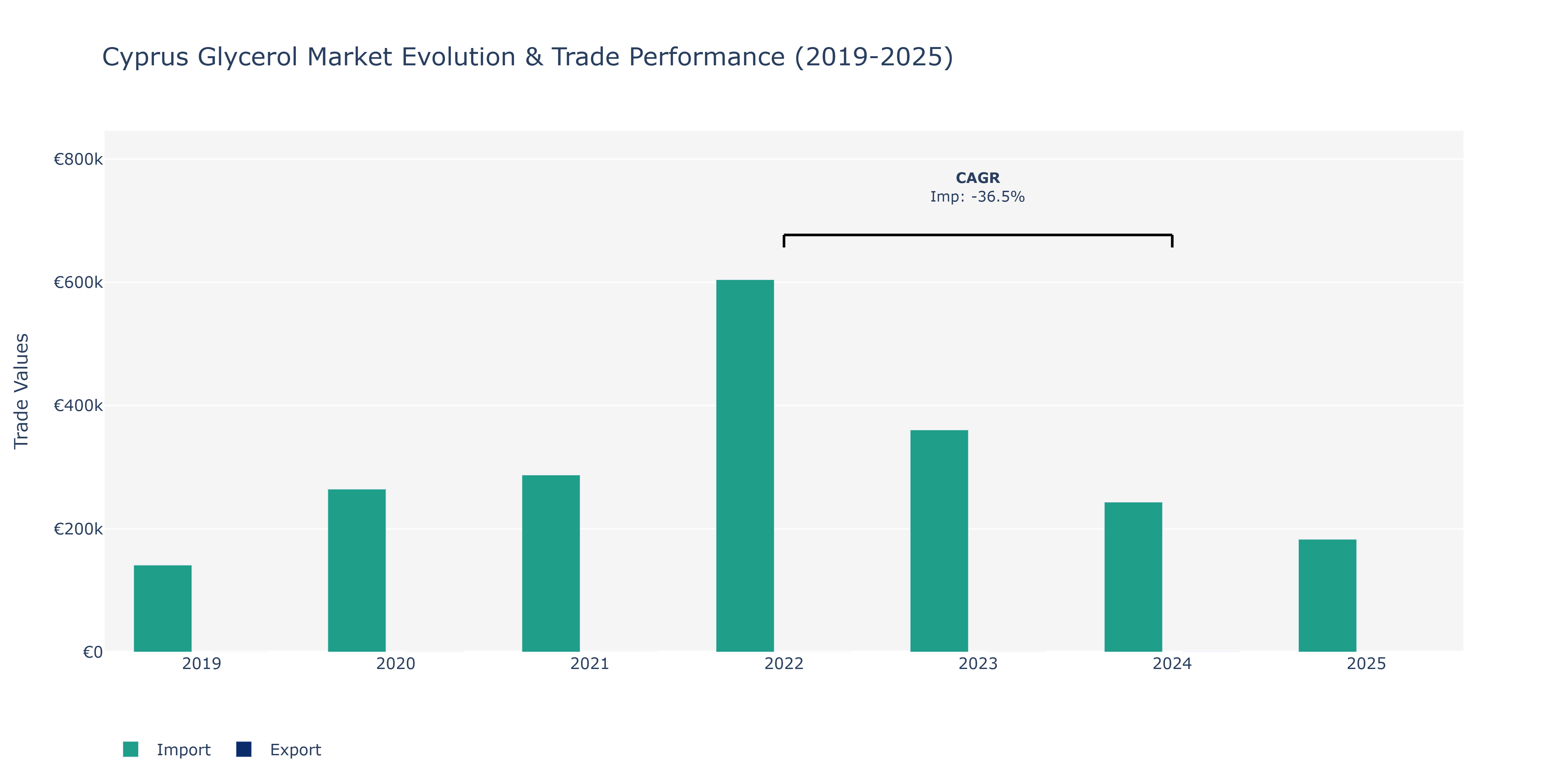
Between 2019 and 2025, Cyprus experienced notable fluctuations in its Glycerol market for exports and imports. In 2019, imports stood at €141.15 thousand, showing a substantial increase in 2020 to €264.41 thousand, with a further rise to €287.39 thousand in 2021. The year 2022 saw a significant surge in imports, reaching €604.43 thousand, potentially driven by increased industrial demand for glycerol in various sectors. However, a decline was observed in 2023 with exports at €261 thousand and imports at €360.52 thousand, possibly due to changing global market dynamics affecting trade patterns. The market rebounded in 2024 with exports reaching €390 thousand and imports at €243.43 thousand, showcasing potential shifts in supply chain strategies. The sudden drop in imports in 2025 to €183 thousand could be attributed to evolving regulatory frameworks impacting trade flows. These fluctuations highlight the market's sensitivity to global economic conditions and regulatory changes, necessitating adaptive strategies for stakeholders in Cyprus' Glycerol market.
Cyprus Glycerol Market Overview
Glycerol, a byproduct of biodiesel production, finds extensive use in the pharmaceutical and food industries. The Cyprus glycerol market is expanding due to increased production of biodiesel and its applications in personal care products, food preservatives, and chemical synthesis.
Drivers of the market
The Cyprus glycerol market is supported by its applications across multiple sectors such as pharmaceuticals, food, cosmetics, and chemical industries. As glycerol is a key byproduct in biodiesel production, the growth in biofuels has indirectly bolstered the glycerol market. Additionally, increased demand for eco-friendly and biodegradable products in personal care and food industries is further fueling market expansion.
Challenges of the market
The glycerol market faces challenges from cheaper synthetic substitutes. Furthermore, the market is impacted by fluctuating crude oil prices, as glycerol is often derived as a byproduct from biodiesel production. This volatility can affect production costs and market pricing. The need for product differentiation and sustainable sourcing is also becoming increasingly important in attracting environmentally conscious consumers.
Government Policy of the market
Glycerol, a key derivative of glycerin, is increasingly in demand in the cosmetics and food industries in Cyprus. The government encourages the development of this market by promoting innovation in glycerol extraction techniques and providing financial support for research initiatives aimed at expanding its applications.
Key Highlights of the Report:
- Cyprus Glycerol Market Outlook
- Market Size of Cyprus Glycerol Market, 2024
- Forecast of Cyprus Glycerol Market, 2031
- Historical Data and Forecast of Cyprus Glycerol Revenues & Volume for the Period 2021-2031
- Cyprus Glycerol Market Trend Evolution
- Cyprus Glycerol Market Drivers and Challenges
- Cyprus Glycerol Price Trends
- Cyprus Glycerol Porter`s Five Forces
- Cyprus Glycerol Industry Life Cycle
- Historical Data and Forecast of Cyprus Glycerol Market Revenues & Volume By Source for the Period 2021-2031
- Historical Data and Forecast of Cyprus Glycerol Market Revenues & Volume By Biodiesel for the Period 2021-2031
- Historical Data and Forecast of Cyprus Glycerol Market Revenues & Volume By Fatty Alcohols for the Period 2021-2031
- Historical Data and Forecast of Cyprus Glycerol Market Revenues & Volume By Fatty Acids for the Period 2021-2031
- Historical Data and Forecast of Cyprus Glycerol Market Revenues & Volume By Soap for the Period 2021-2031
- Historical Data and Forecast of Cyprus Glycerol Market Revenues & Volume By Type for the Period 2021-2031
- Historical Data and Forecast of Cyprus Glycerol Market Revenues & Volume By Crude for the Period 2021-2031
- Historical Data and Forecast of Cyprus Glycerol Market Revenues & Volume By Refined for the Period 2021-2031
- Historical Data and Forecast of Cyprus Glycerol Market Revenues & Volume By End-use for the Period 2021-2031
- Historical Data and Forecast of Cyprus Glycerol Market Revenues & Volume By Food & Beverage for the Period 2021-2031
- Historical Data and Forecast of Cyprus Glycerol Market Revenues & Volume By Pharmaceutical for the Period 2021-2031
- Historical Data and Forecast of Cyprus Glycerol Market Revenues & Volume By Nutraceutical for the Period 2021-2031
- Historical Data and Forecast of Cyprus Glycerol Market Revenues & Volume By Personal Care & Cosmetics for the Period 2021-2031
- Historical Data and Forecast of Cyprus Glycerol Market Revenues & Volume By Industrial for the Period 2021-2031
- Historical Data and Forecast of Cyprus Glycerol Market Revenues & Volume By Others for the Period 2021-2031
- Cyprus Glycerol Import Export Trade Statistics
- Market Opportunity Assessment By Source
- Market Opportunity Assessment By Type
- Market Opportunity Assessment By End-use
- Cyprus Glycerol Top Companies Market Share
- Cyprus Glycerol Competitive Benchmarking By Technical and Operational Parameters
- Cyprus Glycerol Company Profiles
- Cyprus Glycerol Key Strategic Recommendations






































