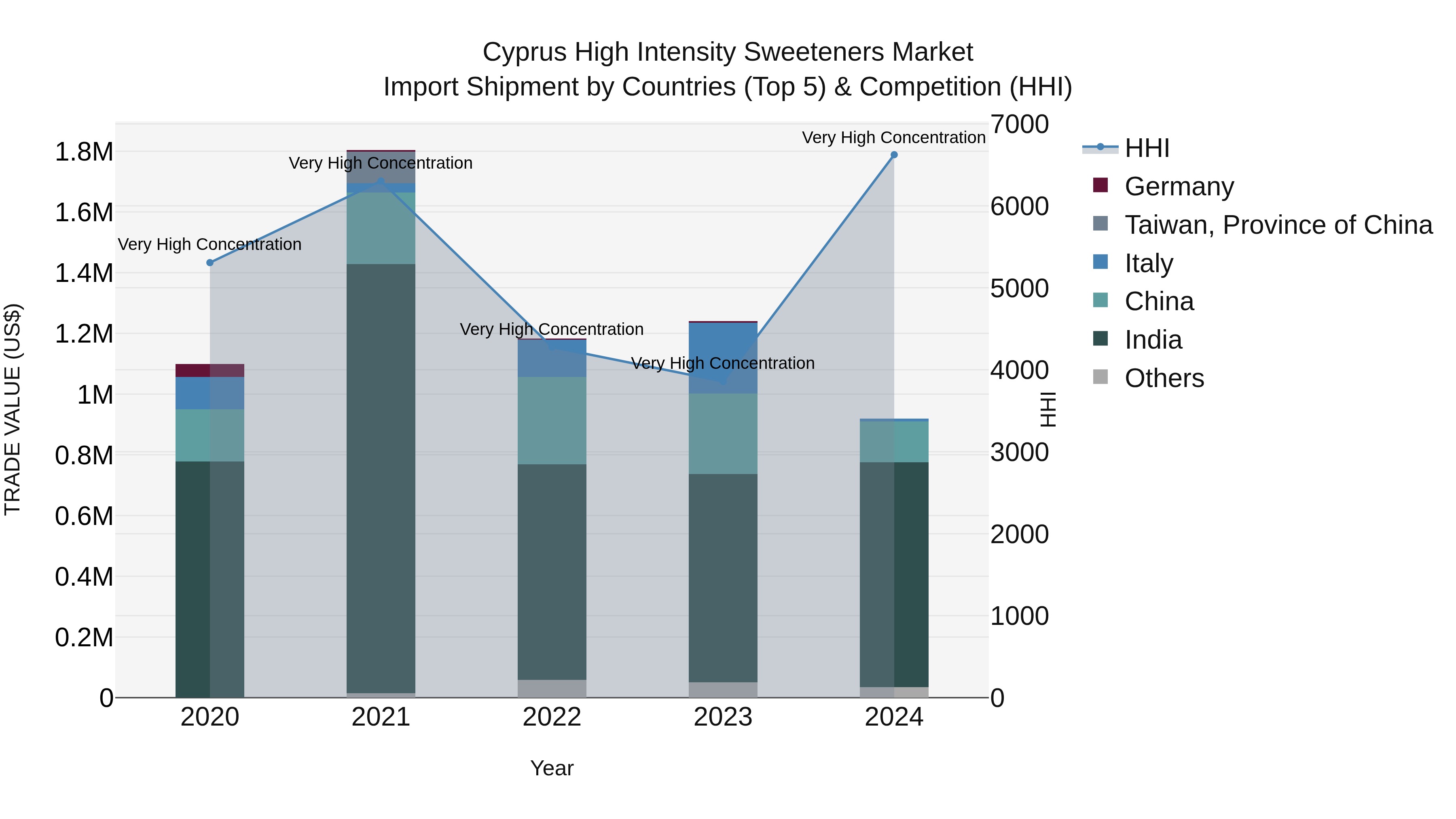
Cyprus High Intensity Sweeteners Market Import Shipment by Countries (Top 5) & Competition (HHI)
Cyprus continues to rely on India, China, Switzerland, Greece, and Italy for its high intensity sweeteners import shipments in 2024. Despite a negative CAGR of -4.37% from 2020 to 2024, the market experienced a significant decline with a growth rate of -25.89% from 2023 to 2024. The high Herfindahl-Hirschman Index (HHI) indicates a concentrated market, suggesting potential challenges for market competition and pricing dynamics in the high intensity sweeteners industry in Cyprus.
Key Highlights of the Report:
- Cyprus High Intensity Sweeteners Market Outlook
- Market Size of Cyprus High Intensity Sweeteners Market,2024
- Forecast of Cyprus High Intensity Sweeteners Market, 2031
- Historical Data and Forecast of Cyprus High Intensity Sweeteners Revenues & Volume for the Period 2021-2031
- Cyprus High Intensity Sweeteners Market Trend Evolution
- Cyprus High Intensity Sweeteners Market Drivers and Challenges
- Cyprus High Intensity Sweeteners Price Trends
- Cyprus High Intensity Sweeteners Porter's Five Forces
- Cyprus High Intensity Sweeteners Industry Life Cycle
- Historical Data and Forecast of Cyprus High Intensity Sweeteners Market Revenues & Volume By Type for the Period 2021-2031
- Historical Data and Forecast of Cyprus High Intensity Sweeteners Market Revenues & Volume By Aspartame for the Period 2021-2031
- Historical Data and Forecast of Cyprus High Intensity Sweeteners Market Revenues & Volume By Saccharin for the Period 2021-2031
- Historical Data and Forecast of Cyprus High Intensity Sweeteners Market Revenues & Volume By Sucralose for the Period 2021-2031
- Historical Data and Forecast of Cyprus High Intensity Sweeteners Market Revenues & Volume By Application for the Period 2021-2031
- Historical Data and Forecast of Cyprus High Intensity Sweeteners Market Revenues & Volume By Food & Beverages for the Period 2021-2031
- Historical Data and Forecast of Cyprus High Intensity Sweeteners Market Revenues & Volume By Pharmaceuticals for the Period 2021-2031
- Historical Data and Forecast of Cyprus High Intensity Sweeteners Market Revenues & Volume By Personal Care for the Period 2021-2031
- Historical Data and Forecast of Cyprus High Intensity Sweeteners Market Revenues & Volume By End User for the Period 2021-2031
- Historical Data and Forecast of Cyprus High Intensity Sweeteners Market Revenues & Volume By Retail for the Period 2021-2031
- Historical Data and Forecast of Cyprus High Intensity Sweeteners Market Revenues & Volume By Industrial for the Period 2021-2031
- Historical Data and Forecast of Cyprus High Intensity Sweeteners Market Revenues & Volume By Commercial for the Period 2021-2031
- Cyprus High Intensity Sweeteners Import Export Trade Statistics
- Market Opportunity Assessment By Type
- Market Opportunity Assessment By Application
- Market Opportunity Assessment By End User
- Cyprus High Intensity Sweeteners Top Companies Market Share
- Cyprus High Intensity Sweeteners Competitive Benchmarking By Technical and Operational Parameters
- Cyprus High Intensity Sweeteners Company Profiles
- Cyprus High Intensity Sweeteners Key Strategic Recommendations






































