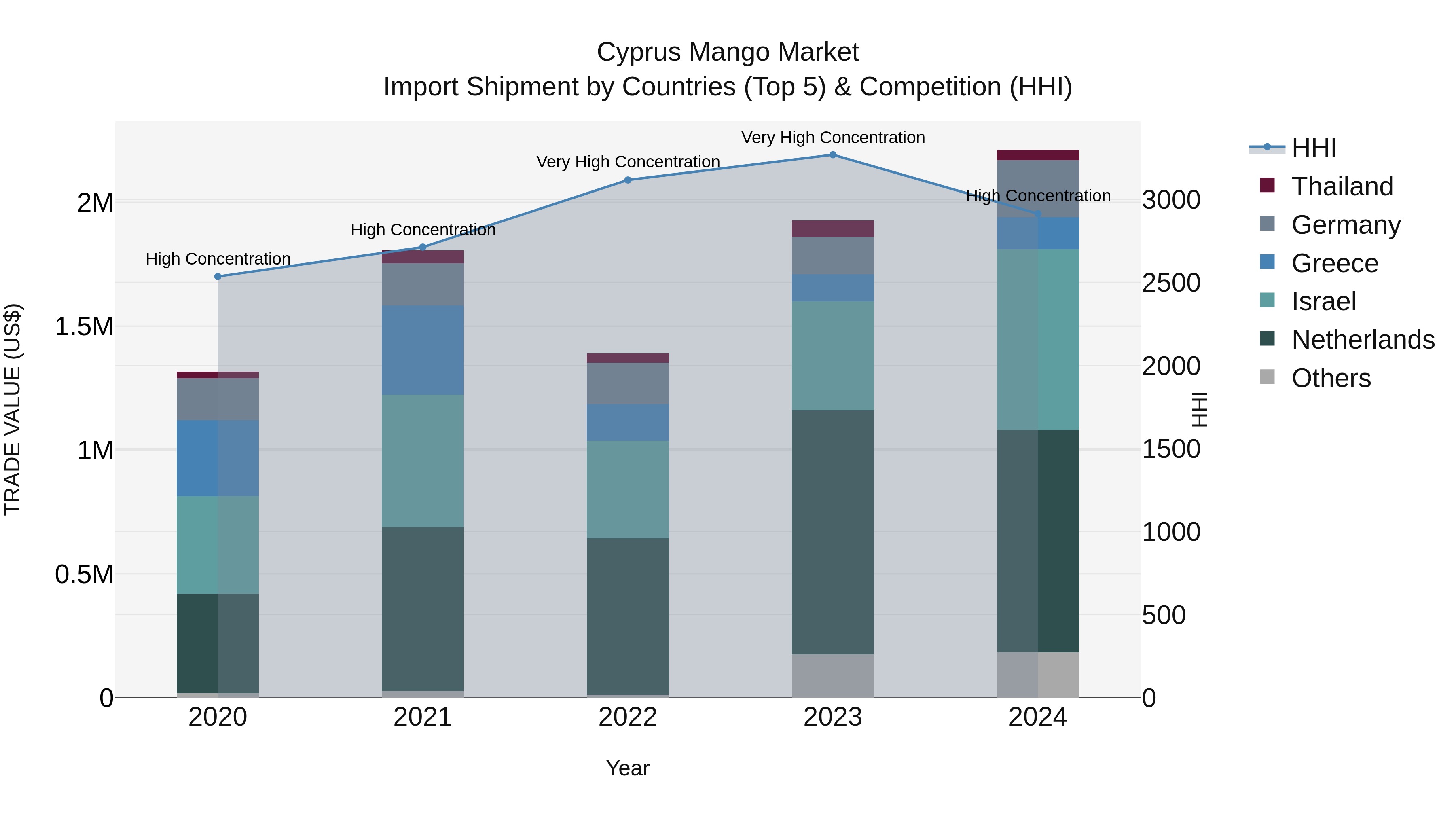
Cyprus Mango Market Import Shipment by Countries (Top 5) & Competition (HHI)
Cyprus experienced a significant increase in mango import shipments in 2024, with top exporting countries being the Netherlands, Israel, Germany, Egypt, and Greece. The market concentration, as measured by the Herfindahl-Hirschman Index (HHI), remained high in 2024, indicating a competitive market with dominant players. The compound annual growth rate (CAGR) from 2020 to 2024 was robust at 13.86%, while the growth rate from 2023 to 2024 accelerated even further to 14.71%. This data suggests a growing demand for mango imports in Cyprus and a dynamic market landscape that may present opportunities for stakeholders.
Key Highlights of the Report:
- Cyprus Mango Market Outlook
- Market Size of Cyprus Mango Market, 2024
- Forecast of Cyprus Mango Market, 2031
- Historical Data and Forecast of Cyprus Mango Revenues & Volume for the Period 2021- 2031
- Cyprus Mango Market Trend Evolution
- Cyprus Mango Market Drivers and Challenges
- Cyprus Mango Price Trends
- Cyprus Mango Porter's Five Forces
- Cyprus Mango Industry Life Cycle
- Historical Data and Forecast of Cyprus Mango Market Revenues & Volume By Variety for the Period 2021- 2031
- Historical Data and Forecast of Cyprus Mango Market Revenues & Volume By Alphonso for the Period 2021- 2031
- Historical Data and Forecast of Cyprus Mango Market Revenues & Volume By Kesar for the Period 2021- 2031
- Historical Data and Forecast of Cyprus Mango Market Revenues & Volume By Dashehari for the Period 2021- 2031
- Historical Data and Forecast of Cyprus Mango Market Revenues & Volume By Chausa for the Period 2021- 2031
- Historical Data and Forecast of Cyprus Mango Market Revenues & Volume By Langra for the Period 2021- 2031
- Historical Data and Forecast of Cyprus Mango Market Revenues & Volume By Banganapali (badami) for the Period 2021- 2031
- Historical Data and Forecast of Cyprus Mango Market Revenues & Volume By Neelum for the Period 2021- 2031
- Historical Data and Forecast of Cyprus Mango Market Revenues & Volume By Packaging Size for the Period 2021- 2031
- Historical Data and Forecast of Cyprus Mango Market Revenues & Volume By Less than 4 kg for the Period 2021- 2031
- Historical Data and Forecast of Cyprus Mango Market Revenues & Volume By 4kg to 8 kg for the Period 2021- 2031
- Historical Data and Forecast of Cyprus Mango Market Revenues & Volume By More than 8kg for the Period 2021- 2031
- Historical Data and Forecast of Cyprus Mango Market Revenues & Volume By Application for the Period 2021- 2031
- Historical Data and Forecast of Cyprus Mango Market Revenues & Volume By B2B for the Period 2021- 2031
- Historical Data and Forecast of Cyprus Mango Market Revenues & Volume By B2C for the Period 2021- 2031
- Historical Data and Forecast of Cyprus Mango Market Revenues & Volume By Distribution Channel for the Period 2021- 2031
- Historical Data and Forecast of Cyprus Mango Market Revenues & Volume By Online for the Period 2021- 2031
- Historical Data and Forecast of Cyprus Mango Market Revenues & Volume By Offline for the Period 2021- 2031
- Cyprus Mango Import Export Trade Statistics
- Market Opportunity Assessment By Variety
- Market Opportunity Assessment By Packaging Size
- Market Opportunity Assessment By Application
- Market Opportunity Assessment By Distribution Channel
- Cyprus Mango Top Companies Market Share
- Cyprus Mango Competitive Benchmarking By Technical and Operational Parameters
- Cyprus Mango Company Profiles
- Cyprus Mango Key Strategic Recommendations






































