Cyprus Oilfield Stimulation Chemicals Market Size (2020-2030)
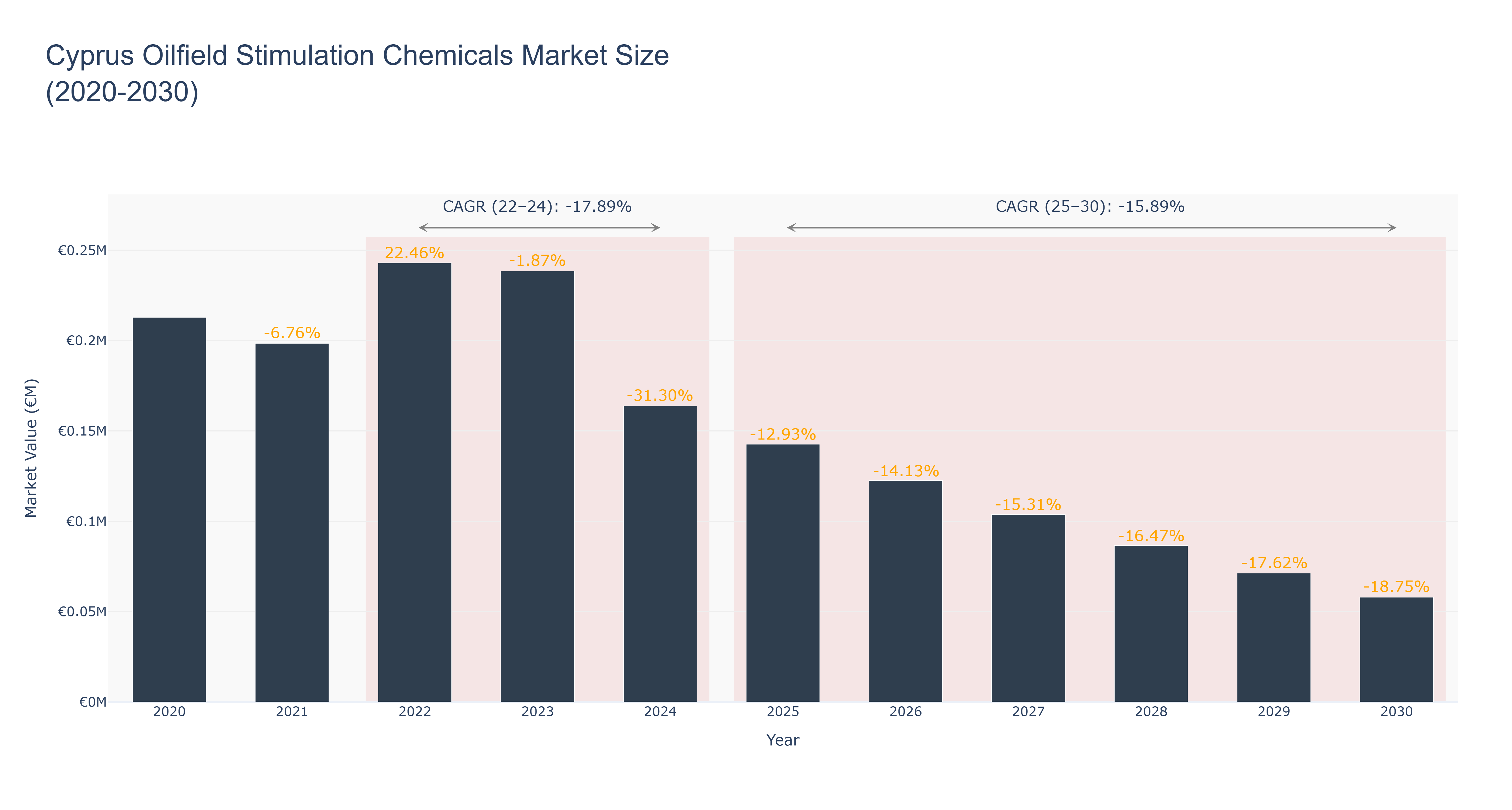
Cyprus Oilfield Stimulation Chemicals Market has witnessed a fluctuating trend in market size over the years. The peak market size of €0.24 million was recorded in 2022, followed by a significant decline to €0.14 million in 2025. The market is forecasted to further decrease to €0.06 million by 2030, with a CAGR of -15.89% from 2025 to 2030. The downfall in market size can be attributed to declining demand for oilfield stimulation chemicals due to global economic slowdowns and advancements in alternative energy sources. However, industry drivers such as increasing oil exploration activities and technological advancements in chemical formulations may drive market growth in the future. Future developments in the market may include collaborations with key oil companies to enhance product offerings and expand market reach.
Cyprus Oilfield Stimulation Chemicals Market: Production & Trade Performance (2019-2025)
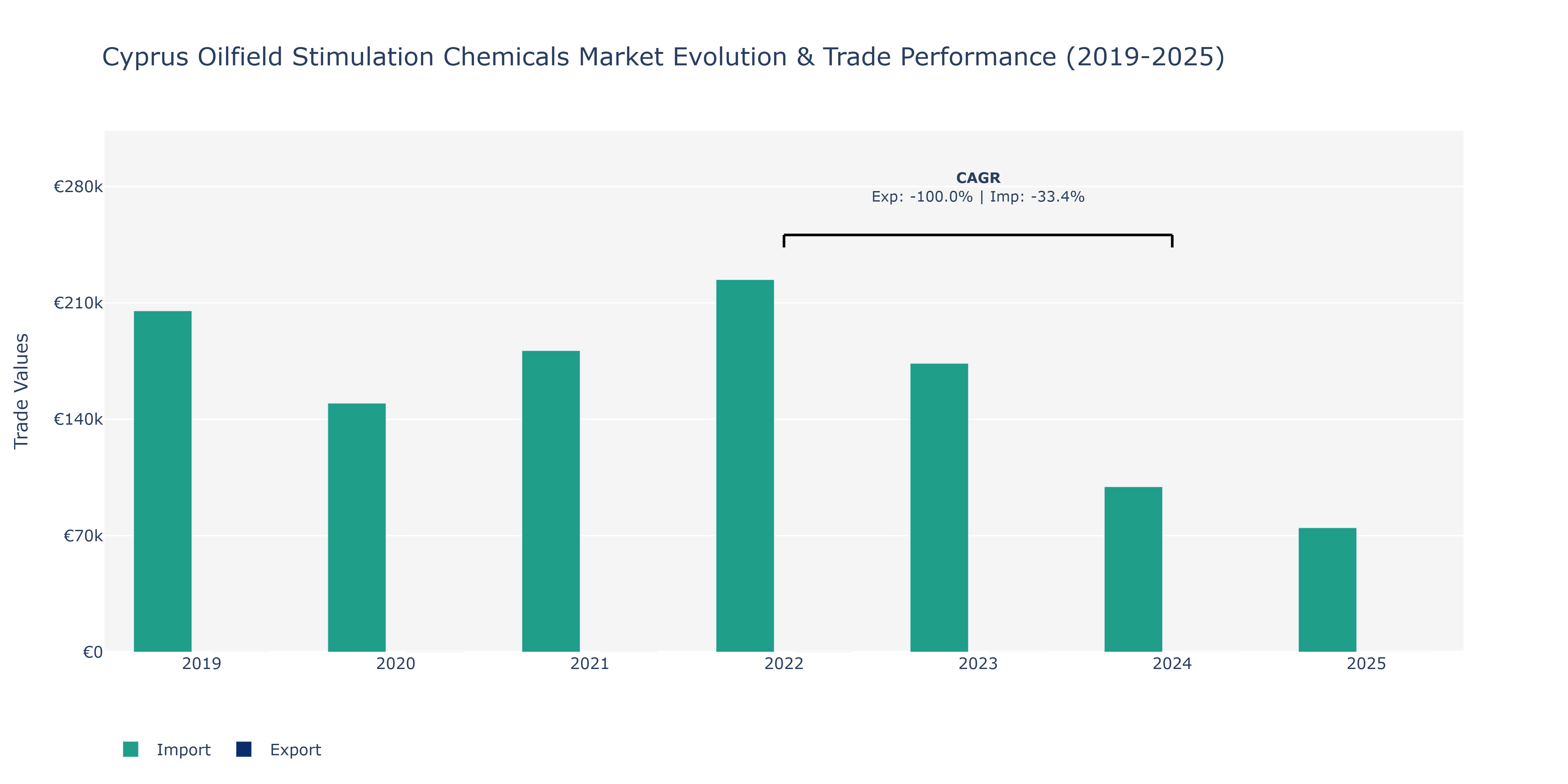
The Cyprus Oilfield Stimulation Chemicals Market saw notable fluctuations in both Exports and Imports during the period under review. In 2019, Imports dominated the market at €205.22 thousand, overshadowing Exports at €40.0 thousand. The year 2020 witnessed a significant surge in Exports to €123.0 thousand, narrowing the gap with Imports amounting to €149.66 thousand. In 2021, Exports slightly decreased to €105.0 thousand while Imports rose to €181.31 thousand. The peak was observed in 2022 with Exports reaching €165.0 thousand and Imports escalating to €223.98 thousand, showcasing a growing market demand. However, Imports experienced a sharp decline in 2023 to €173.63 thousand and further dropped to €99.44 thousand in 2024. This downward trend in Imports could be attributed to global economic uncertainties impacting trade flows and market demand shifts towards renewable energy sources. The market then saw Imports decrease to €74.76 thousand in 2025, signaling ongoing market volatility and the need for market players to adapt to changing industry dynamics by diversifying product portfolios and exploring new market segments to ensure sustained growth in the Cyprus Oilfield Stimulation Chemicals Market.
Key Highlights of the Report:
- Cyprus Oilfield Stimulation Chemicals Market Outlook
- Market Size of Cyprus Oilfield Stimulation Chemicals Market, 2024
- Forecast of Cyprus Oilfield Stimulation Chemicals Market, 2031
- Historical Data and Forecast of Cyprus Oilfield Stimulation Chemicals Revenues & Volume for the Period 2021-2031
- Cyprus Oilfield Stimulation Chemicals Market Trend Evolution
- Cyprus Oilfield Stimulation Chemicals Market Drivers and Challenges
- Cyprus Oilfield Stimulation Chemicals Price Trends
- Cyprus Oilfield Stimulation Chemicals Porter`s Five Forces
- Cyprus Oilfield Stimulation Chemicals Industry Life Cycle
- Historical Data and Forecast of Cyprus Oilfield Stimulation Chemicals Market Revenues & Volume By Types for the Period 2021-2031
- Historical Data and Forecast of Cyprus Oilfield Stimulation Chemicals Market Revenues & Volume By Gelling Agents for the Period 2021-2031
- Historical Data and Forecast of Cyprus Oilfield Stimulation Chemicals Market Revenues & Volume By Surfactants for the Period 2021-2031
- Historical Data and Forecast of Cyprus Oilfield Stimulation Chemicals Market Revenues & Volume By Friction reducers for the Period 2021-2031
- Historical Data and Forecast of Cyprus Oilfield Stimulation Chemicals Market Revenues & Volume By Corrosion for the Period 2021-2031
- Historical Data and Forecast of Cyprus Oilfield Stimulation Chemicals Market Revenues & Volume By Scale Inhibitors for the Period 2021-2031
- Historical Data and Forecast of Cyprus Oilfield Stimulation Chemicals Market Revenues & Volume By Acids for the Period 2021-2031
- Historical Data and Forecast of Cyprus Oilfield Stimulation Chemicals Market Revenues & Volume By Application for the Period 2021-2031
- Historical Data and Forecast of Cyprus Oilfield Stimulation Chemicals Market Revenues & Volume By Hydraulic Fracturing for the Period 2021-2031
- Historical Data and Forecast of Cyprus Oilfield Stimulation Chemicals Market Revenues & Volume By Matrix Acidization for the Period 2021-2031
- Historical Data and Forecast of Cyprus Oilfield Stimulation Chemicals Market Revenues & Volume By Acid Fracking for the Period 2021-2031
- Cyprus Oilfield Stimulation Chemicals Import Export Trade Statistics
- Market Opportunity Assessment By Types
- Market Opportunity Assessment By Application
- Cyprus Oilfield Stimulation Chemicals Top Companies Market Share
- Cyprus Oilfield Stimulation Chemicals Competitive Benchmarking By Technical and Operational Parameters
- Cyprus Oilfield Stimulation Chemicals Company Profiles
- Cyprus Oilfield Stimulation Chemicals Key Strategic Recommendations






































