Cyprus Winding Wire Market Size (2020-2030)
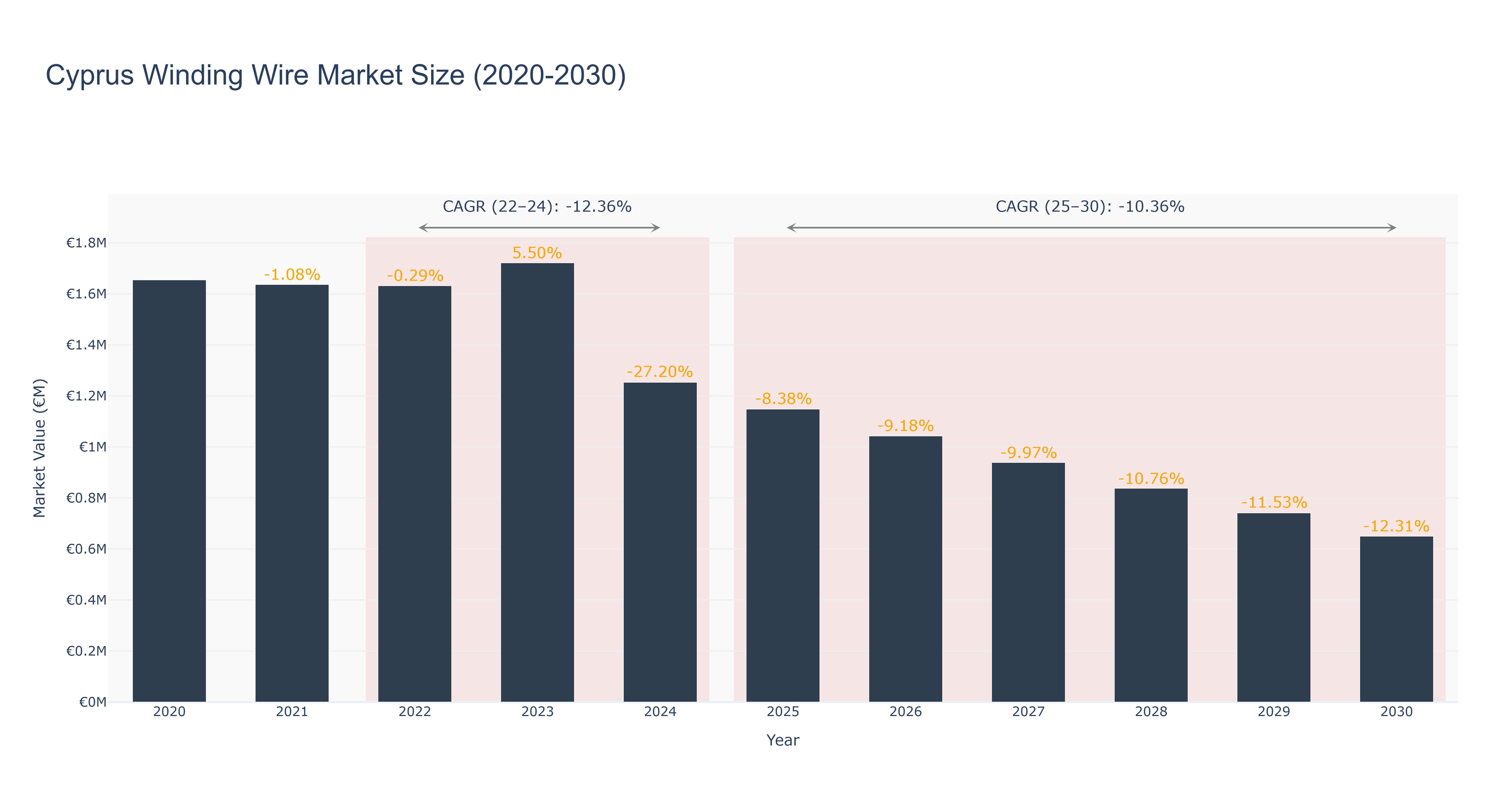
The Cyprus Winding Wire Market experienced its peak in 2020, with a market size of €1.65 million, followed by a gradual decline to €1.25 million in 2024, reflecting an overall negative CAGR of -12.36% from actual data between 2022 and 2024. Despite a brief resurgence in 2023 to €1.72 million, the market is projected to face significant challenges, with forecasted values showing a downward trend from €1.15 million in 2025 to €650.09 thousand by 2030, resulting in a projected CAGR of -10.36%. Factors contributing to these declines may include increased competition, shifts in manufacturing technologies, and a potential reduction in demand from key sectors. Additionally, the market's contraction may be influenced by broader economic trends within Cyprus. While specific upcoming projects have not been detailed, ongoing advancements in renewable energy and electrical components may provide some future opportunities for stabilization and growth in the sector.
Cyprus Winding Wire Market: Production & Trade Performance (2019-2025)
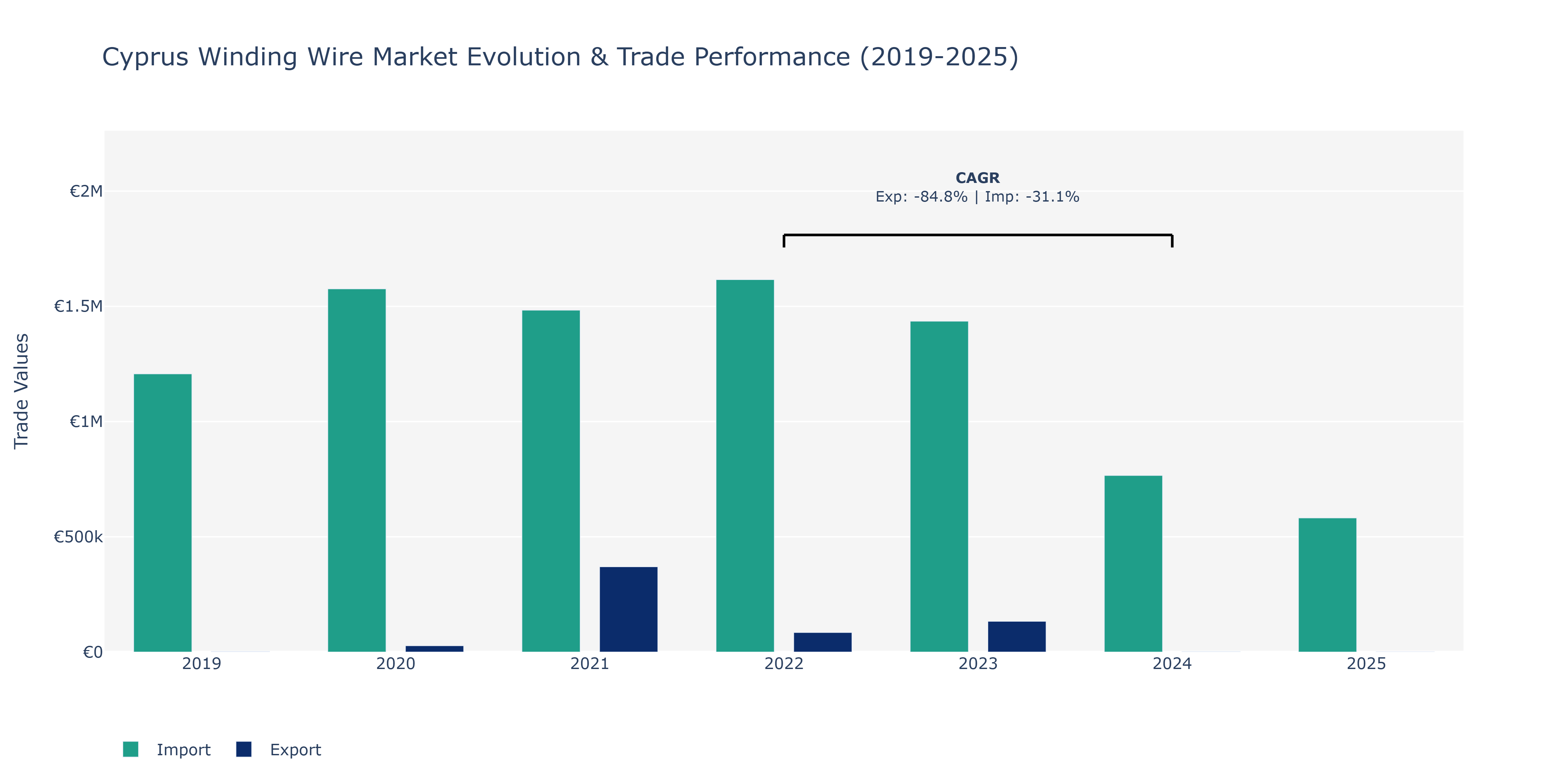
The Cyprus Winding Wire Market experienced notable fluctuations in both exports and imports from 2019 to 2025. Exports showcased an upward trajectory, peaking at €370.01 thousand in 2021 before declining to €1.47 million in 2025. Conversely, imports fluctuated, reaching a peak of €1.58 million in 2020, followed by a gradual decrease to €0.58 million in 2025. The substantial drop in exports between 2021 and 2025 could be attributed to increased competition in the global market, prompting local manufacturers to recalibrate strategies to enhance competitiveness. On the other hand, the fluctuating Import value might reflect shifts in domestic demand for winding wire products due to economic conditions or changes in industrial production levels. These trends highlight the market's sensitivity to both domestic and international factors, underscoring the need for market players to adapt swiftly to changing dynamics to maintain a competitive edge in the industry.
Key Highlights of the Report:
- Cyprus Winding Wire Market Outlook
- Market Size of Cyprus Winding Wire Market, 2024
- Forecast of Cyprus Winding Wire Market, 2031
- Historical Data and Forecast of Cyprus Winding Wire Revenues & Volume for the Period 2021-2031
- Cyprus Winding Wire Market Trend Evolution
- Cyprus Winding Wire Market Drivers and Challenges
- Cyprus Winding Wire Price Trends
- Cyprus Winding Wire Porter`s Five Forces
- Cyprus Winding Wire Industry Life Cycle
- Historical Data and Forecast of Cyprus Winding Wire Market Revenues & Volume By Product for the Period 2021-2031
- Historical Data and Forecast of Cyprus Winding Wire Market Revenues & Volume By Copper Winding Wire for the Period 2021-2031
- Historical Data and Forecast of Cyprus Winding Wire Market Revenues & Volume By Aluminum Winding Wire for the Period 2021-2031
- Cyprus Winding Wire Import Export Trade Statistics
- Market Opportunity Assessment By Product
- Cyprus Winding Wire Top Companies Market Share
- Cyprus Winding Wire Competitive Benchmarking By Technical and Operational Parameters
- Cyprus Winding Wire Company Profiles
- Cyprus Winding Wire Key Strategic Recommendations






































