Czech Republic Cast & Forged Market: Import Trend Analysis
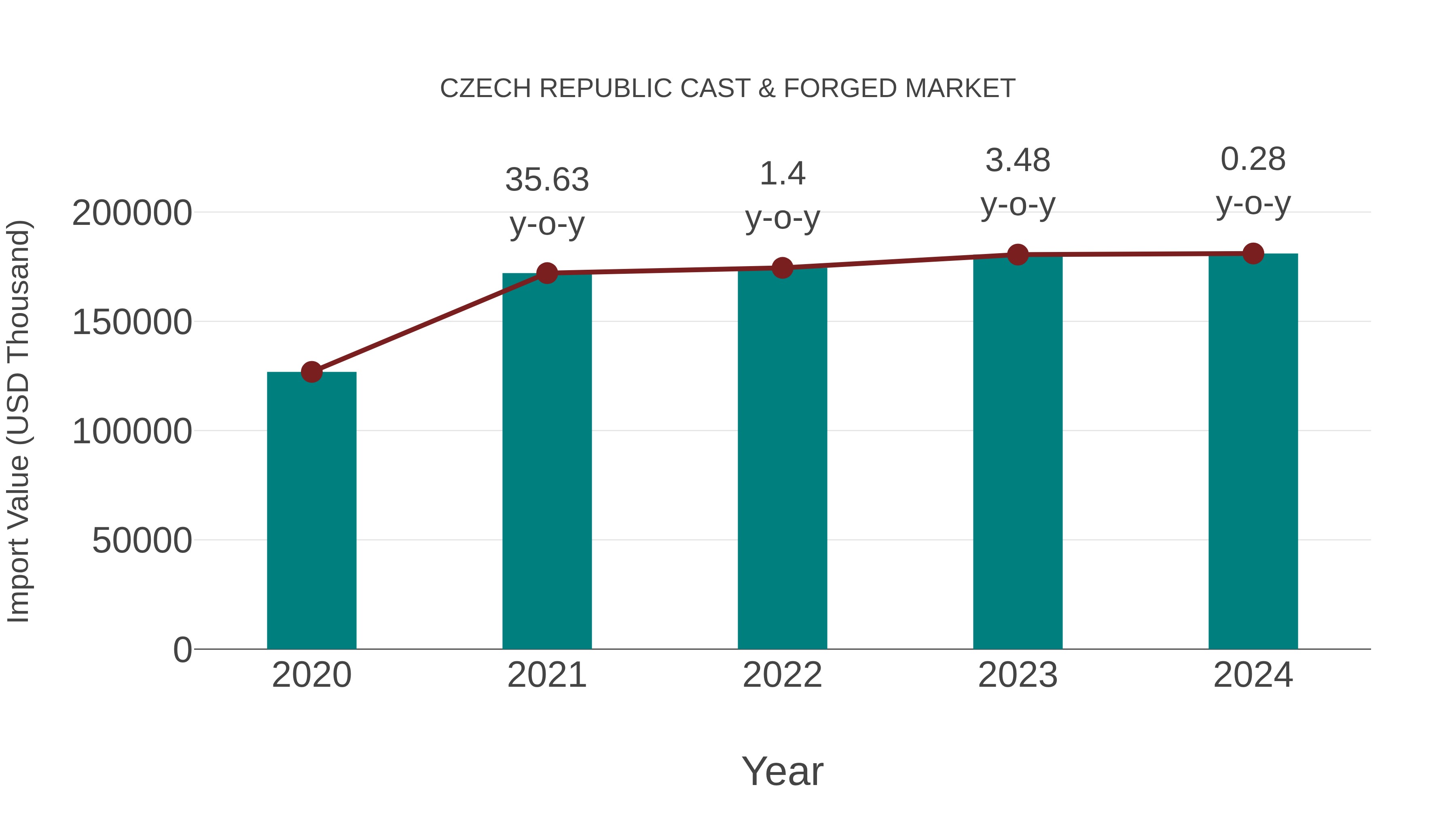
In the Czech Republic`s cast & forged market, the import trend showed a modest growth rate of 0.28% from 2023 to 2024. The compound annual growth rate (CAGR) for imports in this market between 2020 and 2024 stood at 9.3%. This steady import momentum could be attributed to a stable demand for such products within the Czech Republic or possibly influenced by consistent trade policies during this period.
Czech Republic Cast & Forged Market Highlights
| Report Name | Czech Republic Cast & Forged Market |
| Forecast period | 2026-2032 |
| CAGR | 5.7% |
| Growing Sector | Automotive |
Topics Covered in the Czech Republic Cast & Forged Market Report
The Czech Republic Cast & Forged Market report thoroughly covers the market by product types, activity types, and applications. The report provides an unbiased and detailed analysis of ongoing market trends, high-growth opportunities, and key market drivers, helping stakeholders align their business strategies with current and future market dynamics.
Czech Republic Cast & Forged Market Synopsis
The Czech Republic Cast & Forged Market has witnessed steady growth in recent years, driven by rising demand from major industries such as automotive, machinery, and construction. The country’s strong manufacturing ecosystem and advanced production capabilities have strengthened its position in the global cast and forged industry. Investments in innovation, automation, and sustainable manufacturing practices are further supporting market expansion, while increasing exports and international collaborations continue to enhance industry growth.
According to 6Wresearch, the Czech Republic Cast & Forged Market is projected to grow at a CAGR of 6.23% during 2026-2032F. This growth is primarily supported by the increasing adoption of advanced manufacturing technologies and rising demand for cast and forged components across industries including aerospace, construction, automotive, and energy. Government initiatives promoting industrial modernization and export-oriented manufacturing are also expected to contribute significantly to market development. Furthermore, the growing focus on lightweight and high-strength materials is anticipated to create new opportunities for manufacturers and suppliers.
However, the Czech Republic Cast & Forged Industry faces several challenges that could impact long-term growth. Fluctuations in raw material prices continue to increase production costs and pressure profit margins. Additionally, the market faces intense competition from low-cost manufacturing countries. The industry is also under pressure to adopt environmentally sustainable manufacturing practices, requiring significant investments in modern machinery and green technologies. Skilled labor shortages and the need for workforce upskilling further remain major operational challenges for industry participants.
Czech Republic Cast & Forged Market Trends
The Czech Republic Cast & Forged Market is witnessing several emerging trends that are shaping future industry development. Manufacturers are increasingly adopting automation, robotics, and artificial intelligence to improve operational efficiency and reduce production costs. Sustainability initiatives are encouraging the use of recycled raw materials, energy-efficient production systems, and environmentally friendly manufacturing practices. In addition, there is a growing emphasis on producing customized, high-performance components for industries such as aerospace, automotive, renewable energy, and industrial machinery. Rising investments in research and development are expected to further strengthen the market’s competitiveness.
Investment Opportunities in the Czech Republic Cast & Forged Market
The Czech Republic Cast & Forged Market presents significant investment opportunities due to rapid industrial modernization and increasing integration of advanced technologies. Investors can benefit from the growing adoption of automation and AI-driven manufacturing systems that improve productivity and reduce operational costs. The transition toward sustainable production methods also creates opportunities for investments in recycled materials, energy-efficient processes, and carbon-reduction technologies. Additionally, the increasing demand for high-value engineered components in automotive, aerospace, and renewable energy industries offers strong growth potential for specialized manufacturers and suppliers.
Leading Players in the Czech Republic Cast & Forged Market
Leading companies operating in the Czech Republic Cast & Forged Market include prominent manufacturers such as ŽĎAS a.s., Kovosvit MAS, Vítkovice Heavy Machinery, and UNEX a.s. These companies focus on innovation, precision engineering, sustainability, and advanced manufacturing capabilities to strengthen their market position. Their strong product portfolios and export capabilities continue to support the growth of the Czech cast and forged industry in domestic and international markets.
Government Regulations of this industry
Government regulations play a vital role in shaping the Czech Republic Cast & Forged Market by ensuring compliance with environmental, quality, and industrial safety standards. Strict regulations regarding emissions, waste management, and energy efficiency are encouraging manufacturers to adopt cleaner production technologies and sustainable manufacturing practices. Compliance with international certifications such as ISO 9001 and ISO 14001 further supports operational transparency, quality assurance, and environmental responsibility across the industry.
Future Insights of the Czech Republic Cast & Forged Market
The future outlook for the Czech Republic Cast & Forged Market remains positive, supported by technological advancements, industrial automation, and sustainability initiatives. Increasing adoption of Industry 4.0 technologies is expected to improve manufacturing precision, operational efficiency, and cost optimization. Growing investments in energy-efficient systems, waste recycling technologies, and green manufacturing solutions will likely drive future market growth. Additionally, expanding trade partnerships within Europe and global export opportunities are expected to strengthen the long-term growth potential of the market.
Market Segmentation Analysis
The report provides a comprehensive analysis of the following market segments and their leading categories.
Steel Casting to Dominate the Market – By Product Types
According to 6Wresearch, steel casting dominates the product type segment in the Czech Republic Cast & Forged Market due to its superior strength, durability, and versatility. Steel castings are widely used in automotive, construction, and industrial machinery applications where high-performance materials are required. The flexibility of steel alloys enables manufacturers to produce components for a wide range of industrial applications.
Closed Die Forging to Dominate the Market – By Activity Types
Closed die forging holds a dominant position in the activity type segment because it enables the production of highly precise components with excellent mechanical strength and dimensional accuracy. The process minimizes material waste and delivers superior surface finishing, making it highly suitable for automotive, aerospace, and heavy machinery applications.
Automotive to Dominate the Market – By Applications
The automotive segment represents the leading application area in the Czech Republic Cast & Forged Market, driven by increasing demand for lightweight, durable, and high-strength vehicle components. Cast and forged parts, such as crankshafts, gears, engine components, and suspension components, are widely used in automotive manufacturing for their ability to meet strict quality and safety standards. The Czech Republic’s strong automotive production base further supports growth in the segment.
Key Attractiveness of the Report
- 10 Years of Market Data
- Historical Data from 2021 to 2024
- Base Year: 2024
- Forecast Period: 2025 to 2031
- Key Performance Indicators Impacting Market Growth
- Major Upcoming Developments and Projects
- Detailed Competitive Landscape Analysis
- Market Drivers, Challenges, and Opportunities
- Revenue and Volume Forecast Analysis
- Strategic Recommendations for Industry Stakeholders
Key Highlights of the Report:
- Czech Cast & Forged Market Overview
- Czech Cast & Forged Market Outlook
- Market Size of Czech Cast & Forged Market, 2025
- Forecast of Czech Cast & Forged Market, 2032
- Historical Data and Forecast of Czech Cast & Forged Market Revenues & Volume for the Period 2022-2032F
- Czech Cast & Forged Market Trend Evolution
- Czech Cast & Forged Market Drivers and Challenges
- Czech Cast & Forged Price Trends
- Czech Cast & Forged Porter's Five Forces
- Czech Cast & Forged Industry Life Cycle
- Historical Data and Forecast of Czech Cast & Forged Market Revenues & Volume By Product Types for the Period 2022-2032F
- Historical Data and Forecast of Czech Cast & Forged Market Revenues & Volume By Light Alloys for the Period 2022-2032F
- Historical Data and Forecast of Czech Cast & Forged Market Revenues & Volume By Copper Alloys for the Period 2022-2032F
- Historical Data and Forecast of Czech Cast & Forged Market Revenues & Volume By Iron Casting for the Period 2022-2032F
- Historical Data and Forecast of Czech Cast & Forged Market Revenues & Volume By Steel Casting for the Period 2022-2032F
- Historical Data and Forecast of Czech Cast & Forged Market Revenues & Volume By Miscellaneous for the Period 2022-2032F
- Historical Data and Forecast of Czech Cast & Forged Market Revenues & Volume By Activity Types for the Period 2022-2032F
- Historical Data and Forecast of Czech Cast & Forged Market Revenues & Volume By Closed Die Forging for the Period 2022-2032F
- Historical Data and Forecast of Czech Cast & Forged Market Revenues & Volume By Open Die Forging for the Period 2022-2032F
- Historical Data and Forecast of Czech Cast & Forged Market Revenues & Volume By Rolled Ring Forging for the Period 2022-2032F
- Historical Data and Forecast of Czech Cast & Forged Market Revenues & Volume By Cold Forging for the Period 2022-2032F
- Historical Data and Forecast of Czech Cast & Forged Market Revenues & Volume By Non-ferrous Closed Die Forging for the Period 2022-2032F
- Historical Data and Forecast of Czech Cast & Forged Market Revenues & Volume By Applications for the Period 2022-2032F
- Historical Data and Forecast of Czech Cast & Forged Market Revenues & Volume By Automotive for the Period 2022-2032F
- Historical Data and Forecast of Czech Cast & Forged Market Revenues & Volume By Aerospace for the Period 2022-2032F
- Historical Data and Forecast of Czech Cast & Forged Market Revenues & Volume By Oil & Gas for the Period 2022-2032F
- Historical Data and Forecast of Czech Cast & Forged Market Revenues & Volume By Construction for the Period 2022-2032F
- Historical Data and Forecast of Czech Cast & Forged Market Revenues & Volume By Agriculture for the Period 2022-2032F
- Historical Data and Forecast of Czech Cast & Forged Market Revenues & Volume by Industry for the Period 2022-2032F
- Historical Data and Forecast of Czech Cast & Forged Market Revenues & Volume By Others for the Period 2022-2032F
- Czech Cast & Forged Import Export Trade Statistics
- Market Opportunity Assessment By Product Types
- Market Opportunity Assessment By Activity Types
- Market Opportunity Assessment By Applications
- Czech Cast & Forged Top Companies Market Share
- Czech Cast & Forged Competitive Benchmarking By Technical and Operational Parameters
- Czech Cast & Forged Company Profiles
- Czech Cast & Forged Key Strategic Recommendations
Markets Covered
The report provides a detailed analysis of the following market segments:
By Product Types
- Light Alloys
- Copper Alloys
- Iron Casting
- Steel Casting
- Miscellaneous
By Activity Types
- Closed Die Forging
- Open Die Forging
- Rolled Ring Forging
- Cold Forging
- Non-ferrous Closed Die Forging
By Applications
- Automotive
- Aerospace
- Oil & Gas
- Construction
- Agriculture
- Industrial
- Others






































