Czech Republic Agriculture Market Size, Share & Growth Rate
The Czech Republic Agriculture Market was estimated at USD 891 Million in 2025 and is projected to reach USD 1273 Million by 2032, growing at a CAGR of 5.2% from 2026 to 2032. This positive trajectory is largely driven by increasing consumer demand for organic and sustainable farming practices, supported by a growing awareness of health and environmental concerns. Furthermore, the adoption of precision agriculture technologies is enhancing productivity and efficiency, positioning the sector for robust growth.
Czech Republic Agriculture Market Year-wise Growth Rate and Key Drivers
This graph highlights how the Czech Republic Agriculture Market has steadily grown over the years, supported by major growth factors.
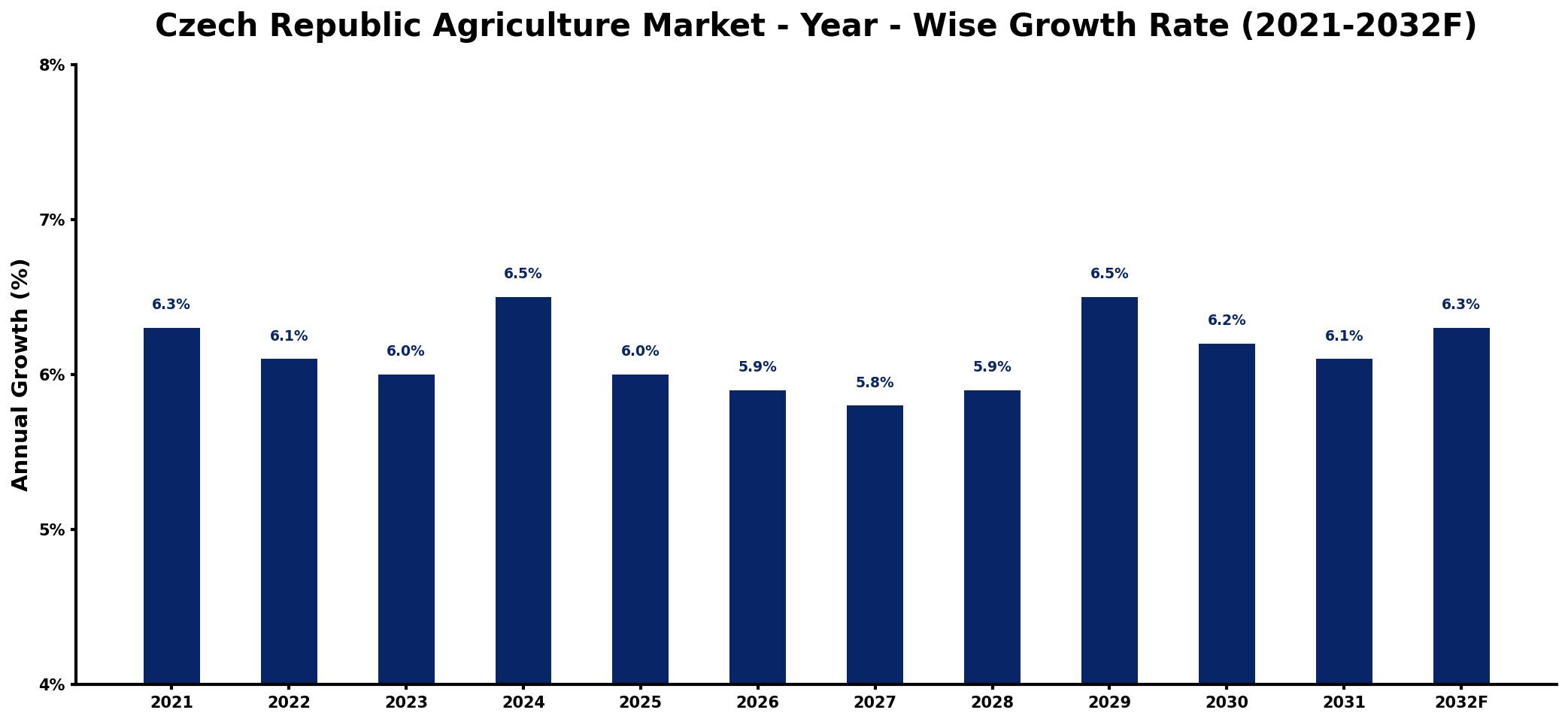
The table below presents the year‑wise growth rates along with the key drivers influencing the market
| Year | Growth Rate | Major Drivers |
| 2021 | 6.3% | Rising consumer health awareness |
| 2022 | 6.1% | Increased investment in technology |
| 2023 | 6.0% | Expansion of organic farming practices |
| 2024 | 6.5% | Growing demand for sustainable products |
| 2025 | 6.0% | Enhanced access to international markets |
| 2026 | 5.9% | Strengthening of local supply chains |
| 2027 | 5.8% | Adoption of precision farming techniques |
| 2028 | 5.9% | Surge in eco-friendly innovations |
| 2029 | 6.5% | Increased government support programs |
| 2030 | 6.2% | Growth in export opportunities |
| 2031 | 6.1% | Emergence of niche market segments |
| 2032 | 6.3% | growing commercial sector adoption |
Note: Market size estimations and growth projections presented in this report are based on 6Wresearch's proprietary forecasting methodology, utilizing the latest available industry data, government publications, and primary research inputs.
Czech Republic Agriculture Market Synopsis
Currently, the Czech Republic's agriculture market reflects a dynamic landscape, heavily focused on crop production with staple crops such as barley, wheat, corn, and sugar beets dominating the sector. Livestock farming remains significant, with pork, poultry, and dairy leading the way in terms of output.
The market is shaped by various factors, including government subsidies and EU agricultural policies, alongside an increasing inclination towards organic farming practices. As consumer preferences evolve, producers are adapting to meet the demand for sustainable and environmentally friendly products, signalling a notable shift within the agricultural paradigm.
Czech Republic Agriculture Market Key Takeaways
- Precision agriculture techniques are gaining traction, enhancing productivity and operational efficiency across the sector.
- Organic farming is experiencing significant growth, fueled by consumer demand for sustainable practices and healthy food options.
- The sector is challenged by land fragmentation and an aging workforce, necessitating strategic modernization efforts.
- Government policies aim to bolster agricultural productivity, environmental sustainability, and rural development.
- Agri-tourism and direct-to-consumer sales channels are emerging as important trends, reflecting changing consumer dynamics.
Evaluation of Restraints in Czech Republic Agriculture Market
Despite its potential, the Czech agriculture market faces significant restraints. Increasing competition from imported agricultural products, a consequence of EU trade agreements, poses a challenge to local producers. Weather volatility significantly impacts crop yields, which can undermine profitability. Furthermore, the aging farming population results in a labor shortage, constraining operational capabilities and innovation. These factors collectively demand a proactive response to ensure long-term viability and growth in the sector.
Czech Republic Agriculture Market Trends
Key trends influencing the Czech Republic Agriculture Market include a pronounced shift towards organic and sustainable farming practices. This trend is driven by heightened consumer awareness of health and environmental issues. Additionally, precision agriculture technologies are gaining prevalence, providing farmers with innovative tools to maximize efficiency and crop yields. Diversification of crops and livestock is also becoming increasingly important, as stakeholders seek to mitigate risks associated with reliance on traditional agricultural products.
Czech Republic Agriculture Market Opportunities
The Czech Republic's agriculture market presents myriad investment opportunities, especially within the realms of agribusiness focusing on crop production, livestock management, and food processing. The growing popularity of organic farming creates a substantial opportunity for businesses aiming to align with sustainable practices. Additionally, the strategic location of the Czech Republic within the EU offers advantageous access to broader markets for agricultural products, further enhancing the investment landscape.
Government Initiatives in the Czech Republic Agriculture Market
The Czech government actively promotes the agriculture sector through various initiatives aimed at fostering growth and sustainability. This includes subsidies designed to enhance agricultural productivity, along with environmental protection measures ensuring sustainable practices. Support for rural development and initiatives focused on modernizing agricultural infrastructure are also critical components of government policy. By aligning with EU regulations and guidelines, the government works to enhance food safety, quality standards, and competitive practices within the market.
Future Insights of the Czech Republic Agriculture Market
Looking ahead to 2026-2032, the Czech Republic Agriculture Market is poised for continued evolution. An emphasis on sustainability and the integration of technology into farming practices will likely drive growth. Increasing consumer interest in organic and locally sourced products presents ample opportunities for local farmers to explore niche markets. Supported by government initiatives, the sector is expected to embrace innovation, fostering competitiveness and resilience in the face of challenges.
Czech Republic Agriculture Market Latest Developments (2025 - 2026)
Recent developments within the Czech agriculture sector reflect a progressive shift towards modernization. This includes greater adoption of precision farming technologies, which facilitate more efficient farming practices and resource management. Additionally, there is a notable rise in collaboration between agricultural producers and tech firms, aimed at enhancing productivity through digital solutions. The sector is also witnessing an increased focus on marketing local agricultural products directly to consumers, bolstering the farm-to-table movement.
Czech Republic Agriculture Market - Key Attractiveness of the Report
- 10 Years of Market Numbers
- Historical Data Starting from 2022 to 2025
- Base Year: 2025
- Forecast Data until 2032
- Key Performance Indicators Impacting the Market
- Major Upcoming Developments and Projects
Key Highlights of the Report:
- Czech Republic Agriculture Market Outlook
- Market Size of Czech Republic Agriculture Market, 2025
- Forecast of Czech Republic Agriculture Market, 2032
- Historical Data and Forecast of Czech Republic Agriculture Revenues & Volume for the Period 2022-2032F
- Czech Republic Agriculture Market Trend Evolution
- Czech Republic Agriculture Market Drivers and Challenges
- Czech Republic Agriculture Price Trends
- Czech Republic Agriculture Porter's Five Forces
- Czech Republic Agriculture Industry Life Cycle
- Historical Data and Forecast of Czech Republic Agriculture Market Revenues & Volume By Type for the Period 2022-2032F
- Historical Data and Forecast of Czech Republic Agriculture Market Revenues & Volume By Animal Produce for the Period 2022-2032F
- Historical Data and Forecast of Czech Republic Agriculture Market Revenues & Volume By Crop Production for the Period 2022-2032F
- Historical Data and Forecast of Czech Republic Agriculture Market Revenues & Volume By Distribution Channel for the Period 2022-2032F
- Historical Data and Forecast of Czech Republic Agriculture Market Revenues & Volume By Supermarkets/Hypermarkets for the Period 2022-2032F
- Historical Data and Forecast of Czech Republic Agriculture Market Revenues & Volume By Convenience Stores for the Period 2022-2032F
- Historical Data and Forecast of Czech Republic Agriculture Market Revenues & Volume By E-Commerce for the Period 2022-2032F
- Historical Data and Forecast of Czech Republic Agriculture Market Revenues & Volume By Others for the Period 2022-2032F
- Historical Data and Forecast of Czech Republic Agriculture Market Revenues & Volume By Nature for the Period 2022-2032F
- Historical Data and Forecast of Czech Republic Agriculture Market Revenues & Volume By Organic for the Period 2022-2032F
- Historical Data and Forecast of Czech Republic Agriculture Market Revenues & Volume By Conventional for the Period 2022-2032F
- Czech Republic Agriculture Import Export Trade Statistics
- Market Opportunity Assessment By Type
- Market Opportunity Assessment By Distribution Channel
- Market Opportunity Assessment By Nature
- Czech Republic Agriculture Top Companies Market Share
- Czech Republic Agriculture Competitive Benchmarking By Technical and Operational Parameters
- Czech Republic Agriculture Company Profiles
- Czech Republic Agriculture Key Strategic Recommendations






































