Czech Republic Automotive Chassis Market Size, Share & Growth Rate
The Czech Republic Automotive Chassis Market was estimated at USD 192 Million in 2025 and is projected to reach USD 254 Million by 2032, growing at a CAGR of 4.1% from 2026 to 2032. This growth is driven by the increasing demand for lightweight chassis components that enhance vehicle performance and fuel efficiency, alongside the expansion of electric and autonomous vehicle technologies. As the automotive sector in the Czech Republic continues to innovate, the market is set to thrive in response to these evolving dynamics.
Czech Republic Automotive Chassis Market Year-wise Growth Rate and Key Drivers
This graph highlights how the Czech Republic Automotive Chassis Market has steadily grown over the years, supported by major growth factors.
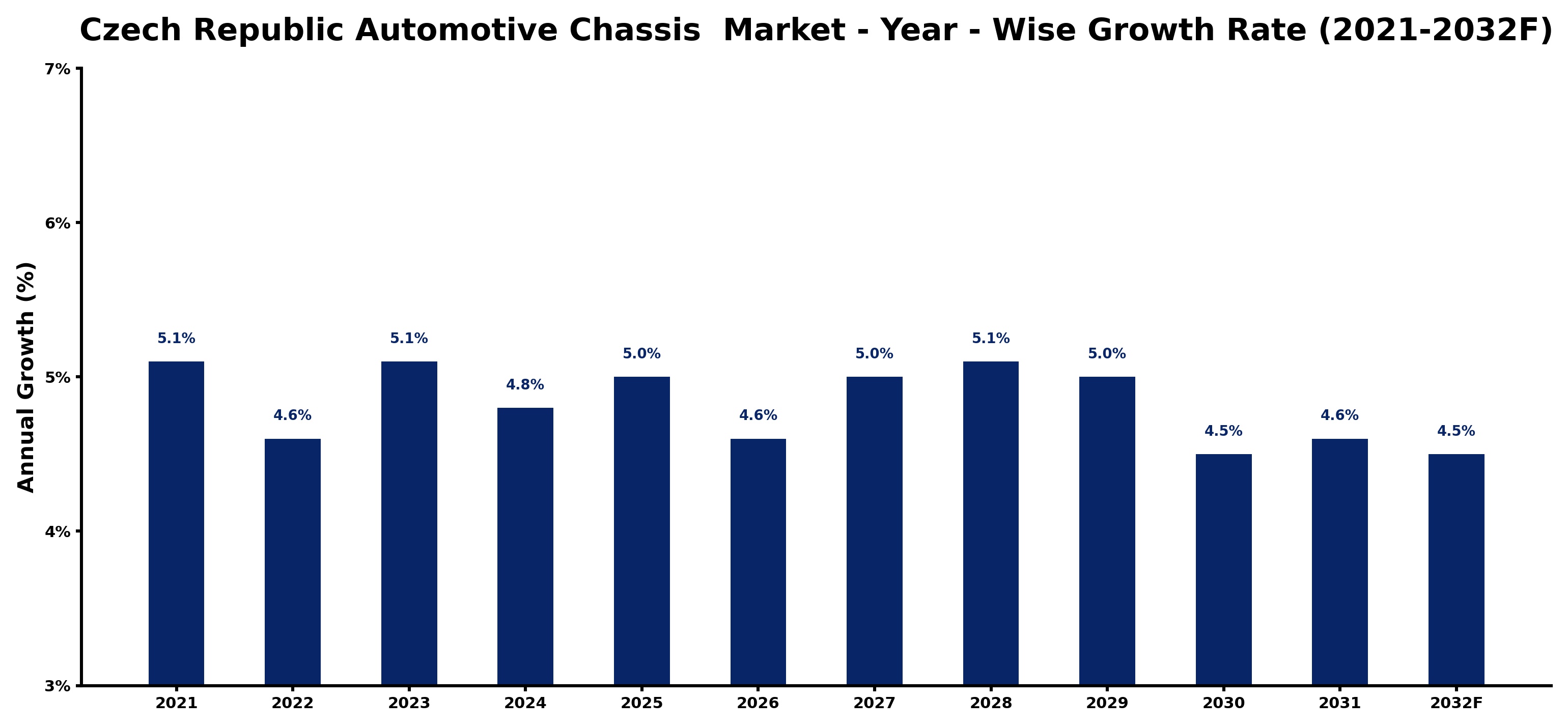
The table below presents the year‑wise growth rates along with the key drivers influencing the market
| Year | Growth Rate | Major Drivers |
| 2021 | 5.1% | Electric vehicle adoption increased demand |
| 2022 | 4.6% | Sustainability initiatives drove innovation |
| 2023 | 5.1% | Technological advancements improved efficiency |
| 2024 | 4.8% | Automotive exports expanded significantly |
| 2025 | 5.0% | Consumer preferences shifted positively |
| 2026 | 4.6% | Investment in R&D accelerated growth |
| 2027 | 5.0% | Collaboration with tech firms enhanced |
| 2028 | 5.1% | Regulatory support fostered development |
| 2029 | 5.0% | Supply chain optimization improved performance |
| 2030 | 4.5% | Market diversification created opportunities |
| 2031 | 4.6% | Increased production capacity supported growth |
| 2032 | 4.5% | Enhanced safety features attracted buyers |
Note - Market size estimations and growth projections presented in this report are based on 6Wresearch’s advanced forecasting approach, validated with industry datasets as of June 2026.
Czech Republic Automotive Chassis Market Synopsis
The Czech Republic is carving a niche in the automotive chassis market, leveraging its robust manufacturing capabilities and strategic position in Europe. With a focus on lightweight materials and high-performance designs, the market is adapting to both local and global automotive trends.
Recent advancements have seen a marked shift towards the integration of smart technologies within chassis systems, reflecting a broader industry trend towards increased safety and efficiency. This is catalyzing a wave of innovation among manufacturers who are eager to meet the changing demands of consumers and regulatory standards alike.
Czech Republic Automotive Chassis Market Key Takeaways
- The market is experiencing steady growth driven by demand for lightweight and durable chassis components.
- Technological advancements are pushing the integration of smart chassis systems with enhanced safety features.
- There is a growing trend towards electric and hybrid vehicle chassis designs optimized for alternative powertrains.
- Continuous research and development are critical for local manufacturers to maintain competitiveness against international players.
- Government policies are supporting innovation and sustainability within the automotive industry.
Evaluation of Restraints in Czech Republic Automotive Chassis Market
While the Czech Republic Automotive Chassis Market is poised for growth, several constraints may limit its potential. The rising influx of international manufacturers has intensified competition, compelling local companies to enhance their value propositions in terms of pricing and quality. Additionally, the need for ongoing investment in research and development poses a financial challenge. With increasingly stringent safety and environmental regulations, companies must navigate compliance complexities, which could hinder swift innovation and market responsiveness.
Czech Republic Automotive Chassis Market Trends
Current trends in the Czech Republic Automotive Chassis Market are heavily influenced by the automotive industry's shift towards sustainability and efficiency. The demand for lightweight materials, such as aluminum and carbon fiber composites, is rising, enabling manufacturers to produce chassis that improve fuel efficiency without sacrificing performance. Moreover, there's a noteworthy trend toward the development of smart chassis systems equipped with sensors and control modules, enhancing the safety and driving experience. These innovations are essential as the market transitions to accommodate electric and autonomous vehicles.
Czech Republic Automotive Chassis Market Opportunities
The Czech Republic Automotive Chassis Market offers abundant investment opportunities, particularly for stakeholders interested in cutting-edge technologies. The growing focus on electric vehicles provides a fertile ground for investment in chassis solutions designed for sustainability. Manufacturers can also benefit from partnerships with local firms to enhance their technological capabilities, ensuring they are well-positioned to capitalize on emerging trends in the automotive sector.
Government Initiatives in the Czech Republic Automotive Chassis Market
The government of the Czech Republic has enacted several policies aimed at bolstering the automotive industry, with a specific emphasis on sustainable practices and innovation. Regulatory frameworks encourage the development of electric and hybrid vehicles while imposing safety standards that chassis components must meet. Furthermore, incentives for research and development initiatives are fostering an environment conducive to technological advancements, ensuring that local manufacturers remain competitive on the global stage.
Future Insights of the Czech Republic Automotive Chassis Market
Looking ahead to 2026-2032, the Czech Republic Automotive Chassis Market is set for transformative growth, propelled by an increasing focus on lightweight and fuel-efficient vehicles. Investments in research and development, alongside the ongoing presence of major automotive players, will drive innovation. The escalating trend towards electric and autonomous vehicles promises to reshape chassis designs, offering fresh avenues for market players to explore and invest in, ultimately ensuring a forward-looking landscape for the industry.
Czech Republic Automotive Chassis Market Latest Developments (May 2025 - June 2026)
In recent months, the Czech Republic automotive industry has seen a surge in initiatives aimed at enhancing chassis technologies. Efforts to integrate smart systems into chassis designs are gaining traction, reflecting a broader shift towards automation and safety. Additionally, manufacturers are increasingly focusing on sustainability, with new materials being tested to improve overall vehicle efficiency. As the industry evolves, collaborations between local companies and global firms are becoming more prevalent, aimed at leveraging technological expertise and innovation.
Czech Republic Automotive Chassis Market - Key Attractiveness of the Report
- 10 Years of Market Numbers
- Historical Data Starting from 2022 to 2025
- Base Year: 2025
- Forecast Data until 2032
- Key Performance Indicators Impacting the Market
- Major Upcoming Developments and Projects
Key Highlights of the Report:
- Czech Republic Automotive Chassis Market Outlook
- Market Size of Czech Republic Automotive Chassis Market, 2025
- Forecast of Czech Republic Automotive Chassis Market, 2032
- Historical Data and Forecast of Czech Republic Automotive Chassis Revenues & Volume for the Period 2022-2032F
- Czech Republic Automotive Chassis Market Trend Evolution
- Czech Republic Automotive Chassis Market Drivers and Challenges
- Czech Republic Automotive Chassis Price Trends
- Czech Republic Automotive Chassis Porter's Five Forces
- Czech Republic Automotive Chassis Industry Life Cycle
- Historical Data and Forecast of Czech Republic Automotive Chassis Market Revenues & Volume By ChassisType for the Period 2022-2032F
- Historical Data and Forecast of Czech Republic Automotive Chassis Market Revenues & Volume By Backbone for the Period 2022-2032F
- Historical Data and Forecast of Czech Republic Automotive Chassis Market Revenues & Volume By Ladder for the Period 2022-2032F
- Historical Data and Forecast of Czech Republic Automotive Chassis Market Revenues & Volume By Monocoque for the Period 2022-2032F
- Historical Data and Forecast of Czech Republic Automotive Chassis Market Revenues & Volume By Modular for the Period 2022-2032F
- Historical Data and Forecast of Czech Republic Automotive Chassis Market Revenues & Volume By Material for the Period 2022-2032F
- Historical Data and Forecast of Czech Republic Automotive Chassis Market Revenues & Volume By Steel for the Period 2022-2032F
- Historical Data and Forecast of Czech Republic Automotive Chassis Market Revenues & Volume By Aluminum Alloy for the Period 2022-2032F
- Historical Data and Forecast of Czech Republic Automotive Chassis Market Revenues & Volume By Carbon Fiber Composite for the Period 2022-2032F
- Historical Data and Forecast of Czech Republic Automotive Chassis Market Revenues & Volume By Electric Vehicle for the Period 2022-2032F
- Historical Data and Forecast of Czech Republic Automotive Chassis Market Revenues & Volume By BEV for the Period 2022-2032F
- Historical Data and Forecast of Czech Republic Automotive Chassis Market Revenues & Volume By PHEV for the Period 2022-2032F
- Historical Data and Forecast of Czech Republic Automotive Chassis Market Revenues & Volume By HEV for the Period 2022-2032F
- Historical Data and Forecast of Czech Republic Automotive Chassis Market Revenues & Volume By Vehicle Type for the Period 2022-2032F
- Historical Data and Forecast of Czech Republic Automotive Chassis Market Revenues & Volume By PC for the Period 2022-2032F
- Historical Data and Forecast of Czech Republic Automotive Chassis Market Revenues & Volume By CV for the Period 2022-2032F
- Czech Republic Automotive Chassis Import Export Trade Statistics
- Market Opportunity Assessment By ChassisType
- Market Opportunity Assessment By Material
- Market Opportunity Assessment By Electric Vehicle
- Market Opportunity Assessment By Vehicle Type
- Czech Republic Automotive Chassis Top Companies Market Share
- Czech Republic Automotive Chassis Competitive Benchmarking By Technical and Operational Parameters
- Czech Republic Automotive Chassis Company Profiles
- Czech Republic Automotive Chassis Key Strategic Recommendations






































