Czech Republic Automotive Engine Market Size, Share & Growth Rate
The Czech Republic Automotive Engine Market was estimated at USD 386 Million in 2025 and is projected to reach USD 557 Million by 2032, growing at a CAGR of 5.4% from 2026 to 2032. This growth trajectory is primarily driven by the increasing demand for advanced, fuel-efficient engines, coupled with the country's robust automotive manufacturing capabilities. The market is also shifting towards sustainable technologies, particularly electric and hybrid engines, reflecting broader global trends towards reducing carbon footprints.
Czech Republic Automotive Engine Market Year-wise Growth Rate and Key Drivers
This graph highlights how the Czech Republic Automotive Engine Market has steadily grown over the years, supported by major growth factors.
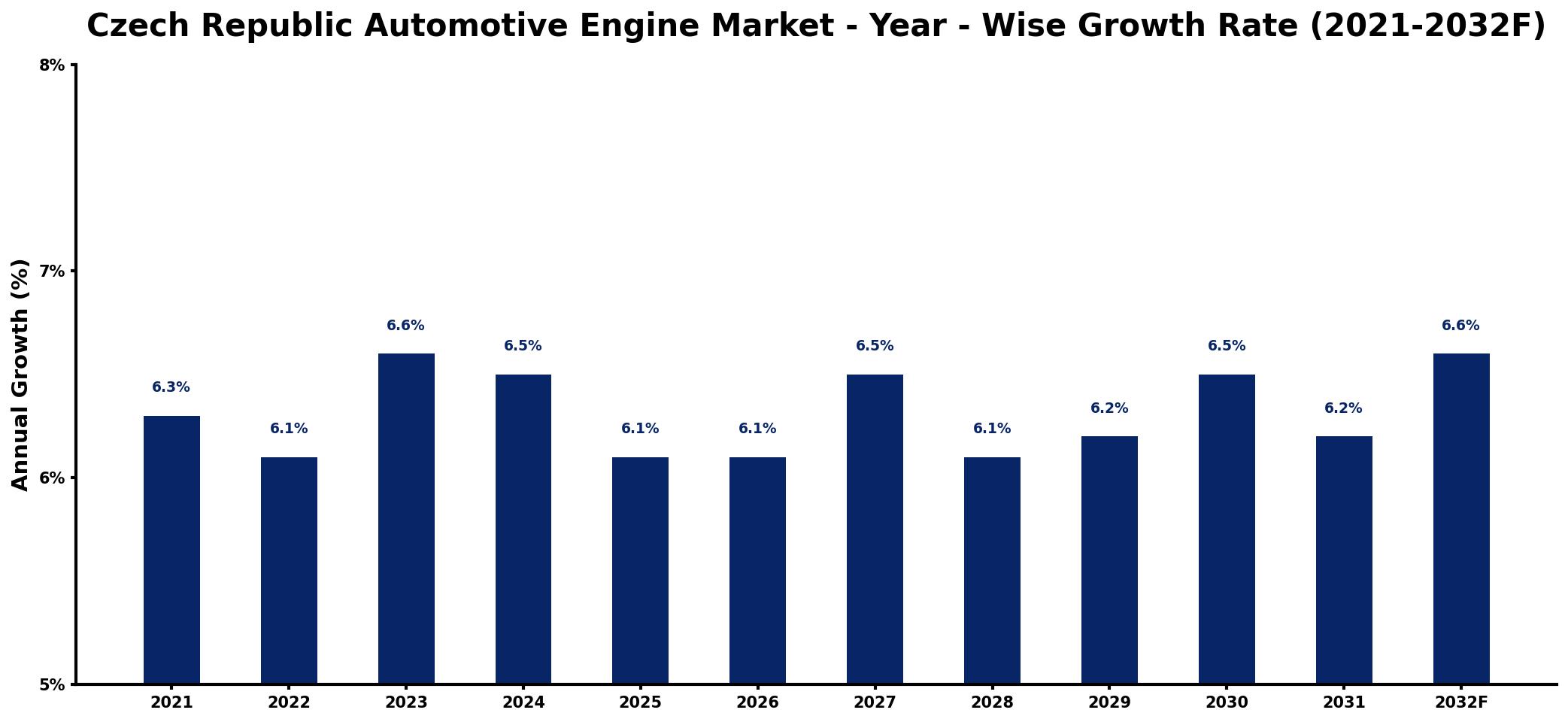
The table below presents the year‑wise growth rates along with the key drivers influencing the market
| Year | Growth Rate | Major Drivers |
| 2021 | 6.3% | Rising consumer demand for vehicles |
| 2022 | 6.1% | Increased investment in technology |
| 2023 | 6.6% | Expansion of manufacturing capabilities |
| 2024 | 6.5% | Growing popularity of electric alternatives |
| 2025 | 6.1% | Strengthening supply chain networks |
| 2026 | 6.1% | Enhanced regulatory support initiatives |
| 2027 | 6.5% | Boost in international trade agreements |
| 2028 | 6.1% | Growing interest in sustainable solutions |
| 2029 | 6.2% | Rising disposable income levels |
| 2030 | 6.5% | Increased focus on performance enhancements |
| 2031 | 6.2% | rising procurement volume requirements |
| 2032 | 6.6% | Growing collaboration with startups |
Note: Market size estimations and growth projections presented in this report are based on 6Wresearch's proprietary forecasting methodology, utilizing the latest available industry data, government publications, and primary research inputs.
Czech Republic Automotive Engine Market Synopsis
The Czech Republic is becoming a focal point for innovation in engine technology, with manufacturers investing heavily in R&D to enhance performance and compliance with stringent emission regulations. This emphasis on sustainability is propelling the demand for alternative fuel engines and sophisticated engine management systems.
The countrys strategic location in Central Europe not only facilitates efficient supply chains but also positions it favorably for exports. As a result, the Czech automotive engine market is poised to attract considerable foreign investments, which will further amplify its growth prospects.
Czech Republic Automotive Engine Market Key Takeaways
- The market is projected to grow steadily, driven by innovations in engine efficiency and eco-friendly technologies.
- Strategic investments in R&D are crucial for companies to meet tightening environmental regulations.
- The transition towards electric and hybrid engines is reshaping the competitive landscape of the market.
- Foreign competition poses challenges, necessitating a focus on quality and technological advancements by local manufacturers.
- The skilled workforce and advanced infrastructure enhance the Czech Republic's attractiveness as an automotive engine production hub.
Evaluation of Restraints in Czech Republic Automotive Engine Market
The Czech Republic Automotive Engine Market faces several notable restraints that could impede its growth. One major concern is the intensifying competition from foreign manufacturers, which places pressure on local companies to innovate continuously. Additionally, fluctuating raw material prices can affect profit margins and overall production costs. Meeting stringent emission regulations requires significant investment in research and development, thereby straining resources for smaller firms. Companies must navigate these challenges effectively to remain competitive and sustainable in this evolving landscape.
Czech Republic Automotive Engine Market Trends
Several significant trends are emerging within the Czech Republic Automotive Engine Market. The rise of electric and hybrid engines is at the forefront, as consumers and manufacturers alike shift towards greener alternatives. This change is accompanied by a growing focus on lightweight engine designs and enhanced fuel efficiency, which align with stringent environmental regulations.
Additionally, advancements in technologies such as turbocharging and downsizing are gaining traction, enabling manufacturers to optimize performance while minimizing emissions. These trends underscore the markets movement towards greater sustainability and innovation, paving the way for new opportunities.
Czech Republic Automotive Engine Market Opportunities
The Czech Republic Automotive Engine Market offers several lucrative investment opportunities. With the ongoing transformation towards green technologies, investors can explore avenues in the manufacturing of electric vehicle components and alternative fuel technologies. Furthermore, the strong local automotive industry coupled with a skilled labor force creates a fertile ground for partnerships and collaborations focused on innovative engine designs. The market's central location within Europe provides advantageous access to key automotive markets, making it an appealing site for expansion and investment.
Government Initiatives in the Czech Republic Automotive Engine Market
The Czech government has implemented various supportive policies aimed at enhancing the Automotive Engine Market. These include incentives for research and development in green technologies, particularly for electric and hybrid engines. Additionally, tax benefits and subsidies are available to promote the production and adoption of environmentally friendly engines. Such initiatives not only encourage innovation but also address critical environmental concerns, further bolstering the markets growth potential.
Future Insights of the Czech Republic Automotive Engine Market
Looking ahead from 2026 to 2032, the Czech Republic Automotive Engine Market is anticipated to thrive amid rising demand for sustainable vehicle technologies. As manufacturers continue to innovate and invest in advanced engine solutions, the market is set to expand significantly. The focus on stricter emission standards and consumer preferences for fuel-efficient vehicles will drive further developments in engine technology. With its advantageous geographic position and well-established infrastructure, the Czech Republic is poised to remain a key player in the European automotive engine landscape.
Czech Republic Automotive Engine Market Latest Developments (2025 - 2026)
In recent months, the Czech Republic has seen notable shifts in its automotive engine sector. The market is increasingly witnessing collaborations between local firms and international players, aimed at advancing electric vehicle technology. Additionally, significant advancements in engine efficiency and reduced emissions have been highlighted in industry conferences, showcasing the commitment of manufacturers to meet future regulatory challenges. The ongoing emphasis on sustainability continues to inspire innovation across the sector, with companies ramping up their R&D efforts.
Czech Republic Automotive Engine Market - Key Attractiveness of the Report
- 10 Years of Market Numbers
- Historical Data Starting from 2022 to 2025
- Base Year: 2025
- Forecast Data until 2032
- Key Performance Indicators Impacting the Market
- Major Upcoming Developments and Projects
Key Highlights of the Report:
- Czech Republic Automotive Engine Market Outlook
- Market Size of Czech Republic Automotive Engine Market, 2025
- Forecast of Czech Republic Automotive Engine Market, 2032
- Historical Data and Forecast of Czech Republic Automotive Engine Revenues & Volume for the Period 2022-2032F
- Czech Republic Automotive Engine Market Trend Evolution
- Czech Republic Automotive Engine Market Drivers and Challenges
- Czech Republic Automotive Engine Price Trends
- Czech Republic Automotive Engine Porter's Five Forces
- Czech Republic Automotive Engine Industry Life Cycle
- Historical Data and Forecast of Czech Republic Automotive Engine Market Revenues & Volume By Placement Type for the Period 2022-2032F
- Historical Data and Forecast of Czech Republic Automotive Engine Market Revenues & Volume By In-line Engine for the Period 2022-2032F
- Historical Data and Forecast of Czech Republic Automotive Engine Market Revenues & Volume By W Engine for the Period 2022-2032F
- Historical Data and Forecast of Czech Republic Automotive Engine Market Revenues & Volume By V-Type for the Period 2022-2032F
- Historical Data and Forecast of Czech Republic Automotive Engine Market Revenues & Volume By Vehicle Type for the Period 2022-2032F
- Historical Data and Forecast of Czech Republic Automotive Engine Market Revenues & Volume By Passenger Car for the Period 2022-2032F
- Historical Data and Forecast of Czech Republic Automotive Engine Market Revenues & Volume By Commercial Vehicle for the Period 2022-2032F
- Historical Data and Forecast of Czech Republic Automotive Engine Market Revenues & Volume By Fuel Type for the Period 2022-2032F
- Historical Data and Forecast of Czech Republic Automotive Engine Market Revenues & Volume By Gasoline for the Period 2022-2032F
- Historical Data and Forecast of Czech Republic Automotive Engine Market Revenues & Volume By Diesel for the Period 2022-2032F
- Historical Data and Forecast of Czech Republic Automotive Engine Market Revenues & Volume By Other Fuel Types for the Period 2022-2032F
- Czech Republic Automotive Engine Import Export Trade Statistics
- Market Opportunity Assessment By Placement Type
- Market Opportunity Assessment By Vehicle Type
- Market Opportunity Assessment By Fuel Type
- Czech Republic Automotive Engine Top Companies Market Share
- Czech Republic Automotive Engine Competitive Benchmarking By Technical and Operational Parameters
- Czech Republic Automotive Engine Company Profiles
- Czech Republic Automotive Engine Key Strategic Recommendations






































