BBQ Charcoal Market: Czech Republic vs Top 5 Major Economies in 2027 (Europe)
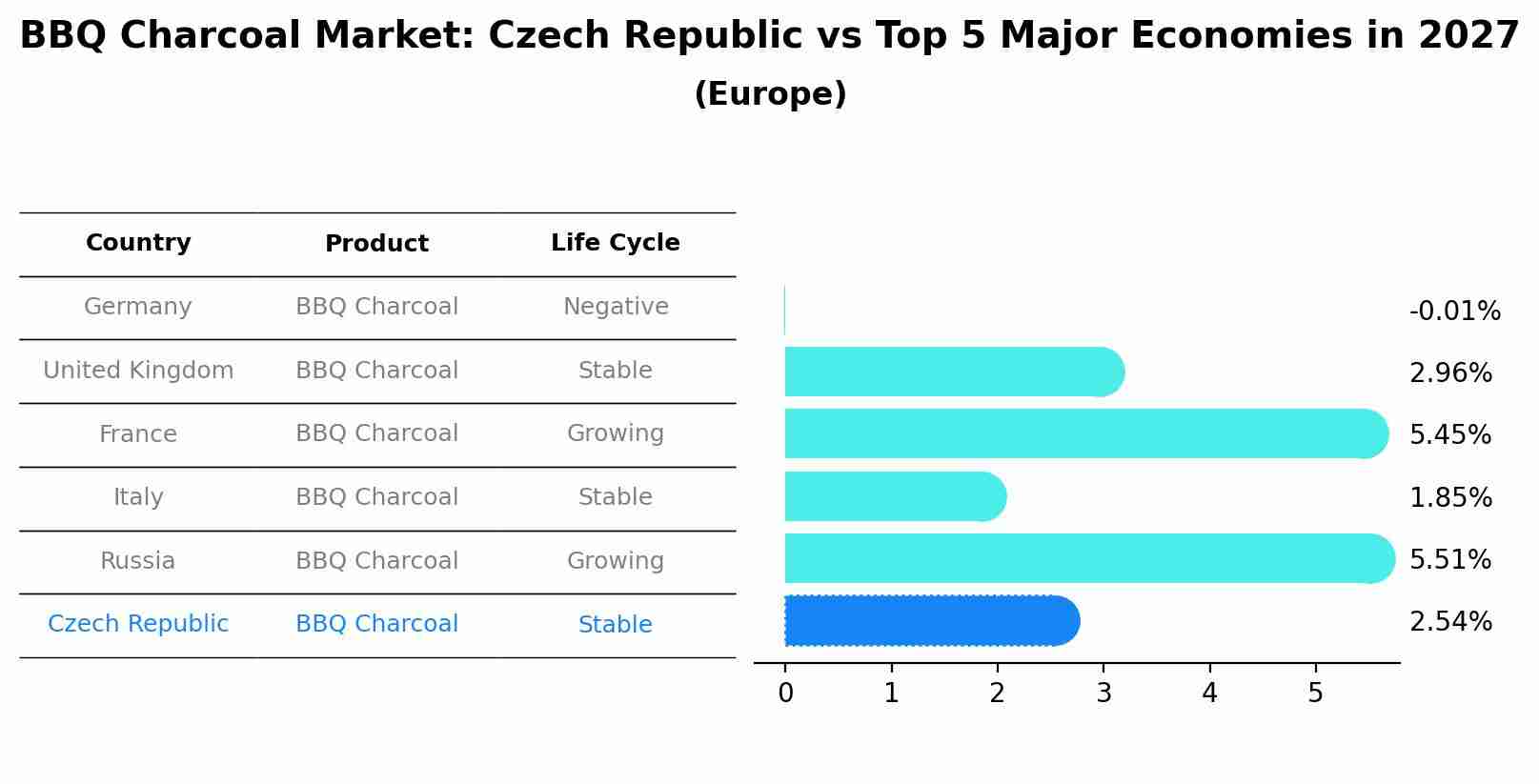
By 2027, the BBQ Charcoal market in Czech Republic is anticipated to reach a growth rate of 2.54%, as part of an increasingly competitive Europe region, where Germany remains at the forefront, supported by United Kingdom, France, Italy and Russia, driving innovations and market adoption across sectors.
Czech Republic BBQ Charcoal Market Overview
The Czech Republics BBQ charcoal market is benefiting from the rising popularity of outdoor grilling and barbecuing, particularly during the summer months. Both domestic production and imports of high-quality BBQ charcoal are growing, fueled by a preference for natural and organic grilling solutions among consumers.
Drivers of the market
The BBQ charcoal market in the Czech Republic is fueled by the growing popularity of outdoor grilling and barbecuing. As consumers increasingly seek enjoyable outdoor cooking experiences, the demand for high-quality charcoal products is on the rise. The market benefits from the trend toward natural and sustainable grilling options, as consumers prioritize eco-friendly charcoal solutions. Additionally, the expansion of retail channels and barbecue culture is further supporting market growth.
Challenges of the market
The BBQ Charcoal Market in the Czech Republic encounters challenges related to raw material sourcing and competition from alternative grilling options. Fluctuations in the availability and price of charcoal production materials, such as wood, can impact supply and production costs. Additionally, the increasing popularity of gas and electric grills may limit market growth for traditional charcoal products. To remain competitive, manufacturers must focus on quality and sustainability in their charcoal production processes while addressing changing consumer preferences for grilling methods.
Government Policy of the market
The Czech BBQ charcoal market is regulated by environmental policies that focus on sustainable forestry and the reduction of carbon emissions from charcoal production. The government enforces strict regulations on charcoal production to ensure that it does not contribute to deforestation or environmental degradation. There are also policies promoting the use of eco-friendly alternatives to traditional charcoal, and manufacturers are encouraged to adopt cleaner production technologies.
Key Highlights of the Report:
- Czech Republic BBQ Charcoal Market Outlook
- Market Size of Czech Republic BBQ Charcoal Market, 2024
- Forecast of Czech Republic BBQ Charcoal Market, 2031
- Historical Data and Forecast of Czech Republic BBQ Charcoal Revenues & Volume for the Period 2021-2031
- Czech Republic BBQ Charcoal Market Trend Evolution
- Czech Republic BBQ Charcoal Market Drivers and Challenges
- Czech Republic BBQ Charcoal Price Trends
- Czech Republic BBQ Charcoal Porter's Five Forces
- Czech Republic BBQ Charcoal Industry Life Cycle
- Historical Data and Forecast of Czech Republic BBQ Charcoal Market Revenues & Volume By Form for the Period 2021-2031
- Historical Data and Forecast of Czech Republic BBQ Charcoal Market Revenues & Volume By Briquettes BBQ Charcoal for the Period 2021-2031
- Historical Data and Forecast of Czech Republic BBQ Charcoal Market Revenues & Volume By Lump Wood BBQ Charcoal for the Period 2021-2031
- Historical Data and Forecast of Czech Republic BBQ Charcoal Market Revenues & Volume By Sales Channel for the Period 2021-2031
- Historical Data and Forecast of Czech Republic BBQ Charcoal Market Revenues & Volume By Direct BBQ Charcoal Sales for the Period 2021-2031
- Historical Data and Forecast of Czech Republic BBQ Charcoal Market Revenues & Volume By Retail BBQ Charcoal Sales for the Period 2021-2031
- Historical Data and Forecast of Czech Republic BBQ Charcoal Market Revenues & Volume By End User for the Period 2021-2031
- Historical Data and Forecast of Czech Republic BBQ Charcoal Market Revenues & Volume By BBQ Charcoal for Hotels, Restaurants and Catering (HoReCa) for the Period 2021-2031
- Historical Data and Forecast of Czech Republic BBQ Charcoal Market Revenues & Volume By BBQ Charcoal for Households for the Period 2021-2031
- Historical Data and Forecast of Czech Republic BBQ Charcoal Market Revenues & Volume By Source for the Period 2021-2031
- Historical Data and Forecast of Czech Republic BBQ Charcoal Market Revenues & Volume By BBQ Charcoal made from Agricultural Waste for the Period 2021-2031
- Historical Data and Forecast of Czech Republic BBQ Charcoal Market Revenues & Volume By BBQ Charcoal made from Coconut Shells for the Period 2021-2031
- Historical Data and Forecast of Czech Republic BBQ Charcoal Market Revenues & Volume By BBQ Charcoal made from Nutshells for the Period 2021-2031
- Historical Data and Forecast of Czech Republic BBQ Charcoal Market Revenues & Volume By BBQ Charcoal made from Hardwood for the Period 2021-2031
- Historical Data and Forecast of Czech Republic BBQ Charcoal Market Revenues & Volume By BBQ Charcoal made from Bamboo for the Period 2021-2031
- Czech Republic BBQ Charcoal Import Export Trade Statistics
- Market Opportunity Assessment By Form
- Market Opportunity Assessment By Sales Channel
- Market Opportunity Assessment By End User
- Market Opportunity Assessment By Source
- Czech Republic BBQ Charcoal Top Companies Market Share
- Czech Republic BBQ Charcoal Competitive Benchmarking By Technical and Operational Parameters
- Czech Republic BBQ Charcoal Company Profiles
- Czech Republic BBQ Charcoal Key Strategic Recommendations






































