Czech Republic Bcg Vaccine Market Size, Share & Growth Rate
The Czech Republic Bcg Vaccine Market was estimated at USD 310 Million in 2025 and is projected to reach USD 443 Million by 2032, growing at a CAGR of 5.2% from 2026 to 2032. This growth is primarily fueled by heightened government initiatives aimed at increasing vaccination rates and improving healthcare infrastructure. Furthermore, the growing recognition of vaccination's critical role in preventing tuberculosis, alongside ongoing public health campaigns, is contributing to a robust demand for BCG vaccines across the nation.
Czech Republic Bcg Vaccine Market Year-wise Growth Rate and Key Drivers
This graph highlights how the Czech Republic Bcg Vaccine Market has steadily grown over the years, supported by major growth factors.
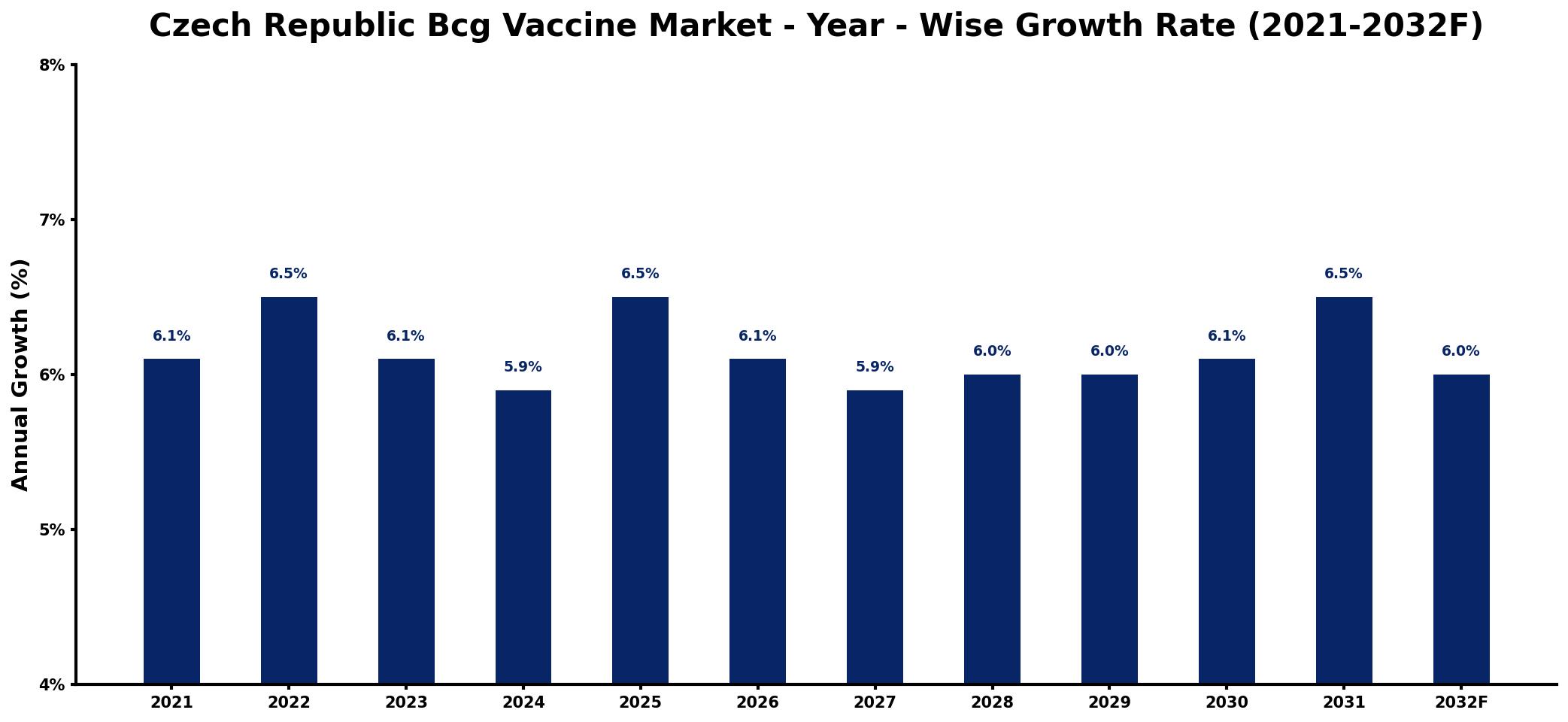
The table below presents the year‑wise growth rates along with the key drivers influencing the market
| Year | Growth Rate | Major Drivers |
| 2021 | 6.1% | increased healthcare investments and funding |
| 2022 | 6.5% | rising public health awareness initiatives |
| 2023 | 6.1% | expansion of immunization programs nationwide |
| 2024 | 5.9% | growing demand for preventive healthcare |
| 2025 | 6.5% | enhanced research and development activities |
| 2026 | 6.1% | increased collaboration with international organizations |
| 2027 | 5.9% | strengthened healthcare infrastructure improvements |
| 2028 | 6.0% | growing emerging market penetration |
| 2029 | 6.0% | stronger distribution network expansion |
| 2030 | 6.1% | increased educational outreach campaigns |
| 2031 | 6.5% | rising global health security concerns |
| 2032 | 6.0% | expanding industrial usage applications |
Note: Market size estimations and growth projections presented in this report are based on 6Wresearch's proprietary forecasting methodology, utilizing the latest available industry data, government publications, and primary research inputs.
Czech Republic Bcg Vaccine Market Synopsis
The demand for BCG vaccines in the Czech Republic is significantly influenced by the governments commitment to tuberculosis prevention strategies. Notably, the BCG vaccine is administered shortly after birth as part of the national immunization program, ensuring that newborns are protected from this infectious disease.
A strong network of healthcare providers collaborates with vaccine manufacturers to enhance distribution and accessibility of BCG vaccines. This synergy is crucial in addressing regional disparities in vaccine availability, enabling broader coverage across both urban and rural areas in the country.
Czech Republic Bcg Vaccine Market Key Takeaways
- Steady growth anticipated in the BCG vaccine market due to government-backed immunization programs.
- Increased public awareness regarding the significance of vaccinations in disease prevention bolstering demand.
- Collaborations between vaccine manufacturers and healthcare providers play a pivotal role in market accessibility.
- Continuous enhancements in healthcare infrastructure are facilitating better vaccine distribution.
- Investment opportunities abound as the prevalence of tuberculosis necessitates effective preventive measures.
Evaluation of Restraints in Czech Republic Bcg Vaccine Market
Despite the positive trajectory, the Czech Republic BCG vaccine market faces noteworthy constraints. The impact of global vaccine shortages remains a significant concern, as it can lead to interruptions in supply chains and fluctuating availability for healthcare institutions. Furthermore, regulatory hurdles associated with vaccine importation and distribution can complicate market operations. Navigating these challenges demands a coordinated effort among manufacturers, healthcare professionals, and regulatory bodies to maintain a consistent supply of BCG vaccines necessary for tuberculosis prevention.
Czech Republic Bcg Vaccine Market Trends
Current trends in the Czech Republic's BCG vaccine market are characterized by an increasing shift towards innovative vaccine formulations. Healthcare providers are gradually adopting more advanced products, reflecting a growing interest in enhancing vaccine efficacy. Government efforts to include BCG vaccines in national immunization schedules further reinforce this trend, demonstrating a commitment to eradicating tuberculosis.
Additionally, there is a marked focus on educational initiatives that aim to raise public awareness about tuberculosis and the crucial role of vaccinations. This awareness is translating into higher vaccination rates, thereby propelling overall market growth.
Czech Republic Bcg Vaccine Market Opportunities
With a rising incidence of tuberculosis, significant investment opportunities are emerging within the BCG vaccine sector in the Czech Republic. The governments robust initiatives to enhance healthcare infrastructure provide a solid foundation for investors looking to penetrate the market. Collaborating with local healthcare institutions and establishing strong distribution networks can unlock lucrative avenues for both production and distribution of BCG vaccines.
Furthermore, advancements in research and development for more effective tuberculosis vaccines present exciting possibilities for innovation, making it an opportune time for investments targeting this burgeoning market.
Government Initiatives in the Czech Republic Bcg Vaccine Market
The Czech government has implemented a mandatory BCG vaccination policy, ensuring that all infants receive the vaccine free of charge as part of their initial healthcare regimen. This policy is integral to the national vaccination program aimed at controlling tuberculosis. To enhance safety and efficacy, healthcare providers are also mandated to report any adverse effects following vaccination to the Czech National Institute of Public Health, thereby enabling effective monitoring and evaluation.
Regulatory oversight ensures that production and distribution comply with stringent quality standards, reinforcing public confidence in the BCG vaccination process and promoting widespread coverage.
Future Insights of the Czech Republic Bcg Vaccine Market
Looking ahead to 2026-2032, the Czech Republic BCG vaccine market is set for steady expansion, bolstered by an increasing emphasis on preventive healthcare. Heightened awareness regarding the critical role of vaccination in controlling tuberculosis will likely drive sustained demand. Enhanced healthcare infrastructure is expected to improve vaccine accessibility, while ongoing advancements in vaccine technology are projected to increase the overall efficacy of BCG vaccines available in the market.
Czech Republic Bcg Vaccine Market Latest Developments (2025 - 2026)
Recent developments in the Czech Republics BCG vaccine market indicate a focus on expanding distribution networks to ensure vaccine availability across diverse healthcare settings. Concurrently, efforts are being made to improve vaccine formulations to enhance efficacy against tuberculosis, aligning with global health strategies. Continuous collaboration between government agencies and healthcare providers is fostering an environment conducive to innovation and accessibility, ultimately benefiting the population's health.
Czech Republic Bcg Vaccine Market - Key Attractiveness of the Report
- 10 Years of Market Numbers
- Historical Data Starting from 2022 to 2025
- Base Year: 2025
- Forecast Data until 2032
- Key Performance Indicators Impacting the Market
- Major Upcoming Developments and Projects
Key Highlights of the Report:
- Czech Republic Bcg Vaccine Market Outlook
- Market Size of Czech Republic Bcg Vaccine Market, 2025
- Forecast of Czech Republic Bcg Vaccine Market, 2032
- Historical Data and Forecast of Czech Republic Bcg Vaccine Revenues & Volume for the Period 2022-2032F
- Czech Republic Bcg Vaccine Market Trend Evolution
- Czech Republic Bcg Vaccine Market Drivers and Challenges
- Czech Republic Bcg Vaccine Price Trends
- Czech Republic Bcg Vaccine Porter's Five Forces
- Czech Republic Bcg Vaccine Industry Life Cycle
- Historical Data and Forecast of Czech Republic Bcg Vaccine Market Revenues & Volume By Demographics for the Period 2022-2032F
- Historical Data and Forecast of Czech Republic Bcg Vaccine Market Revenues & Volume By Pediatrics (0-18 Years) for the Period 2022-2032F
- Historical Data and Forecast of Czech Republic Bcg Vaccine Market Revenues & Volume By Adults (19-35 years) for the Period 2022-2032F
- Czech Republic Bcg Vaccine Import Export Trade Statistics
- Market Opportunity Assessment By Demographics
- Czech Republic Bcg Vaccine Top Companies Market Share
- Czech Republic Bcg Vaccine Competitive Benchmarking By Technical and Operational Parameters
- Czech Republic Bcg Vaccine Company Profiles
- Czech Republic Bcg Vaccine Key Strategic Recommendations






































