Czech Republic Bleached Sulphite Pulp Market Size, Share & Growth Rate
The Czech Republic Bleached Sulphite Pulp Market was estimated at USD 423 Million in 2025 and is projected to reach USD 553 Million by 2032, growing at a CAGR of 3.9% from 2026 to 2032. This growth trajectory is primarily driven by increasing demand for high-quality pulp in paper and packaging applications, underscoring the need for products that meet eco-friendly standards. The rising focus on sustainability across various industries, coupled with the push for recyclable materials, significantly influences the demand for bleached sulphite pulp in the Czech Republic.
Czech Republic Bleached Sulphite Pulp Market Year-wise Growth Rate and Key Drivers
This graph highlights how the Czech Republic Bleached Sulphite Pulp Market has steadily grown over the years, supported by major growth factors.
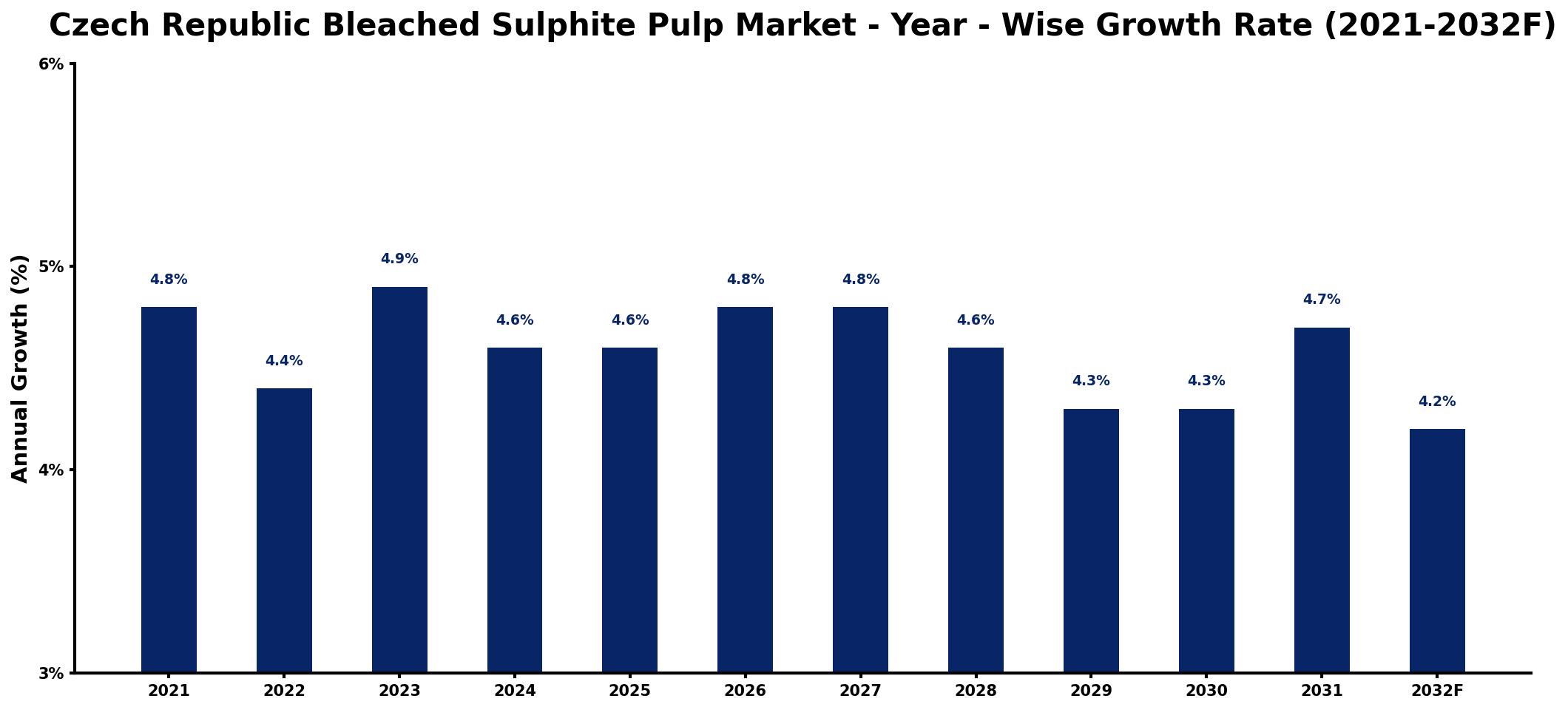
The table below presents the year‑wise growth rates along with the key drivers influencing the market
| Year | Growth Rate | Major Drivers |
| 2021 | 4.8% | Increased demand from packaging industry |
| 2022 | 4.4% | Growing interest in sustainable materials |
| 2023 | 4.9% | Rise in consumer eco-consciousness |
| 2024 | 4.6% | Expansion of recycling initiatives globally |
| 2025 | 4.6% | Higher production capacities for manufacturers |
| 2026 | 4.8% | Investments in advanced processing technologies |
| 2027 | 4.8% | Growing exports to neighboring markets |
| 2028 | 4.6% | Emergence of new market players |
| 2029 | 4.3% | Increased applications in hygiene products |
| 2030 | 4.3% | Strengthened partnerships with suppliers |
| 2031 | 4.7% | Innovations in product development strategies |
| 2032 | 4.2% | Focus on renewable resource utilization |
Note: Market size estimations and growth projections presented in this report are based on 6Wresearch's proprietary forecasting methodology, utilizing the latest available industry data, government publications, and primary research inputs.
Czech Republic Bleached Sulphite Pulp Market Synopsis
Recently, the bleached sulphite pulp market in the Czech Republic has experienced a notable uptick in momentum, primarily propelled by the escalating demand for premium pulp used in high-grade paper production. However, as environmental awareness continues to grow, the market is expected to shift towards more sustainable practices and compliance with stringent regulations.
Looking ahead, the market is on a path towards enhanced sustainability, driven by innovations in pulp production and a rising preference for eco-conscious consumer products. As industries adapt to these changes, the market's trajectory will reflect a greater alignment with environmental policies and consumer expectations for greener packaging solutions.
Czech Republic Bleached Sulphite Pulp Market Key Takeaways
- The market is experiencing robust growth due to heightened demand for sustainable and high-quality pulp products.
- Innovations in production processes are crucial for meeting evolving environmental standards.
- Adoption of recyclable packaging materials is driving significant interest in bleached sulphite pulp applications.
- Stricter regulations are shaping the operational landscape for manufacturers in the sector.
- The outlook remains positive, with continued investments anticipated in sustainable practices and technologies.
Evaluation of Restraints in Czech Republic Bleached Sulphite Pulp Market
Despite the promising growth prospects, the Czech Republic bleached sulphite pulp market faces notable restraints that could impede progress. Foremost among these are stringent environmental regulations that require manufacturers to adopt sustainable production methodologies. As the demand for eco-friendly products continues to rise, companies must not only comply with these regulations but also demonstrate their sustainability credentials, which can entail significant investment and operational adjustments. Furthermore, increasing competition from alternative materials, particularly recycled pulp, presents challenges in maintaining market share and profitability.
Czech Republic Bleached Sulphite Pulp Market Trends
The demand for bleached sulphite pulp is increasingly influenced by several key trends. First, there is a growing emphasis on sustainability, leading companies to invest in environmentally responsible production techniques. Innovations in pulping technology are also emerging, aiming to enhance the performance of bleached sulphite pulp while reducing environmental impact. Furthermore, the rise in e-commerce is driving demand for quality packaging materials, propelling market players to focus on solutions that combine performance with eco-friendliness. These trends will likely shape the future landscape of the market.
Czech Republic Bleached Sulphite Pulp Market Opportunities
Several growth and investment opportunities exist within the Czech Republic bleached sulphite pulp market. The ongoing shift towards sustainable packaging solutions presents a unique opportunity for market players to expand their product offerings and innovate in areas that enhance biodegradability and recyclability. Additionally, collaborative efforts with research institutions can pave the way for the development of advanced pulp technologies, fostering product differentiation. Emerging applications in sectors such as textiles and specialty papers also signal areas for potential growth and diversification.
Government Initiatives in the Czech Republic Bleached Sulphite Pulp Market
The Czech government has implemented various initiatives aimed at fostering sustainability in the bleached sulphite pulp market. Key policies emphasize sustainable forestry practices and the reduction of environmental impacts from pulp production. Compliance with European Union regulations on emissions and waste management is mandatory for producers, with additional government incentives available for companies that adopt eco-friendly practices. Furthermore, research and development initiatives are supported to explore new applications for bleached sulphite pulp, promoting innovation and competitiveness in the market.
Future Insights of the Czech Republic Bleached Sulphite Pulp Market
The outlook for the Czech Republic bleached sulphite pulp market from 2026 to 2032 indicates a continued alignment with sustainability and quality standards. As consumer preferences shift towards eco-friendly products, manufacturers will need to adopt innovative practices to maintain competitiveness. The anticipated regulatory environment will further encourage firms to invest in cleaner technologies, ensuring compliance while meeting growing market demands. Overall, the market is positioned for steady growth, supported by a combination of sustainability initiatives and evolving industry dynamics.
Czech Republic Bleached Sulphite Pulp Market Latest Developments (2025 - 2026)
Recent developments within the Czech Republic's bleached sulphite pulp sector reveal a strong commitment to sustainability and innovation. Many manufacturers are focusing on upgrading their facilities to comply with stricter environmental regulations while enhancing production efficiency. Additionally, collaborations with research institutions are gaining momentum, aimed at developing advanced pulping technologies that align with ecological goals. The push for recyclable packaging continues to shape investment decisions, leading to a more competitive market landscape.
Czech Republic Bleached Sulphite Pulp Market - Key Attractiveness of the Report
- 10 Years of Market Numbers
- Historical Data Starting from 2022 to 2025
- Base Year: 2025
- Forecast Data until 2032
- Key Performance Indicators Impacting the Market
- Major Upcoming Developments and Projects
Key Highlights of the Report:
- Czech Republic Bleached Sulphite Pulp Market Outlook
- Market Size of Czech Republic Bleached Sulphite Pulp Market, 2025
- Forecast of Czech Republic Bleached Sulphite Pulp Market, 2032
- Historical Data and Forecast of Czech Republic Bleached Sulphite Pulp Revenues & Volume for the Period 2022-2032F
- Czech Republic Bleached Sulphite Pulp Market Trend Evolution
- Czech Republic Bleached Sulphite Pulp Market Drivers and Challenges
- Czech Republic Bleached Sulphite Pulp Price Trends
- Czech Republic Bleached Sulphite Pulp Porter's Five Forces
- Czech Republic Bleached Sulphite Pulp Industry Life Cycle
- Historical Data and Forecast of Czech Republic Bleached Sulphite Pulp Market Revenues & Volume By End Use for the Period 2022-2032F
- Historical Data and Forecast of Czech Republic Bleached Sulphite Pulp Market Revenues & Volume By Chemical for the Period 2022-2032F
- Historical Data and Forecast of Czech Republic Bleached Sulphite Pulp Market Revenues & Volume By Healthcare for the Period 2022-2032F
- Historical Data and Forecast of Czech Republic Bleached Sulphite Pulp Market Revenues & Volume By Furniture for the Period 2022-2032F
- Historical Data and Forecast of Czech Republic Bleached Sulphite Pulp Market Revenues & Volume By Others for the Period 2022-2032F
- Czech Republic Bleached Sulphite Pulp Import Export Trade Statistics
- Market Opportunity Assessment By End Use
- Czech Republic Bleached Sulphite Pulp Top Companies Market Share
- Czech Republic Bleached Sulphite Pulp Competitive Benchmarking By Technical and Operational Parameters
- Czech Republic Bleached Sulphite Pulp Company Profiles
- Czech Republic Bleached Sulphite Pulp Key Strategic Recommendations






































