Czech Republic Critical Infrastructure Protection Market Size & Growth Rate (2026-2032)
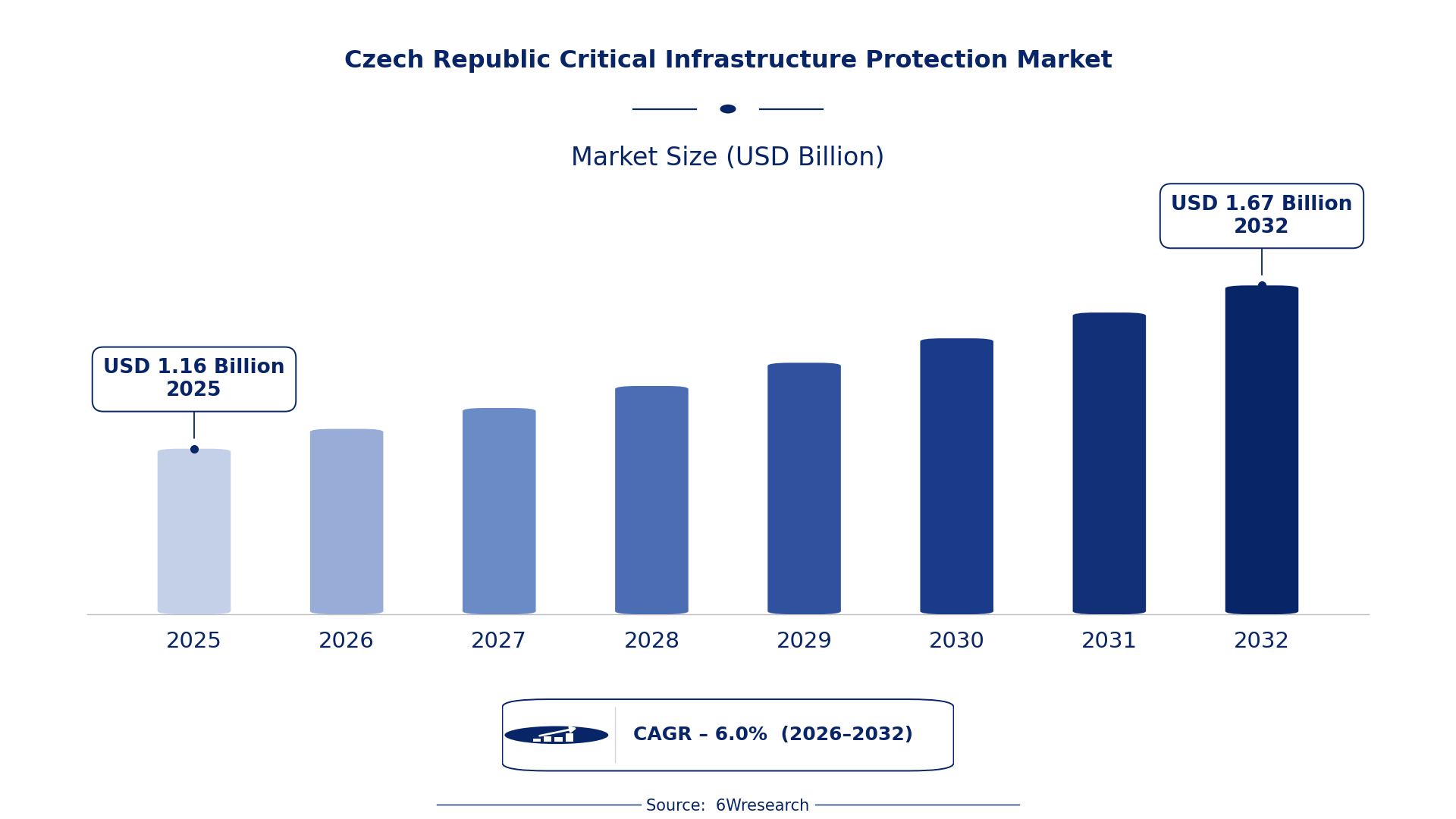
The Czech Republic Critical Infrastructure Protection Market was estimated at USD 1158 Million in 2025 and is projected to reach USD 1672 Million by 2032, growing at a CAGR of 6.0% from 2026 to 2032.
Czech Republic Critical Infrastructure Protection Market Synopsis
The Czech Republic's Critical Infrastructure Protection Market is gaining momentum, driven by heightened awareness of potential threats. As the country increasingly recognizes the vulnerabilities in sectors like energy, transportation, and information technology, the shift towards advanced security solutions becomes more pronounced.
Looking ahead, this market is on a clear trajectory toward integrating innovative technologies and collaborative efforts. With public and private entities now more focused on resilience, the push for comprehensive security measures is not just a response to immediate threats, but a strategic investment in national stability.
Czech Republic Critical Infrastructure Protection Market Year-wise Growth Rate and Key Drivers
This graph illustrates the annual growth rates of the Czech Republic Critical Infrastructure Protection Market from 2021 to 2032, highlighting a steady upward trajectory and projected expansion over the forecast period.
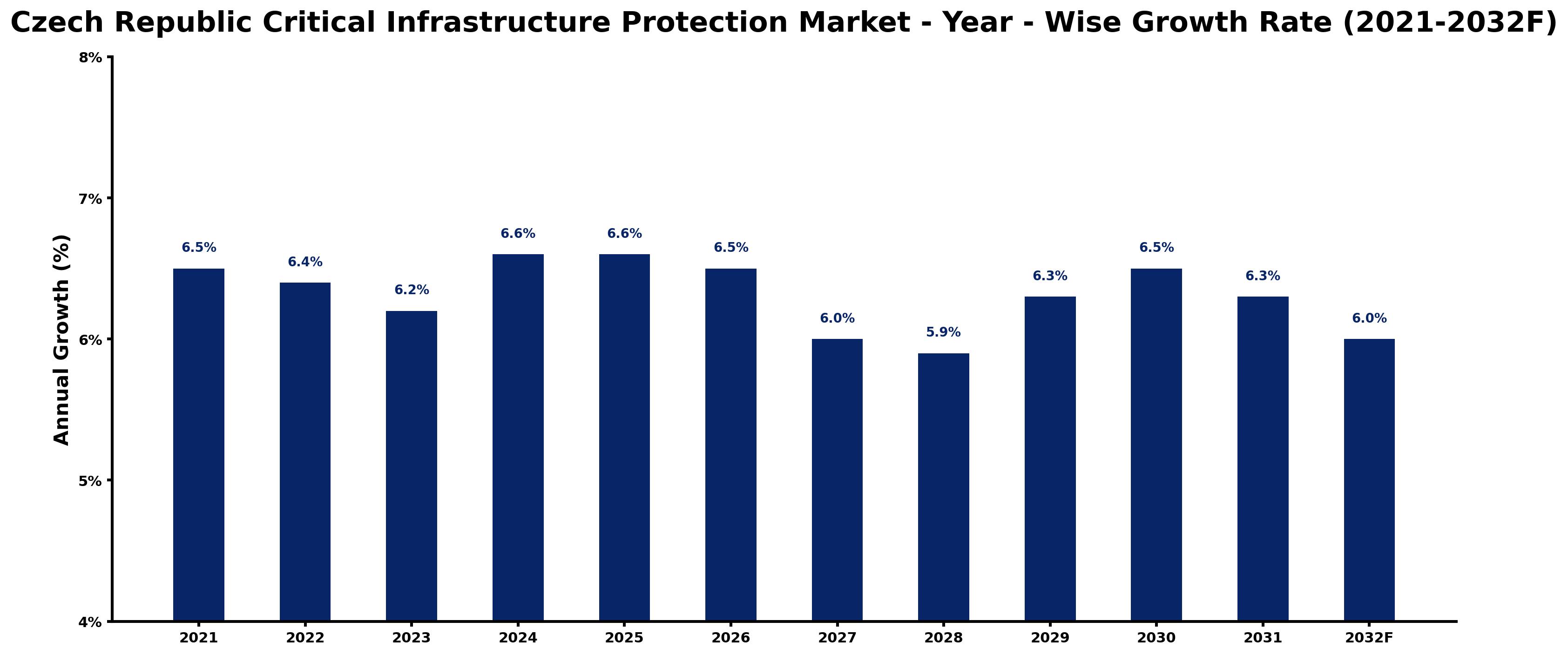
The table below presents the year‑wise growth rates along with the key drivers influencing the market
| Year | Growth Rate | Major Drivers |
| 2021 | 6.5% | Increased NATO cybersecurity commitments for member states. |
| 2022 | 6.4% | New Cyber Security Act enhancing national defense protocols. |
| 2023 | 6.2% | Growing private sector investment in critical infrastructure security. |
| 2024 | 6.6% | Czech government's focus on protecting energy sector assets. |
| 2025 | 6.6% | EU funding for resilience in critical infrastructure projects. |
| 2026 | 6.5% | Public awareness campaigns on critical infrastructure vulnerabilities. |
| 2027 | 6.0% | National strategy prioritizing protection against cyber threats. |
| 2028 | 5.9% | Emergence of local startups in infrastructure security technology. |
| 2029 | 6.3% | Strengthened cooperation with EU on critical infrastructure security. |
| 2030 | 6.5% | Regulatory framework evolution supporting risk assessment practices. |
| 2031 | 6.3% | Increased threat levels prompting advanced security solutions demand. |
| 2032 | 6.0% | Focus on smart grids enhancing infrastructure protection measures. |
Note: Market size estimations and growth projections presented in this report are based on 6Wresearch's proprietary forecasting methodology, utilizing the latest available industry data, government publications, and primary research inputs.
Czech Republic Critical Infrastructure Protection Market Key Takeaways
Below are some of the specific key takeaways from the market, including:
- The growing demand for cybersecurity solutions reflects the urgent need to protect critical infrastructure from cyber threats.
- Advanced technologies such as IoT security and cloud-based services are increasingly integrated into security frameworks.
- Government policies are facilitating public-private partnerships to enhance the security of critical infrastructure.
- Investment opportunities exist across various sectors, including energy, transportation, and telecommunications.
- The market's evolution is characterized by a continuous focus on technology-driven solutions to bolster resilience.
Evaluation of Restraints in Czech Republic Critical Infrastructure Protection Market
Despite the positive outlook, several constraints challenge the growth of the Czech Republic Critical Infrastructure Protection Market. The rapid evolution of cyber threats necessitates constant technological advancements, a task that demands significant investment and expertise. Compliance with stringent regulations also places a burden on operators who must balance costs against security needs.
on top of that, the interconnectivity of critical systems raises concerns about cascading failures during incidents. This complexity underscores the importance of comprehensive strategies that can effectively address vulnerabilities. A shortage of skilled professionals in cybersecurity further exacerbates these challenges, necessitating focused training and recruitment efforts.
Czech Republic Critical Infrastructure Protection Market Trends
Key trends are shaping the Czech Republic Critical Infrastructure Protection Market. There’s a pronounced shift toward cybersecurity, particularly as more critical services embrace digitalization. This trend catalyzes a demand for risk assessment and incident response capabilities, which are essential for managing and mitigating threats effectively.
Additionally, the collaboration between government bodies and private entities is becoming a defining characteristic of market dynamics. Such partnerships are facilitating improved information sharing and enhancing overall security postures across critical infrastructure sectors.
Czech Republic Critical Infrastructure Protection Market Opportunities
Opportunities for investment in the Czech Republic Critical Infrastructure Protection Market abound as sectors seek advanced security solutions. The increasing threat of cyberattacks compels organizations to prioritize cybersecurity services, from surveillance systems to access control measures. Investors can also focus on developing tailored risk assessment services that cater to the specific needs of infrastructure operators.
Research and development plays a crucial role in addressing the evolving security landscape, presenting avenues for innovation that can lead to new security solutions. This emphasis on customization and advanced technology will likely yield fruitful investments in the coming years.
Government Initiatives in the Czech Republic Critical Infrastructure Protection Market
Government policies are instrumental in shaping the Czech Republic Critical Infrastructure Protection Market, focusing on enhancing security across essential sectors like energy and transportation. Agencies such as the National Cyber and Information Security Agency (NUKIB) are actively working to mitigate risks and ensure resilience against threats. The emphasis on regulatory frameworks solidifies the public sector's commitment to protecting critical infrastructure.
- A recent initiative by the National Security Authority (NSÚ) established a set of guidelines for organizations to improve their cybersecurity measures.
- Currently underway is a national program aimed at bolstering public-private partnerships to share cybersecurity intelligence effectively.
- Upcoming plans include the rollout of a comprehensive digital infrastructure upgrade initiative by 2026 to enhance the resilience of critical services.
- Additionally, the adoption of the EU NIS Directive highlights the government's focus on standardizing security practices across sectors.
- The government is promoting awareness campaigns targeting key sectors to highlight the importance of infrastructure protection.
Future Insights of the Czech Republic Critical Infrastructure Protection Market
Looking ahead to 2026-2032, the Czech Republic Critical Infrastructure Protection Market is set for a period of steady growth, driven by the ongoing evolution of cybersecurity threats and government initiatives. The integration of new technologies and increased collaboration between sectors will play vital roles in shaping future developments.
As organizations recognize the imperative to safeguard critical infrastructure, the demand for advanced security solutions will continue to escalate. This growing awareness, coupled with government support, positions the market favorably for sustained investment and innovation.
Czech Republic Critical Infrastructure Protection Market Latest Developments
Recent activity in the Czech Republic Critical Infrastructure Protection Market has been characterized by a notable surge in initiatives aimed at enhancing security. In the past year, various stakeholders have begun prioritizing advanced solutions that address both physical and cyber threats effectively.
- A major technology vendor launched a new cybersecurity platform tailored for critical infrastructure operators, with deployment completed in early 2025.
- An ongoing partnership between several municipalities is focusing on developing a shared cybersecurity framework to protect local infrastructure, initiated in Q3 2025.
- A planned expansion of surveillance capabilities across transportation hubs is expected to commence by mid-2026, enhancing physical security measures.
- A recent public sector initiative established a certification program for cybersecurity professionals, currently being implemented to bridge the skills gap.
- Another ongoing project aims to integrate AI-driven analytics into existing security systems, with a rollout expected by early 2026.
Czech Republic Critical Infrastructure Protection Market - Key Attractiveness of the Report
- 10 Years of Market Numbers
- Historical Data Starting from 2022 to 2025
- Base Year: 2025
- Forecast Data until 2032
- Key Performance Indicators Impacting the Market
- Major Upcoming Developments and Projects
Key Highlights of the Report:
- Czech Republic Critical Infrastructure Protection Market Outlook
- Market Size of Czech Republic Critical Infrastructure Protection Market, 2025
- Forecast of Czech Republic Critical Infrastructure Protection Market, 2032
- Historical Data and Forecast of Czech Republic Critical Infrastructure Protection Revenues & Volume for the Period 2022-2032F
- Czech Republic Critical Infrastructure Protection Market Trend Evolution
- Czech Republic Critical Infrastructure Protection Market Drivers and Challenges
- Czech Republic Critical Infrastructure Protection Price Trends
- Czech Republic Critical Infrastructure Protection Porter's Five Forces
- Czech Republic Critical Infrastructure Protection Industry Life Cycle
- Historical Data and Forecast of Czech Republic Critical Infrastructure Protection Market Revenues & Volume By Solution for the Period 2022-2032F
- Historical Data and Forecast of Czech Republic Critical Infrastructure Protection Market Revenues & Volume By Physical Safety for the Period 2022-2032F
- Historical Data and Forecast of Czech Republic Critical Infrastructure Protection Market Revenues & Volume By Security Video Surveillance Systems for the Period 2022-2032F
- Historical Data and Forecast of Czech Republic Critical Infrastructure Protection Market Revenues & Volume By Screening for the Period 2022-2032F
- Historical Data and Forecast of Czech Republic Critical Infrastructure Protection Market Revenues & Volume By Scanning for the Period 2022-2032F
- Historical Data and Forecast of Czech Republic Critical Infrastructure Protection Market Revenues & Volume By Cybersecurity for the Period 2022-2032F
- Historical Data and Forecast of Czech Republic Critical Infrastructure Protection Market Revenues & Volume By Encryption for the Period 2022-2032F
- Historical Data and Forecast of Czech Republic Critical Infrastructure Protection Market Revenues & Volume By Threat Intelligence for the Period 2022-2032F
- Historical Data and Forecast of Czech Republic Critical Infrastructure Protection Market Revenues & Volume By Component for the Period 2022-2032F
- Historical Data and Forecast of Czech Republic Critical Infrastructure Protection Market Revenues & Volume By Solution for the Period 2022-2032F
- Historical Data and Forecast of Czech Republic Critical Infrastructure Protection Market Revenues & Volume By Services for the Period 2022-2032F
- Historical Data and Forecast of Czech Republic Critical Infrastructure Protection Market Revenues & Volume By Vertical for the Period 2022-2032F
- Historical Data and Forecast of Czech Republic Critical Infrastructure Protection Market Revenues & Volume By Financial Institutions for the Period 2022-2032F
- Historical Data and Forecast of Czech Republic Critical Infrastructure Protection Market Revenues & Volume By Government for the Period 2022-2032F
- Historical Data and Forecast of Czech Republic Critical Infrastructure Protection Market Revenues & Volume By Defense for the Period 2022-2032F
- Historical Data and Forecast of Czech Republic Critical Infrastructure Protection Market Revenues & Volume By Transport and Logistics for the Period 2022-2032F
- Historical Data and Forecast of Czech Republic Critical Infrastructure Protection Market Revenues & Volume By Energy and Power for the Period 2022-2032F
- Historical Data and Forecast of Czech Republic Critical Infrastructure Protection Market Revenues & Volume By Commercial Sector for the Period 2022-2032F
- Historical Data and Forecast of Czech Republic Critical Infrastructure Protection Market Revenues & Volume By Telecom for the Period 2022-2032F
- Historical Data and Forecast of Czech Republic Critical Infrastructure Protection Market Revenues & Volume By Chemicals and Manufacturing for the Period 2022-2032F
- Czech Republic Critical Infrastructure Protection Import Export Trade Statistics
- Market Opportunity Assessment By Solution
- Market Opportunity Assessment By Cybersecurity
- Market Opportunity Assessment By Component
- Market Opportunity Assessment By Vertical
- Czech Republic Critical Infrastructure Protection Top Companies Market Share
- Czech Republic Critical Infrastructure Protection Competitive Benchmarking By Technical and Operational Parameters
- Czech Republic Critical Infrastructure Protection Company Profiles
- Czech Republic Critical Infrastructure Protection Key Strategic Recommendations






































