Czech Republic Cultured Meat Market Size, Share & Growth Rate
The Czech Republic Cultured Meat Market was estimated at USD 166 Million in 2025 and is projected to reach USD 229 Million by 2032, growing at a CAGR of 4.7% from 2026 to 2032. This growth trajectory reflects the nation's increasing consumer interest in sustainable food options and a burgeoning awareness of the ethical implications of traditional meat production. Coupled with advancements in food technology and government support, these factors collectively enhance the market's appeal among health-conscious and environmentally aware consumers.
Czech Republic Cultured Meat Market Year-wise Growth Rate and Key Drivers
This graph highlights how the Czech Republic Cultured Meat Market has steadily grown over the years, supported by major growth factors.
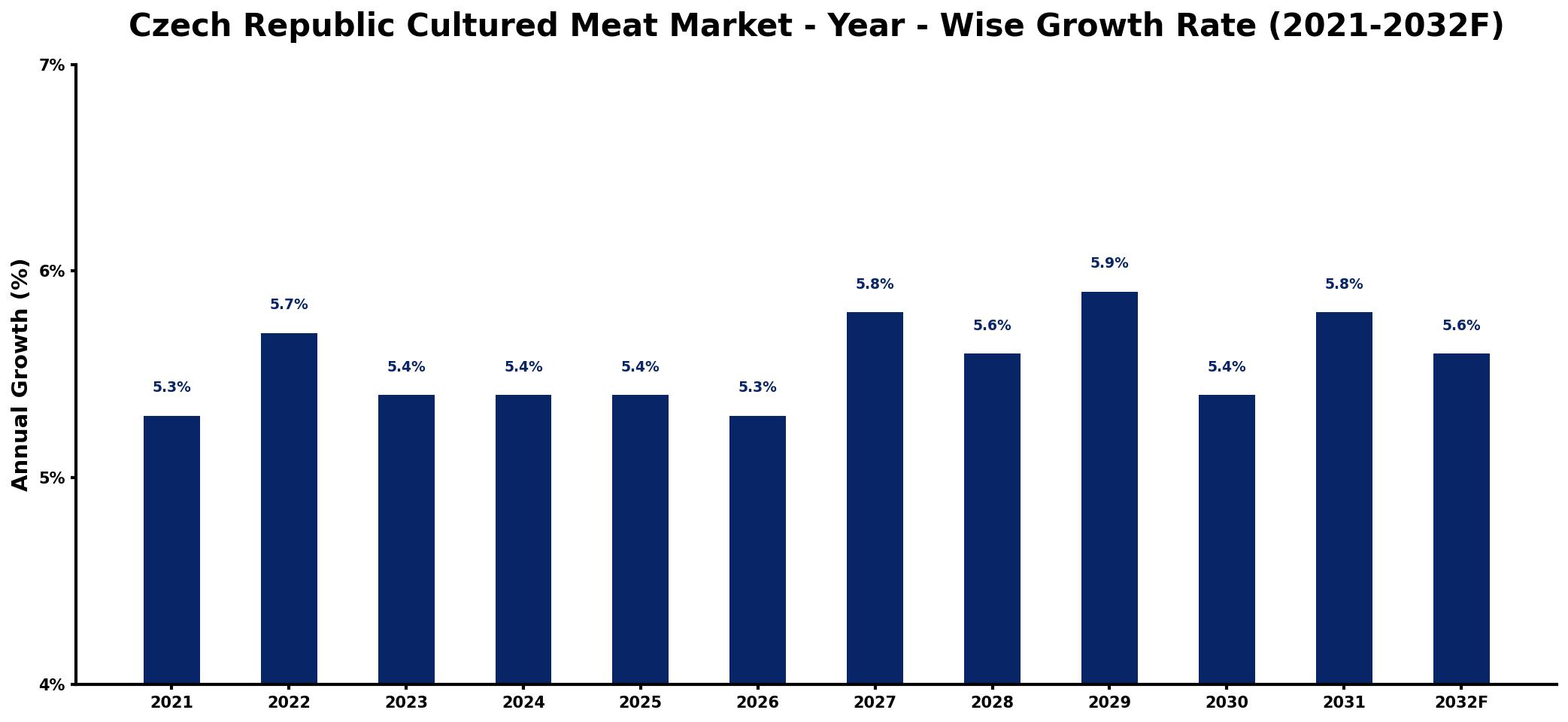
The table below presents the year‑wise growth rates along with the key drivers influencing the market
| Year | Growth Rate | Major Drivers |
| 2021 | 5.3% | Rising consumer health awareness |
| 2022 | 5.7% | Increased investment in technology |
| 2023 | 5.4% | Growing environmental sustainability focus |
| 2024 | 5.4% | Expansion of regulatory frameworks |
| 2025 | 5.4% | Surge in alternative protein options |
| 2026 | 5.3% | Enhanced production efficiency methods |
| 2027 | 5.8% | Growing global market acceptance |
| 2028 | 5.6% | Strengthened supply chain partnerships |
| 2029 | 5.9% | Increased food safety regulations |
| 2030 | 5.4% | Higher consumer education initiatives |
| 2031 | 5.8% | Emergence of innovative startups |
| 2032 | 5.6% | Wider distribution network development |
Note: Market size estimations and growth projections presented in this report are based on 6Wresearch's proprietary forecasting methodology, utilizing the latest available industry data, government publications, and primary research inputs.
Czech Republic Cultured Meat Market Synopsis
As consumer preferences shift toward sustainable food sources, the cultured meat market in the Czech Republic has begun to gain traction. The focus on ethical production practices and reducing the carbon footprint of food production is steering consumers toward lab-grown alternatives, marking a significant change in eating habits.
The advancements in cellular agriculture not only appeal to the environmentally conscious but also cater to an evolving palate. With a growing number of startups and research initiatives developing innovative cultured meat products, the market landscape is poised for expansion as it adapts to local tastes and preferences.
Czech Republic Cultured Meat Market Key Takeaways
- Rising consumer awareness surrounding sustainability and animal welfare drives market growth.
- Government support and funding are critical for research initiatives in cultured meat production.
- Technological advancements are essential to lowering production costs and enhancing product acceptance.
- Public perception remains a significant barrier to widespread adoption of lab-grown meat alternatives.
- Market growth is projected to be steady, reflecting a gradual shift in consumer preferences.
Evaluation of Restraints in Czech Republic Cultured Meat Market
Despite its promising potential, the Czech Republic Cultured Meat Market faces several notable restraints. Regulatory challenges are particularly pressing, as the approval process for cultured meat remains in its infancy, complicating the ability of producers to enter the market. Furthermore, public skepticism regarding lab-grown meat creates an additional hurdle; consumers often express reluctance to embrace products perceived as artificial. Lastly, the high production costs tied to research and technology development continue to impede affordability and accessibility, which could otherwise accelerate market penetration.
Czech Republic Cultured Meat Market Trends
Several trends are influencing the Czech Republic Cultured Meat Market. Firstly, the integration of innovative food technology is transforming production methods and improving the quality of cultured meat offerings. Moreover, consumer education initiatives are emerging to address misconceptions about lab-grown meat, helping to mitigate public skepticism. Finally, the increasing collaboration between academia and industry is fostering advancements in cultured meat science, enhancing product development and market readiness.
Czech Republic Cultured Meat Market Opportunities
Opportunities for growth within the Czech Republic Cultured Meat Market lie significantly in the development of niche products tailored to local tastes. Additionally, strategic partnerships between startups and established food companies can expedite market entry and broaden distribution channels. Emerging platforms for consumer education present the chance to reshape public perception, encouraging greater acceptance of cultured meat as a mainstream alternative. Lastly, as production technology matures and costs decrease, new avenues for product innovation and diversification are expected to unfold.
Government Initiatives in the Czech Republic Cultured Meat Market
The Czech government is actively promoting innovation in the food sector, particularly in alternative proteins such as cultured meat. Policies encouraging research and development, along with funding for initiatives that align with EU sustainability goals, are pivotal in shaping the market landscape. Regulatory frameworks focused on food safety and ethical production are also being developed, which aim to reassure consumers and foster a conducive environment for market growth.
Future Insights of the Czech Republic Cultured Meat Market
Looking ahead to 2026-2032, the Czech Republic Cultured Meat Market is set to evolve as consumer preferences continue to shift toward sustainable dining. The expected advancements in production technology will likely address current cost barriers, making cultured meat more accessible. Additionally, as regulatory bodies formalize guidelines and standards, consumer confidence is expected to rise, facilitating broader acceptance. This combination of factors positions the market for steady growth, reflecting a fundamental transformation in how meat products are perceived and consumed.
Czech Republic Cultured Meat Market Latest Developments (2025 - 2026)
In the recent months, the Czech Republic has seen a surge in research initiatives aimed at improving the viability of cultured meat products. Additionally, there has been increased collaboration among academic institutions and industry leaders focused on overcoming production challenges. Consumer engagement efforts are gaining momentum, with events designed to educate the public about the benefits of lab-grown meat. These developments signify a proactive approach to nurturing the cultured meat sector as it strives for growth and acceptance.
Czech Republic Cultured Meat Market - Key Attractiveness of the Report
- 10 Years of Market Numbers
- Historical Data Starting from 2022 to 2025
- Base Year: 2025
- Forecast Data until 2032
- Key Performance Indicators Impacting the Market
- Major Upcoming Developments and Projects
Key Highlights of the Report:
- Czech Republic Cultured Meat Market Outlook
- Market Size of Czech Republic Cultured Meat Market, 2025
- Forecast of Czech Republic Cultured Meat Market, 2032
- Historical Data and Forecast of Czech Republic Cultured Meat Revenues & Volume for the Period 2022-2032F
- Czech Republic Cultured Meat Market Trend Evolution
- Czech Republic Cultured Meat Market Drivers and Challenges
- Czech Republic Cultured Meat Price Trends
- Czech Republic Cultured Meat Porter's Five Forces
- Czech Republic Cultured Meat Industry Life Cycle
- Historical Data and Forecast of Czech Republic Cultured Meat Market Revenues & Volume By Product Type for the Period 2022-2032F
- Historical Data and Forecast of Czech Republic Cultured Meat Market Revenues & Volume By Poultry for the Period 2022-2032F
- Historical Data and Forecast of Czech Republic Cultured Meat Market Revenues & Volume By Beef for the Period 2022-2032F
- Historical Data and Forecast of Czech Republic Cultured Meat Market Revenues & Volume By Seafood for the Period 2022-2032F
- Historical Data and Forecast of Czech Republic Cultured Meat Market Revenues & Volume By Pork for the Period 2022-2032F
- Historical Data and Forecast of Czech Republic Cultured Meat Market Revenues & Volume By Duck for the Period 2022-2032F
- Historical Data and Forecast of Czech Republic Cultured Meat Market Revenues & Volume By End-Use for the Period 2022-2032F
- Historical Data and Forecast of Czech Republic Cultured Meat Market Revenues & Volume By Nuggets for the Period 2022-2032F
- Historical Data and Forecast of Czech Republic Cultured Meat Market Revenues & Volume By Burgers for the Period 2022-2032F
- Historical Data and Forecast of Czech Republic Cultured Meat Market Revenues & Volume By Meatballs for the Period 2022-2032F
- Historical Data and Forecast of Czech Republic Cultured Meat Market Revenues & Volume By Sausage for the Period 2022-2032F
- Historical Data and Forecast of Czech Republic Cultured Meat Market Revenues & Volume By Hot dogs for the Period 2022-2032F
- Historical Data and Forecast of Czech Republic Cultured Meat Market Revenues & Volume By Others for the Period 2022-2032F
- Czech Republic Cultured Meat Import Export Trade Statistics
- Market Opportunity Assessment By Product Type
- Market Opportunity Assessment By End-Use
- Czech Republic Cultured Meat Top Companies Market Share
- Czech Republic Cultured Meat Competitive Benchmarking By Technical and Operational Parameters
- Czech Republic Cultured Meat Company Profiles
- Czech Republic Cultured Meat Key Strategic Recommendations






































