Czech Republic Electrical Equipment Market Summary
The czech republic electrical equipment market was estimated at USD 1199 Million in 2025 and is projected to reach USD 1741 Million by 2032, growing at a CAGR of 6.7% from 2026 to 2032.
Czech Republic Electrical Equipment Market Year-wise Growth Rate and Key Drivers
This graph highlights how the Czech Republic Electrical Equipment Market has steadily grown over the past five years, supported by major growth factors.
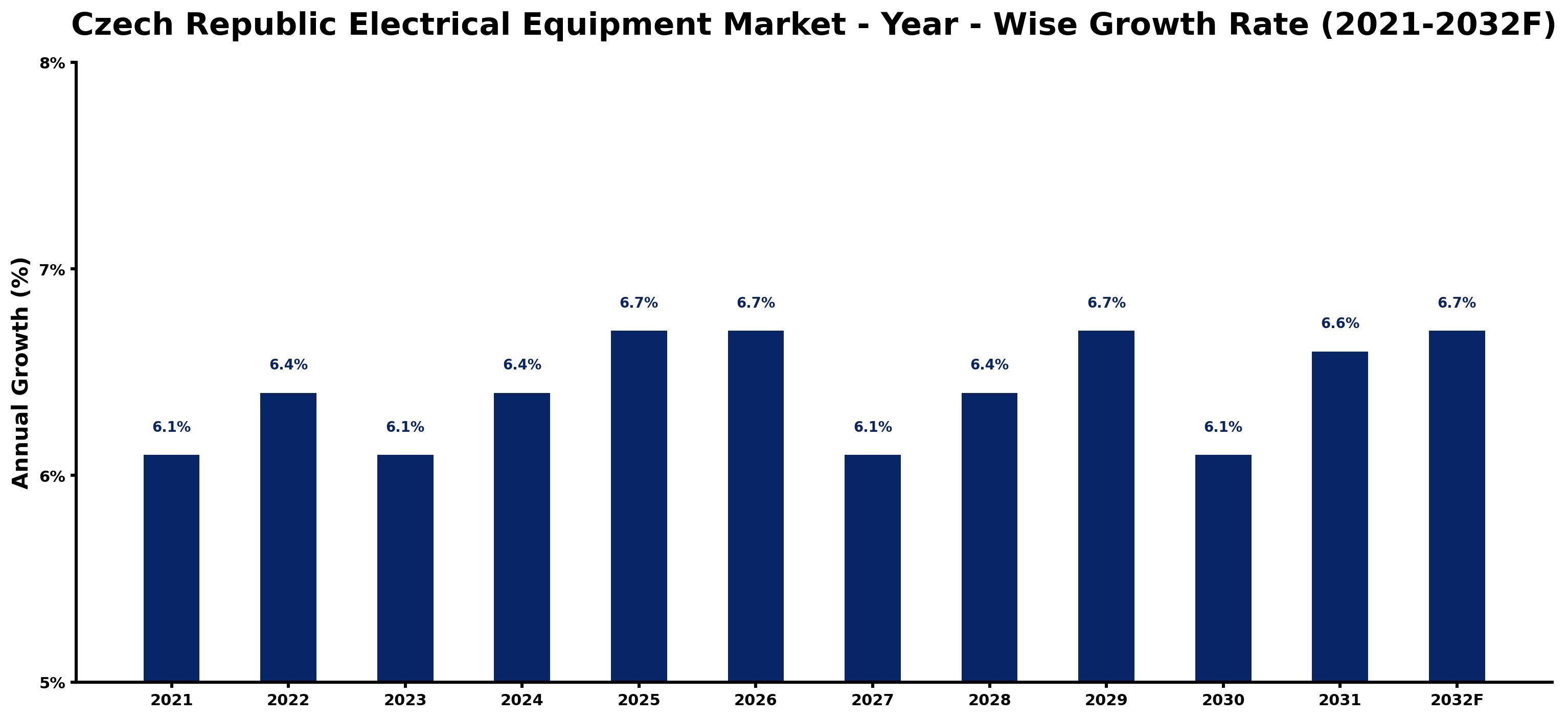
The table below presents the year wise growth rates along with the key drivers influencing the market
| Year | Growth Rate | Major Drivers |
| 2021 | 6.1% | Post-lockdown retail projects began investing heavily in energy-efficient technologies. |
| 2022 | 6.4% | Transition towards smart grids highlighted the need for advanced electrical infrastructure upgrades. |
| 2023 | 6.1% | Corporate sustainability initiatives prioritized investment in renewable energy sources and equipment. |
| 2024 | 6.4% | Local manufacturers increasingly sought to enhance production capacities through automation enhancements. |
| 2025 | 6.7% | Emerging technologies in energy storage created new market opportunities for electrical suppliers. |
| 2026 | 6.7% | Industrial sectors adapted to stricter energy efficiency regulations, necessitating updated electrical equipment. |
| 2027 | 6.1% | Collaboration between tech startups and established firms fostered innovative electrical solutions. |
| 2028 | 6.4% | Urbanization trends prompted infrastructure expansions, amplifying demand for electrical installations. |
| 2029 | 6.7% | Consumer preferences shifted towards smart home technologies, influencing electrical product designs. |
| 2030 | 6.1% | Investment in electric mobility surged, pressing manufacturers for compatible charging solutions. |
| 2031 | 6.6% | Challenges in conventional energy sources led to increased focus on sustainable electrical systems. |
| 2032 | 6.7% | Market consolidation among electrical equipment firms aimed to enhance service offerings and technology. |
Note - Market size estimations and growth projections presented in this report are based on 6Wresearch's advanced forecasting approach, validated with industry datasets as of June 2026.
Czech Republic Electrical Equipment Market Synopsis
The Czech Republic Electrical Equipment Market is projected to reach 6.7% and witness significant growth during the forecast period (2026-2032). This growth is driven by the increasing demand for energy-efficient products and advanced technologies in various sectors, including industrial automation and infrastructure development. Additionally, the transition towards renewable energy sources is influencing market dynamics, creating opportunities for innovative electrical solutions. Key segments within the market encompass wiring devices, lighting fixtures, power distribution equipment, and electrical machinery, each contributing to the overall expansion of this sector.
Czech Republic Electrical Equipment Market Growth Drivers
Several factors are propelling the Czech Republic Electrical Equipment Market forward. Firstly, the drive for energy efficiency has become a primary focus, especially as consumers and businesses alike seek to minimize energy consumption. Secondly, the growth of the construction sector, particularly in commercial and residential developments, is necessitating a higher demand for electrical installations. Thirdly, the adoption of smart technologies such as IoT applications and automation is enhancing operational efficiency across industries. Fourthly, the government's commitment to sustainability is incentivizing investments in renewable energy infrastructure, thereby increasing the need for related electrical equipment. Lastly, as digital transformation continues to reshape business processes, the overall demand for advanced electrical solutions is expected to rise significantly.
Czech Republic Electrical Equipment Market Challenges and Restraints
Despite the promising growth prospects, the Czech Republic Electrical Equipment Market faces several challenges. One major challenge is the intense competition from both domestic and international manufacturers, which can lead to pricing pressures that affect profitability. Additionally, the rapid pace of technological advancement necessitates continual innovation, placing strain on manufacturers to keep up with evolving consumer expectations. Fluctuating raw material prices pose another significant concern, as they can impact production costs and ultimately retail pricing. Furthermore, regulatory compliance regarding safety, quality, and environmental standards can impose additional burdens on manufacturers. Lastly, external factors such as economic uncertainties and geopolitical tensions may impact market stability and investor confidence.
Czech Republic Electrical Equipment Market Investment Opportunities
Investment opportunities within the Czech Republic Electrical Equipment Market are robust, fueled by a strong industrial base and the increasing demand for cutting-edge technology. Major areas for potential investment include:
- Smart home automation systems, which are increasingly favored by consumers seeking convenience and energy management.
- Energy-efficient lighting solutions, reflecting the global shift towards sustainability and reduced energy consumption.
- Electric vehicle charging infrastructure, driven by the rise of electric vehicles as a sustainable transportation option.
- Advanced power distribution equipment and smart grid technologies, which are vital for modernizing the energy landscape.
- Renewable energy systems such as solar panels and wind turbines, aligning with the government's initiatives for sustainable energy solutions.
Czech Republic Electrical Equipment Market Government Investment and Initiatives
The government of the Czech Republic has implemented various policies aimed at promoting energy efficiency and sustainability within the Electrical Equipment Market. Regulations requiring energy labeling for electrical appliances empower consumers by providing transparency about energy consumption. Additionally, incentives and subsidies for businesses and households investing in energy-saving technologies enhance market demand for such products. The Czech Republic also aligns with European Union directives on waste electrical and electronic equipment (WEEE) to ensure proper disposal and recycling, minimizing environmental impact. Through these initiatives, the government seeks to stimulate innovation while ensuring compliance with sustainability objectives.
Czech Republic Electrical Equipment Market Latest Developments (May 2025 - June 2026)
Recent developments in the Czech Republic Electrical Equipment Market indicate a growing momentum towards electrical modernization. During this period, there has been an increasing emphasis on integrating smart technologies into electrical equipment, fostering an environment for enhanced energy management and operational efficiency. The government has reinforced its initiatives to promote renewable energy adoption, leading to a noticeable uptick in investments related to solar and wind technologies. Further, industries are progressively implementing automation solutions, aligning with the global trend of digital transformation. These developments reflect a broader commitment to achieving a sustainable and technologically advanced electrical infrastructure in the country.
Czech Republic Electrical Equipment Market - Key Attractiveness of the Report
- 10 Years of Market Numbers
- Historical Data Starting from 2022 to 2025
- Base Year: 2025
- Forecast Data until 2032
- Key Performance Indicators Impacting the Market
- Major Upcoming Developments and Projects
Key Highlights of the Report:
- Czech Republic Electrical Equipment Market Outlook
- Market Size of Czech Republic Electrical Equipment Market, 2025
- Forecast of Czech Republic Electrical Equipment Market, 2032F
- Historical Data and Forecast of Czech Republic Electrical Equipment Revenues & Volume for the Period 2022-2032F
- Czech Republic Electrical Equipment Market Trend Evolution
- Czech Republic Electrical Equipment Market Drivers and Challenges
- Czech Republic Electrical Equipment Price Trends
- Czech Republic Electrical Equipment Porter's Five Forces
- Czech Republic Electrical Equipment Industry Life Cycle
- Historical Data and Forecast of Czech Republic Electrical Equipment Market Revenues & Volume By Types for the Period 2022-2032F
- Historical Data and Forecast of Czech Republic Electrical Equipment Market Revenues & Volume By Electronic and electrical wires and cables for the Period 2022-2032F
- Historical Data and Forecast of Czech Republic Electrical Equipment Market Revenues & Volume By Batteries and accumulators for the Period 2022-2032F
- Historical Data and Forecast of Czech Republic Electrical Equipment Market Revenues & Volume By Wiring devices for the Period 2022-2032F
- Historical Data and Forecast of Czech Republic Electrical Equipment Market Revenues & Volume By Electric lighting equipment for the Period 2022-2032F
- Historical Data and Forecast of Czech Republic Electrical Equipment Market Revenues & Volume By Others for the Period 2022-2032F
- Historical Data and Forecast of Czech Republic Electrical Equipment Market Revenues & Volume By Applications for the Period 2022-2032F
- Historical Data and Forecast of Czech Republic Electrical Equipment Market Revenues & Volume By Residential end-users for the Period 2022-2032F
- Historical Data and Forecast of Czech Republic Electrical Equipment Market Revenues & Volume By Non-residential end-users for the Period 2022-2032F
- Czech Republic Electrical Equipment Import Export Trade Statistics
- Market Opportunity Assessment By Types
- Market Opportunity Assessment By Applications
- Czech Republic Electrical Equipment Top Companies Market Share
- Czech Republic Electrical Equipment Competitive Benchmarking By Technical and Operational Parameters
- Czech Republic Electrical Equipment Company Profiles
- Czech Republic Electrical Equipment Key Strategic Recommendations






































