Czech Republic Facility Management Market Size & Growth Rate (2026-2032)
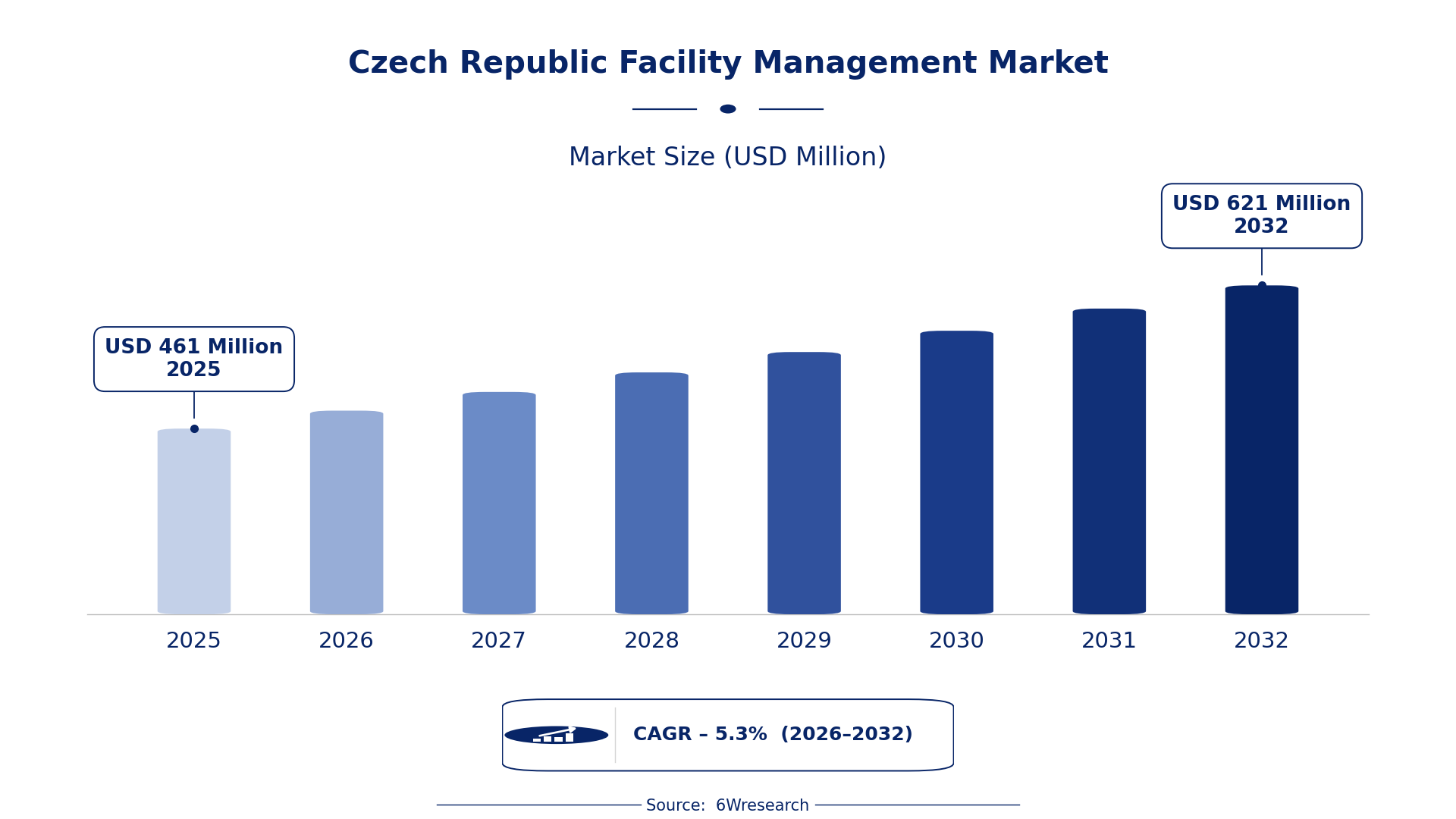
The Czech Republic Facility Management Market was estimated at USD 461 Million in 2025 and is projected to reach USD 621 Million by 2032, growing at a CAGR of 5.3% from 2026 to 2032.
Czech Republic Facility Management Market Synopsis
The Czech Republic Facility Management Market is on a solid growth trajectory, fueled by an increasing demand for effective management of commercial properties. As businesses recognize the advantages of outsourcing facility management services, the market is witnessing a marked shift towards integrated solutions that emphasize cost efficiency and sustainability.
Technological integration is another critical factor driving this market. The adoption of smart building technologies, IoT devices, and data analytics is reshaping how facility management operates, enabling real-time monitoring and predictive maintenance. As these trends continue to evolve, the market is set to offer abundant opportunities for innovation and specialization.
Czech Republic Facility Management Market Year-wise Growth Rate and Key Drivers
This graph illustrates the annual growth rates of the Czech Republic Facility Management Market from 2021 to 2032, highlighting a steady upward trajectory and projected expansion over the forecast period.
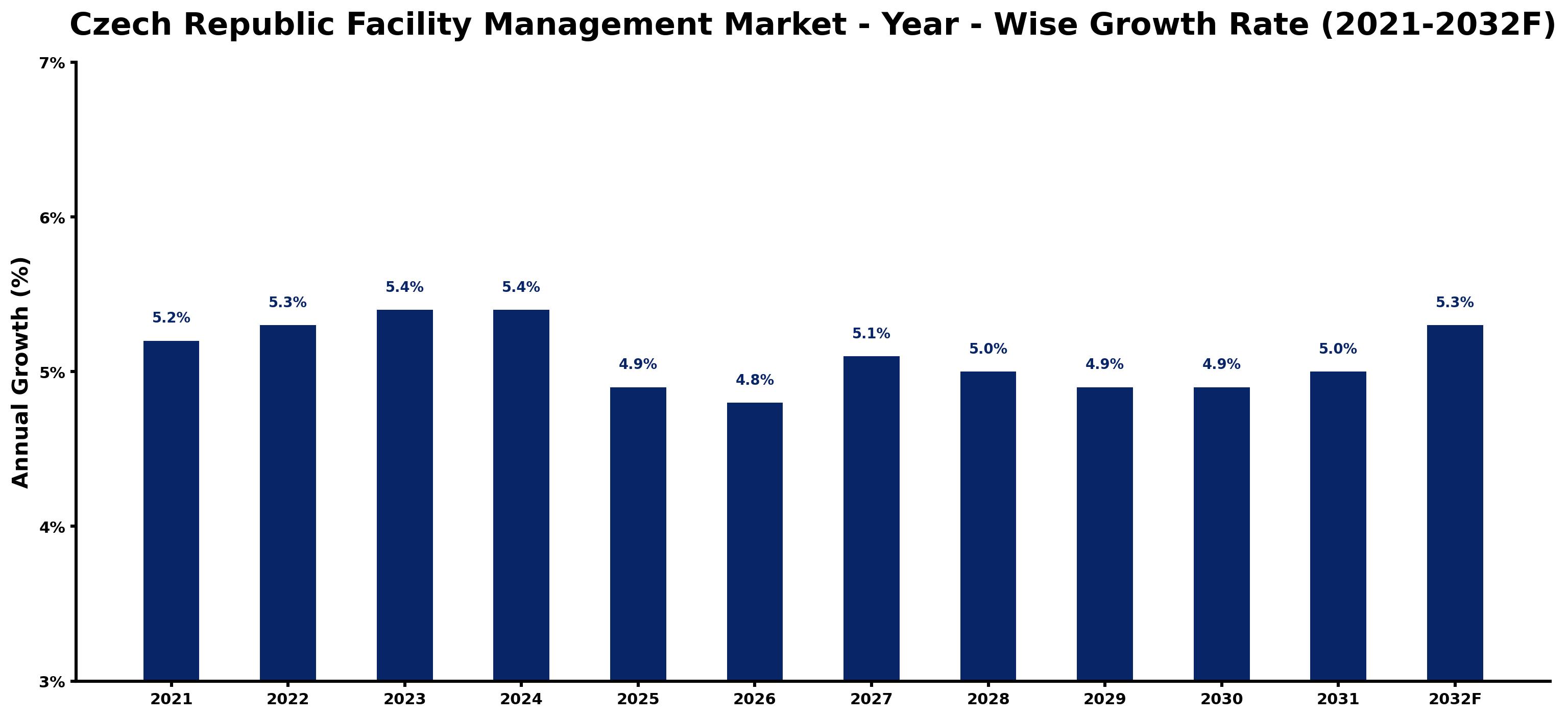
The table below presents the year‑wise growth rates along with the key drivers influencing the market
| Year | Growth Rate | Major Drivers |
| 2021 | 5.2% | Increased emphasis on workplace safety regulations by government. |
| 2022 | 5.3% | Growing trend of energy efficiency in building management. |
| 2023 | 5.4% | Implementation of stricter waste management laws enhancing services. |
| 2024 | 5.4% | Government support for smart building technologies adoption. |
| 2025 | 4.9% | Rising maintenance needs for aging infrastructure in cities. |
| 2026 | 4.8% | Boost in leasing activities pushing facility management demand. |
| 2027 | 5.1% | Increased investment in sustainable building practices nationwide. |
| 2028 | 5.0% | Demand for flexible workspace solutions post-COVID-19 pandemic. |
| 2029 | 4.9% | Heightened focus on occupational health and safety standards. |
| 2030 | 4.9% | Expanding corporate commitments to CSR enhancing facility services. |
| 2031 | 5.0% | Growth of remote work policies influencing facility strategies. |
| 2032 | 5.3% | Supportive legislation for digital transformation in facilities sector. |
Note: Market size estimations and growth projections presented in this report are based on 6Wresearch's proprietary forecasting methodology, utilizing the latest available industry data, government publications, and primary research inputs.
Czech Republic Facility Management Market Key Takeaways
Below are some of the specific key takeaways from the market, including:
- The market is characterized by a competitive environment with both local and international players.
- Outsourcing non-core functions is becoming a prevalent strategy among businesses.
- Sustainability and energy efficiency are emerging as primary focus areas.
- Technological advancements, particularly in IoT and data analytics, are transforming operational practices.
- Future growth is expected to be driven by sectors like healthcare and commercial real estate.
Evaluation of Restraints in Czech Republic Facility Management Market
Despite its promising outlook, the Czech Republic Facility Management Market faces notable challenges. Intense competition, especially in urban centers like Prague, compels service providers to continuously enhance their offerings and maintain competitive pricing. This competitive pressure can lead to reduced margins, making it difficult for companies to sustain profitability.
on top of that, the increasing demand for sustainable and technologically advanced solutions necessitates significant investment in new technologies and workforce training. Companies must adapt to shifting regulatory frameworks and labor market conditions, which can disrupt operations and impact service delivery.
Czech Republic Facility Management Market Trends
Current trends in the Czech Republic Facility Management Market highlight a marked shift towards integrated facility management solutions. Companies are prioritizing sustainability and energy efficiency, while simultaneously seeking ways to optimize operational costs. The integration of smart technologies and IoT devices is enhancing efficiency, allowing businesses to monitor and manage their facilities proactively.
Another emerging trend is the increasing reliance on data analytics to inform decision-making. Organizations are leveraging analytics to improve service delivery, enhance workplace experiences, and optimize resource allocation. This focus on technology-driven solutions is reshaping the market and setting the stage for future growth.
Czech Republic Facility Management Market Opportunities
There are significant growth opportunities within the Czech Republic Facility Management Market, particularly in sectors that are ripe for innovation. The healthcare and retail sectors are increasingly seeking comprehensive facility management solutions that integrate sustainability and technology. As businesses continue to outsource non-core functions, facility management companies have the chance to expand their service offerings.
Additionally, the growing emphasis on smart building technologies presents an avenue for FM companies to differentiate themselves. By adopting IoT-enabled devices and data-driven strategies, providers can offer enhanced operational efficiencies and improved client satisfaction. This focus on integrated solutions will be crucial for capturing emerging market opportunities.
Government Initiatives in the Czech Republic Facility Management Market
Government policies are significantly shaping the Czech Republic Facility Management Market. Authorities are promoting energy efficiency and sustainable practices through regulations and incentives. Compliance with health and safety standards in workplace environments is also emphasized, affecting how facility management services are delivered. As the government prioritizes infrastructure development and sustainability, facility management companies must align their strategies accordingly.
- A regulatory framework introduced in 2025 mandates energy efficiency standards for all new commercial buildings.
- Current initiatives include subsidies for implementing green technologies in facility management, aimed at reducing carbon footprints.
- A national waste management program is underway, influencing how facility services manage waste in commercial properties.
- Upcoming procurement regulations are expected to enhance transparency in selecting facility management providers for public sector projects.
Future Insights of the Czech Republic Facility Management Market
Looking ahead to 2026-2032, the Czech Republic Facility Management Market is anticipated to continue its upward trajectory. The ongoing trend of outsourcing non-core functions will drive demand for professional facility management services. As organizations increasingly focus on sustainability and operational efficiency, the market will likely see a surge in integrated solutions that address these needs.
The integration of advanced technologies will play a pivotal role in shaping the future of facility management. Companies that invest in IoT, AI, and data analytics will be better positioned to meet evolving client expectations and enhance their competitive edge. As the market matures, opportunities for innovation and specialization will emerge, fostering long-term growth.
Czech Republic Facility Management Market Latest Developments
Recent activity in the Czech Republic Facility Management Market indicates a dynamic environment, marked by a strong focus on technological advancements and sustainable practices. Companies are increasingly adopting innovative solutions to stay competitive and meet client demands. The market is evolving rapidly, creating opportunities for growth and expansion.
- A leading regional operator launched a new smart building management system in early 2025, enhancing operational efficiency.
- An initiative that began in mid-2025 aims to upgrade existing facilities with eco-friendly technologies, currently underway.
- A major technology vendor announced plans for a cloud-based platform rollout expected to begin in the second half of 2026, targeting enhanced service delivery.
- A partnership between two facility management providers was established in Q3 2025 to offer integrated services focused on sustainability.
Czech Republic Facility Management Market - Key Attractiveness of the Report
- 10 Years of Market Numbers
- Historical Data Starting from 2022 to 2025
- Base Year: 2025
- Forecast Data until 2032
- Key Performance Indicators Impacting the Market
- Major Upcoming Developments and Projects
What are the government’s key initiatives affecting facility management?
Key Highlights of the Report:
- Czech Republic Facility Management Market Outlook
- Market Size of Czech Republic Facility Management Market, 2025
- Forecast of Czech Republic Facility Management Market, 2032
- Historical Data and Forecast of Czech Republic Facility Management Revenues & Volume for the Period 2022-2032F
- Czech Republic Facility Management Market Trend Evolution
- Czech Republic Facility Management Market Drivers and Challenges
- Czech Republic Facility Management Price Trends
- Czech Republic Facility Management Porter's Five Forces
- Czech Republic Facility Management Industry Life Cycle
- Historical Data and Forecast of Czech Republic Facility Management Market Revenues & Volume By Component for the Period 2022-2032F
- Historical Data and Forecast of Czech Republic Facility Management Market Revenues & Volume By Solutions for the Period 2022-2032F
- Historical Data and Forecast of Czech Republic Facility Management Market Revenues & Volume By Services for the Period 2022-2032F
- Historical Data and Forecast of Czech Republic Facility Management Market Revenues & Volume By Deployment Mode for the Period 2022-2032F
- Historical Data and Forecast of Czech Republic Facility Management Market Revenues & Volume By Cloud for the Period 2022-2032F
- Historical Data and Forecast of Czech Republic Facility Management Market Revenues & Volume By On-premises for the Period 2022-2032F
- Historical Data and Forecast of Czech Republic Facility Management Market Revenues & Volume By Organization Size for the Period 2022-2032F
- Historical Data and Forecast of Czech Republic Facility Management Market Revenues & Volume By Large enterprises for the Period 2022-2032F
- Historical Data and Forecast of Czech Republic Facility Management Market Revenues & Volume By Small and medium-sized enterprises (SMEs) for the Period 2022-2032F
- Historical Data and Forecast of Czech Republic Facility Management Market Revenues & Volume By Vertical for the Period 2022-2032F
- Historical Data and Forecast of Czech Republic Facility Management Market Revenues & Volume By BFSI for the Period 2022-2032F
- Historical Data and Forecast of Czech Republic Facility Management Market Revenues & Volume By IT and Telecom for the Period 2022-2032F
- Historical Data and Forecast of Czech Republic Facility Management Market Revenues & Volume By Government and Public Administration for the Period 2022-2032F
- Historical Data and Forecast of Czech Republic Facility Management Market Revenues & Volume By Healthcare for the Period 2022-2032F
- Historical Data and Forecast of Czech Republic Facility Management Market Revenues & Volume By Education for the Period 2022-2032F
- Historical Data and Forecast of Czech Republic Facility Management Market Revenues & Volume By Retail for the Period 2022-2032F
- Historical Data and Forecast of Czech Republic Facility Management Market Revenues & Volume By Energy and Utilities for the Period 2022-2032F
- Historical Data and Forecast of Czech Republic Facility Management Market Revenues & Volume By Manufacturing for the Period 2022-2032F
- Czech Republic Facility Management Import Export Trade Statistics
- Market Opportunity Assessment By Component
- Market Opportunity Assessment By Deployment Mode
- Market Opportunity Assessment By Organization Size
- Market Opportunity Assessment By Vertical
- Czech Republic Facility Management Top Companies Market Share
- Czech Republic Facility Management Competitive Benchmarking By Technical and Operational Parameters
- Czech Republic Facility Management Company Profiles
- Czech Republic Facility Management Key Strategic Recommendations






































