Czech Republic Fans and Ventilators Market Summary
The czech republic fans and ventilators market was estimated at USD 287 Million in 2025 and is projected to reach USD 380 Million by 2032, growing at a CAGR of 5.0% from 2026 to 2032.
Czech Republic Fans and Ventilators Market Year-wise Growth Rate and Key Drivers
This graph highlights how the Czech Republic Fans and Ventilators Market has steadily grown over the past five years, supported by major growth factors.
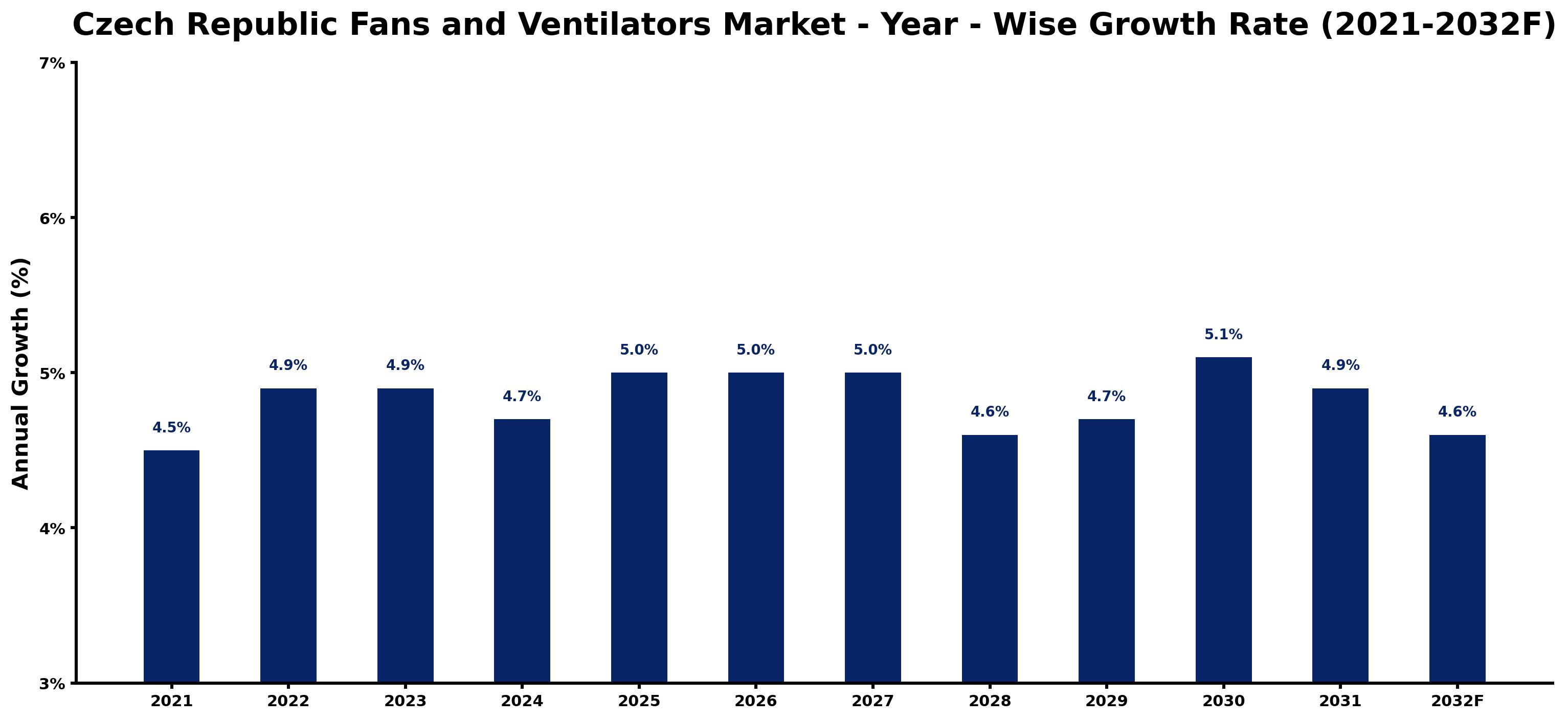
The table below presents the year wise growth rates along with the key drivers influencing the market
| Year | Growth Rate | Major Drivers |
| 2021 | 4.5% | Post-lockdown retail projects rejuvenated interest in reliable indoor air quality solutions. |
| 2022 | 4.9% | Rising health awareness prompted households to invest in personal air circulation systems. |
| 2023 | 4.9% | Increased temperatures throughout summer highlighted the need for efficient ventilation solutions. |
| 2024 | 4.7% | Urbanization trends led to more compact living spaces demanding effective air circulation. |
| 2025 | 5.0% | Technological innovations made smart fans and ventilators more appealing to tech-savvy consumers. |
| 2026 | 5.0% | Sustainable living practices prompted consumers to switch to energy-efficient ventilation options. |
| 2027 | 5.0% | Architectural designs increasingly prioritized integrated ventilation systems for new constructions. |
| 2028 | 4.6% | Strong marketing campaigns emphasized the health benefits of maintaining optimal indoor climates. |
| 2029 | 4.7% | Consumerism trends shifted towards eco-friendly products, enhancing market appeal for green solutions. |
| 2030 | 5.1% | Rise in remote work culture created demand for improved home office ventilation systems. |
| 2031 | 4.9% | Emerging local brands began to compete with international players, diversifying market offerings. |
| 2032 | 4.6% | Post-pandemic lifestyle changes solidified the importance of air quality in residential settings. |
Note - Market size estimations and growth projections presented in this report are based on 6Wresearch's advanced forecasting approach, validated with industry datasets as of June 2026.
Czech Republic Fans and Ventilators Market Synopsis
The Czech Republic Fans and Ventilators Market is projected to reach 5.0% and witness significant growth during the forecast period (2026-2032). This market is intricately linked to residential, commercial, and industrial sectors, reflecting a growing focus on enhancing indoor air quality and improving energy efficiency. The rise in demand for effective ventilation solutions in HVAC applications, coupled with advancements in technology, drives the expansion of this market.
Czech Republic Fans and Ventilators Market Growth Drivers
The Czech Republic Fans and Ventilators Market is driven by several key factors:
- Increased focus on indoor air quality is a significant driver for both residential and commercial sectors, leading to substantial investments in modern ventilation systems.
- The expansion of the HVAC industry is propelling the demand for advanced fans and ventilators, as effective air circulation has become essential in maintaining optimal indoor environments.
- Technological advancements promoting energy efficiency and performance in fan designs are attracting consumers who prioritize sustainability.
- The heightened consumer awareness regarding health and environmental impacts of poor air quality is catalyzing market growth, resulting in a shift towards more efficient ventilation solutions.
- Regulatory frameworks that emphasize energy conservation and improved air quality standards are necessitating upgrades in existing systems, thereby boosting demand for innovative fans and ventilators.
Czech Republic Fans and Ventilators Market Challenges and Restraints
The Czech Republic Fans and Ventilators Market faces certain challenges that could hinder its growth:
- Stricter energy efficiency standards present a challenge, compelling manufacturers to invest heavily in research and development to create compliant products.
- The ongoing evolution of consumer preferences towards smart and connected devices requires companies to innovate continuously, which can be resource-intensive.
- Market competition is intensifying as various firms strive to offer advanced features and greater energy efficiency, potentially leading to price wars.
- The reliance on imported components for fan and ventilator manufacturing poses risks related to supply chain disruptions and fluctuating costs.
- Consumers may exhibit resistance to adopting newer technologies, preferring traditional systems, which can limit market penetration for advanced solutions.
Czech Republic Fans and Ventilators Market Government Investment and Initiatives
The Czech government's commitment to promoting energy efficiency and enhancing indoor air quality is evident in various initiatives aimed at fostering the growth of the fans and ventilators market:
- Policies aimed at reducing energy consumption are encouraging the development and implementation of energy-efficient ventilation systems across residential and commercial applications.
- Government incentives for research and development efforts in improving ventilation technology are fostering innovation in the industry.
- Public spending on infrastructure projects is guiding investments in modern HVAC systems that align with environmental standards.
- Regulatory frameworks are being established to ensure compliance with energy efficiency benchmarks, effectively shaping the market landscape.
- Collaborations between government bodies and private sector entities are enhancing the overall market potential by addressing technological gaps in fan and ventilator systems.
Czech Republic Fans and Ventilators Market Latest Developments (May 2025 - June 2026)
Recent developments in the Czech Republic Fans and Ventilators Market between May 2025 and June 2026 indicate a significant trend towards the adoption of smart ventilation solutions. Manufacturers are increasingly focusing on integrating IoT technologies into their products, allowing for real-time monitoring and enhanced energy management. Additionally, notable strides in energy-efficient technologies are paving the way for further advancements in fan design, directly addressing consumer demand for sustainability. Collaborative research efforts are driving innovations, emphasizing the need for compliance with emerging environmental regulations. These developments reflect a responsive market that is adapting to both consumer preferences and regulatory demands.
Czech Republic Fans and Ventilators Market - Key Attractiveness of the Report
- 10 Years of Market Numbers
- Historical Data Starting from 2022 to 2025
- Base Year: 2025
- Forecast Data until 2032
- Key Performance Indicators Impacting the Market
- Major Upcoming Developments and Projects
Key Highlights of the Report:
- Czech Republic Fans and Ventilators Market Outlook
- Market Size of Czech Republic Fans and Ventilators Market, 2025
- Forecast of Czech Republic Fans and Ventilators Market, 2032
- Historical Data and Forecast of Czech Republic Fans and Ventilators Revenues & Volume for the Period 2022-2032F
- Czech Republic Fans and Ventilators Market Trend Evolution
- Czech Republic Fans and Ventilators Market Drivers and Challenges
- Czech Republic Fans and Ventilators Price Trends
- Czech Republic Fans and Ventilators Porter's Five Forces
- Czech Republic Fans and Ventilators Industry Life Cycle
- Historical Data and Forecast of Czech Republic Fans and Ventilators Market Revenues & Volume By Material for the Period 2022-2032F
- Historical Data and Forecast of Czech Republic Fans and Ventilators Market Revenues & Volume By Metal for the Period 2022-2032F
- Historical Data and Forecast of Czech Republic Fans and Ventilators Market Revenues & Volume By Composite for the Period 2022-2032F
- Historical Data and Forecast of Czech Republic Fans and Ventilators Market Revenues & Volume By Rubber for the Period 2022-2032F
- Historical Data and Forecast of Czech Republic Fans and Ventilators Market Revenues & Volume By Plastic for the Period 2022-2032F
- Historical Data and Forecast of Czech Republic Fans and Ventilators Market Revenues & Volume By Application for the Period 2022-2032F
- Historical Data and Forecast of Czech Republic Fans and Ventilators Market Revenues & Volume By Interior for the Period 2022-2032F
- Historical Data and Forecast of Czech Republic Fans and Ventilators Market Revenues & Volume By Exterior for the Period 2022-2032F
- Historical Data and Forecast of Czech Republic Fans and Ventilators Market Revenues & Volume By Structural for the Period 2022-2032F
- Historical Data and Forecast of Czech Republic Fans and Ventilators Market Revenues & Volume By Powertrain for the Period 2022-2032F
- Historical Data and Forecast of Czech Republic Fans and Ventilators Market Revenues & Volume By Vehicle Types for the Period 2022-2032F
- Historical Data and Forecast of Czech Republic Fans and Ventilators Market Revenues & Volume By Passenger Vehicles for the Period 2022-2032F
- Historical Data and Forecast of Czech Republic Fans and Ventilators Market Revenues & Volume By Light Commercial Vehicles for the Period 2022-2032F
- Historical Data and Forecast of Czech Republic Fans and Ventilators Market Revenues & Volume By Heavy Commercial Vehicles for the Period 2022-2032F
- Czech Republic Fans and Ventilators Import Export Trade Statistics
- Market Opportunity Assessment By Material
- Market Opportunity Assessment By Application
- Market Opportunity Assessment By Vehicle Types
- Czech Republic Fans and Ventilators Top Companies Market Share
- Czech Republic Fans and Ventilators Competitive Benchmarking By Technical and Operational Parameters
- Czech Republic Fans and Ventilators Company Profiles
- Czech Republic Fans and Ventilators Key Strategic Recommendations






































