Czech Republic Gas Analyzer Market: Import Trend Analysis
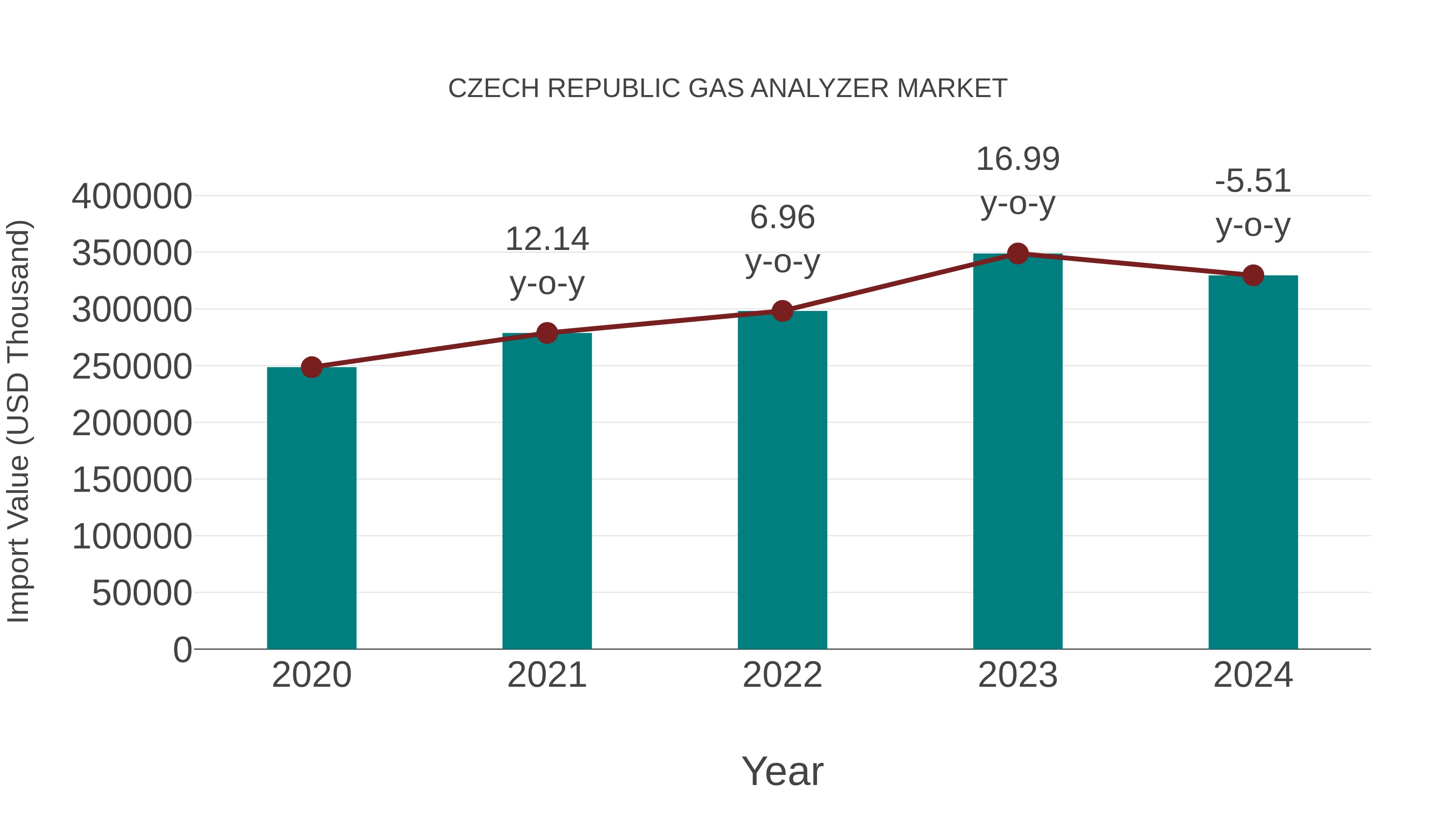
The Czech Republic gas analyzer market witnessed a steady increase in imports from 2020 to 2024, with a compound annual growth rate (CAGR) of 7.31%. Despite a slight decrease in the year-on-year growth rate of -5.51% in 2023-2024, the overall trend showed a positive trajectory during this period.
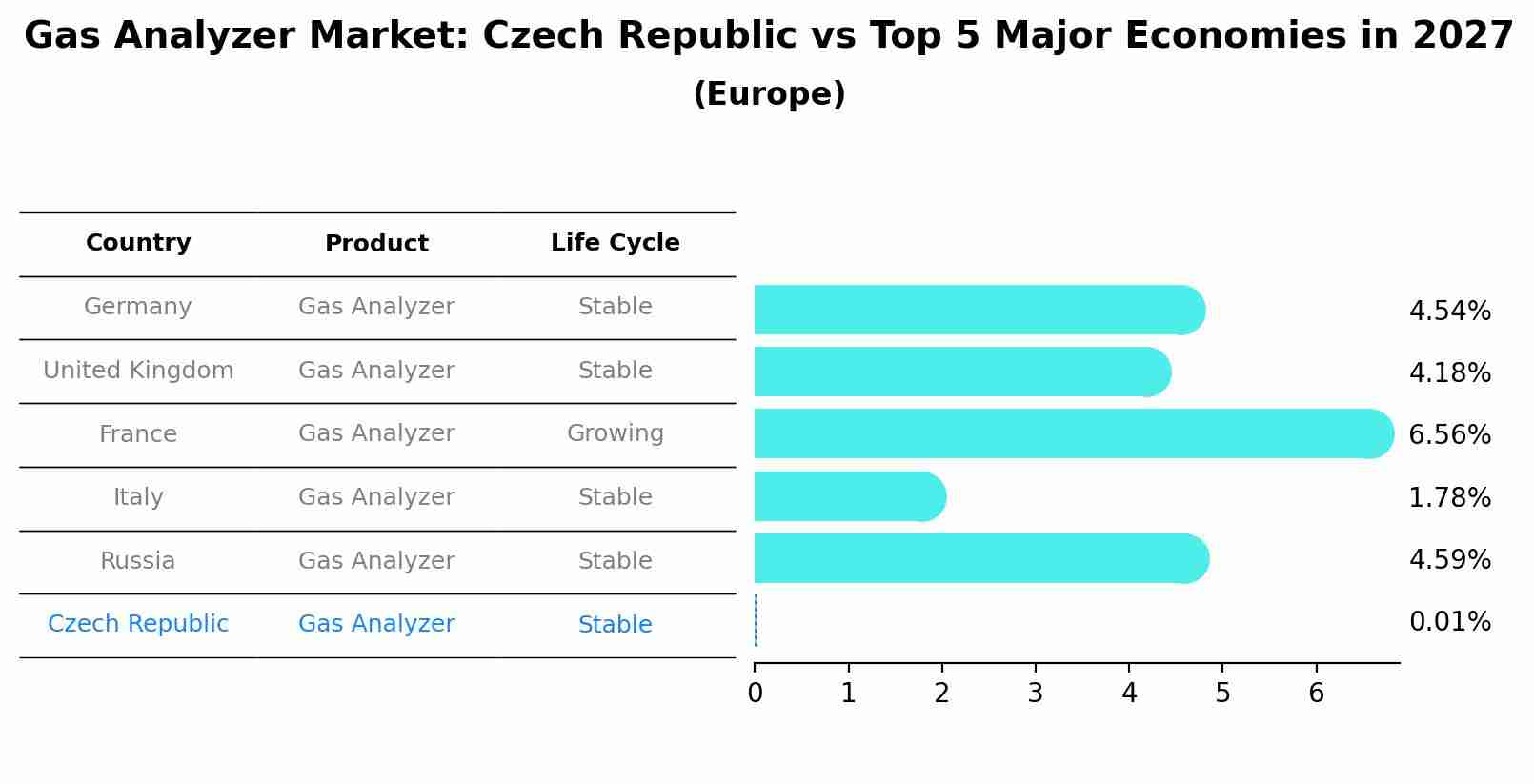
Gas Analyzer Market: Czech Republic vs Top 5 Major Economies in 2027 (Europe)
Czech Republic's Gas Analyzer market is anticipated to experience a stable growth rate of 0.01% by 2027, reflecting trends observed in the largest economy Germany, followed by United Kingdom, France, Italy and Russia.
Czech Republic Gas Analyzer Market Overview
The gas analyzer market in the Czech Republic is growing due to the increasing need for environmental monitoring and industrial safety. Gas analyzers are used to detect and measure gas concentrations in various applications, including manufacturing, energy production, and environmental protection. The market is supported by stringent government regulations on emissions and workplace safety, prompting companies to invest in reliable gas detection technologies.
Drivers of the market
The gas analyzer market in the Czech Republic is influenced by the growing need for environmental monitoring and compliance with air quality regulations. Industries such as manufacturing, energy, and automotive are increasingly utilizing gas analyzers to ensure safety and optimize processes. The rising emphasis on sustainability and reducing emissions further drives the demand for advanced gas analysis technologies.
Challenges of the market
In the Gas Analyzer Market, challenges stem from regulatory compliance and technological complexity. As environmental regulations become more stringent, manufacturers must ensure that their gas analyzers meet rigorous standards, often requiring significant investment in testing and quality assurance. Additionally, the need for continuous innovation in measurement technology poses challenges for companies aiming to stay competitive in a rapidly evolving market.
Government Policy of the market
In the gas analyzer market, the Czech government emphasizes environmental compliance and safety. Regulatory frameworks ensure adherence to safety standards for gas analyzer production and usage, promoting accurate emissions monitoring. The government supports research initiatives aimed at developing advanced gas analysis technologies that enhance environmental protection and industrial safety.
Key Highlights of the Report:
- Czech Republic Gas Analyzer Market Outlook
- Market Size of Czech Republic Gas Analyzer Market, 2024
- Forecast of Czech Republic Gas Analyzer Market, 2031
- Historical Data and Forecast of Czech Republic Gas Analyzer Revenues & Volume for the Period 2018 - 2031
- Czech Republic Gas Analyzer Market Trend Evolution
- Czech Republic Gas Analyzer Market Drivers and Challenges
- Czech Republic Gas Analyzer Price Trends
- Czech Republic Gas Analyzer Porter's Five Forces
- Czech Republic Gas Analyzer Industry Life Cycle
- Historical Data and Forecast of Czech Republic Gas Analyzer Market Revenues & Volume By Product Type for the Period 2018 - 2031
- Historical Data and Forecast of Czech Republic Gas Analyzer Market Revenues & Volume By Fixed for the Period 2018 - 2031
- Historical Data and Forecast of Czech Republic Gas Analyzer Market Revenues & Volume By Portable for the Period 2018 - 2031
- Historical Data and Forecast of Czech Republic Gas Analyzer Market Revenues & Volume By Technology for the Period 2018 - 2031
- Historical Data and Forecast of Czech Republic Gas Analyzer Market Revenues & Volume By Electrochemical for the Period 2018 - 2031
- Historical Data and Forecast of Czech Republic Gas Analyzer Market Revenues & Volume By Paramagnetic for the Period 2018 - 2031
- Historical Data and Forecast of Czech Republic Gas Analyzer Market Revenues & Volume By Zirconia (ZR) for the Period 2018 - 2031
- Historical Data and Forecast of Czech Republic Gas Analyzer Market Revenues & Volume By Non-dispersive IR (NDIR) for the Period 2018 - 2031
- Historical Data and Forecast of Czech Republic Gas Analyzer Market Revenues & Volume By Other Technologies for the Period 2018 - 2031
- Historical Data and Forecast of Czech Republic Gas Analyzer Market Revenues & Volume By End-users for the Period 2018 - 2031
- Historical Data and Forecast of Czech Republic Gas Analyzer Market Revenues & Volume By Oil and Gas for the Period 2018 - 2031
- Historical Data and Forecast of Czech Republic Gas Analyzer Market Revenues & Volume By Chemical and Petrochemical for the Period 2018 - 2031
- Historical Data and Forecast of Czech Republic Gas Analyzer Market Revenues & Volume By Water and Wastewater for the Period 2018 - 2031
- Historical Data and Forecast of Czech Republic Gas Analyzer Market Revenues & Volume By Pharmaceutical for the Period 2018 - 2031
- Historical Data and Forecast of Czech Republic Gas Analyzer Market Revenues & Volume By Utility for the Period 2018 - 2031
- Historical Data and Forecast of Czech Republic Gas Analyzer Market Revenues & Volume By Food and Beverage for the Period 2018 - 2031
- Historical Data and Forecast of Czech Republic Gas Analyzer Market Revenues & Volume By Other End-user Verticals for the Period 2018 - 2031
- Czech Republic Gas Analyzer Import Export Trade Statistics
- Market Opportunity Assessment By Product Type
- Market Opportunity Assessment By Technology
- Market Opportunity Assessment By End-users
- Czech Republic Gas Analyzer Top Companies Market Share
- Czech Republic Gas Analyzer Competitive Benchmarking By Technical and Operational Parameters
- Czech Republic Gas Analyzer Company Profiles
- Czech Republic Gas Analyzer Key Strategic Recommendations






































