Czech Republic Glass Market: Import Trend Analysis
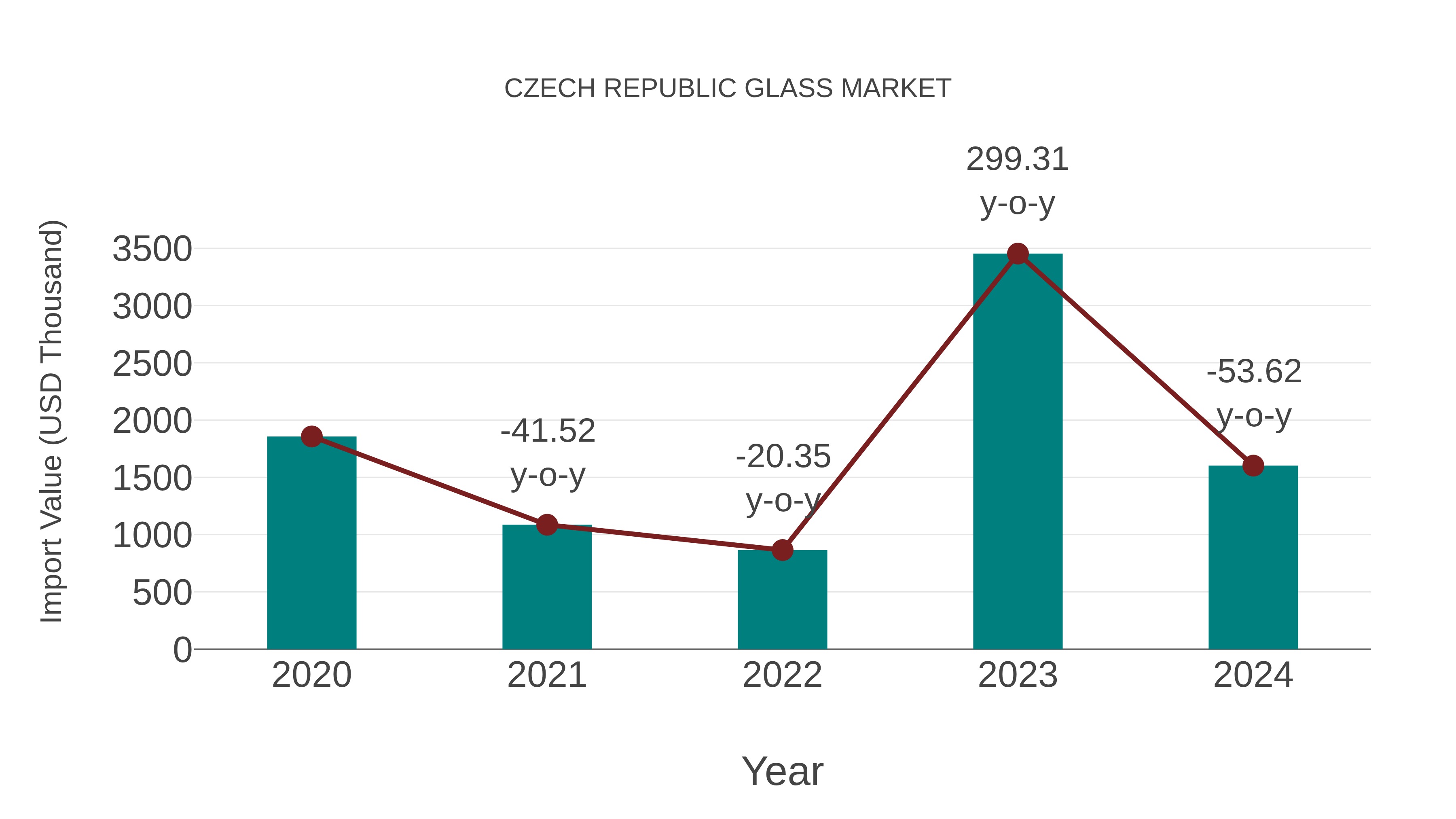
The Czech Republic glass market experienced a decline in imports from 2020 to 2024, with a Compound Annual Growth Rate (CAGR) of -3.63%. The year-on-year growth rate from 2023 to 2024 further decreased by -53.62%, indicating a significant downturn in import volumes during this period.
Glass Market: Czech Republic vs Top 5 Major Economies in 2027 (Europe)
By 2027, Czech Republic's Glass market is forecasted to achieve a negative growth rate of -1.03%, with Germany leading the Europe region, followed by United Kingdom, France, Italy and Russia.

czech republic glass market Synopsis
The Czech Republic glass market is expected to register a CAGR of approximately 4.4% during the forecast period, 2020-2026. The country`s increasing emphasis on energy conservation and cost reduction in building construction are some of the key factors driving the growth of this market. Additionally, rising investments for maintenance and repair activities are also playing a vital role in supporting healthy commercialization prospects across the region. Furthermore, favorable government regulations that promote efficient insulation techniques and encourage usage of eco-friendly materials are further contributing towards bolstering demand for Glass products in various end-use industries such as construction & automotive among others over the coming years.
The Czech Republic has become one of Europe?s leading producers and consumers of glass due to its increased focus on green materials like glass for residential projects as well as numerous commercial projects such as office buildings, hotels, and shopping malls etc., which is likely to open up new opportunities for industry participants over the upcoming period. Moreover, with growing urbanization trends along with an increase in disposable income levels among people has led to higher consumption rate particularly from residential sector creating sustainable revenue streams for manufacturers operating across this domain.
Furthermore, growing awareness regarding health benefits associated with use of high quality glasses that offer enhanced UV protection capability along durability factor is anticipated to catalyze product penetration significantly over forecast timeframe thus propelling overall market growth substantially over next few years.
Key Highlights of the Report:
- Czech Republic Glass Market Outlook
- Market Size of Czech Republic Glass Market, 2019
- Forecast of Czech Republic Glass Market, 2026
- Historical Data and Forecast of Czech Republic Glass Revenues & Volume for the Period 2016 - 2026
- Czech Republic Glass Market Trend Evolution
- Czech Republic Glass Market Drivers and Challenges
- Czech Republic Glass Price Trends
- Czech Republic Glass Porter's Five Forces
- Czech Republic Glass Industry Life Cycle
- Historical Data and Forecast of Czech Republic Glass Market Revenues & Volume By Product Types for the Period 2016 - 2026
- Historical Data and Forecast of Czech Republic Glass Market Revenues & Volume By Basic for the Period 2016 - 2026
- Historical Data and Forecast of Czech Republic Glass Market Revenues & Volume By Tempered for the Period 2016 - 2026
- Historical Data and Forecast of Czech Republic Glass Market Revenues & Volume By Laminated for the Period 2016 - 2026
- Historical Data and Forecast of Czech Republic Glass Market Revenues & Volume By Insulated for the Period 2016 - 2026
- Historical Data and Forecast of Czech Republic Glass Market Revenues & Volume By Others for the Period 2016 - 2026
- Historical Data and Forecast of Czech Republic Glass Market Revenues & Volume By Applications for the Period 2016 - 2026
- Historical Data and Forecast of Czech Republic Glass Market Revenues & Volume By Architectural for the Period 2016 - 2026
- Historical Data and Forecast of Czech Republic Glass Market Revenues & Volume By Automotive & transportation for the Period 2016 - 2026
- Historical Data and Forecast of Czech Republic Glass Market Revenues & Volume By Others for the Period 2016 - 2026
- Historical Data and Forecast of Czech Republic Glass Market Revenues & Volume By Technology Types for the Period 2016 - 2026
- Historical Data and Forecast of Czech Republic Glass Market Revenues & Volume By Float for the Period 2016 - 2026
- Historical Data and Forecast of Czech Republic Glass Market Revenues & Volume By Rolled for the Period 2016 - 2026
- Historical Data and Forecast of Czech Republic Glass Market Revenues & Volume By Sheet for the Period 2016 - 2026
- Czech Republic Glass Import Export Trade Statistics
- Market Opportunity Assessment By Product Types
- Market Opportunity Assessment By Applications
- Market Opportunity Assessment By Technology Types
- Czech Republic Glass Top Companies Market Share
- Czech Republic Glass Competitive Benchmarking By Technical and Operational Parameters
- Czech Republic Glass Company Profiles
- Czech Republic Glass Key Strategic Recommendations






































