Czech Republic Glycerol Market Size (2020-2030)
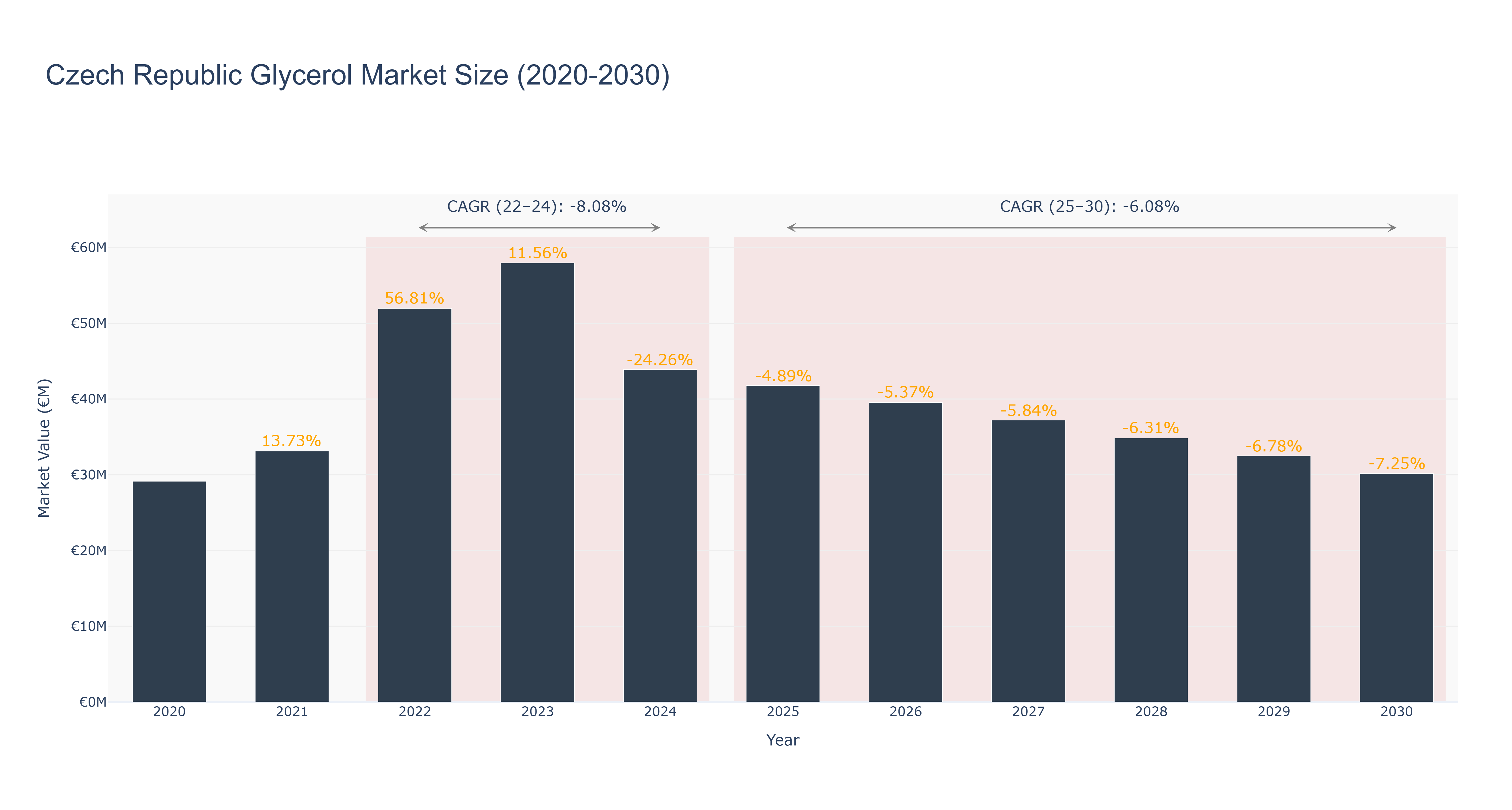
Czech Republic Glycerol Market has shown a fluctuating trend over the past decade. The peak market size of €57.97 million was observed in 2023, followed by a decline to €41.76 million in 2025. The market is forecasted to continue its downward trajectory, with an estimated size of €30.14 million in 2030. The CAGR from 2022 to 2024 is -8.08%, while from 2025 to 2030 it is projected at -6.08%. The market's decline can be attributed to various factors such as changing consumer preferences, regulatory changes, and increasing competition. Despite the challenging environment, upcoming investments in sustainable production methods and innovative product offerings are expected to drive growth in the Czech Republic Glycerol Market in the near future.
Czech Republic Glycerol Market: Production & Trade Performance (2019-2025)
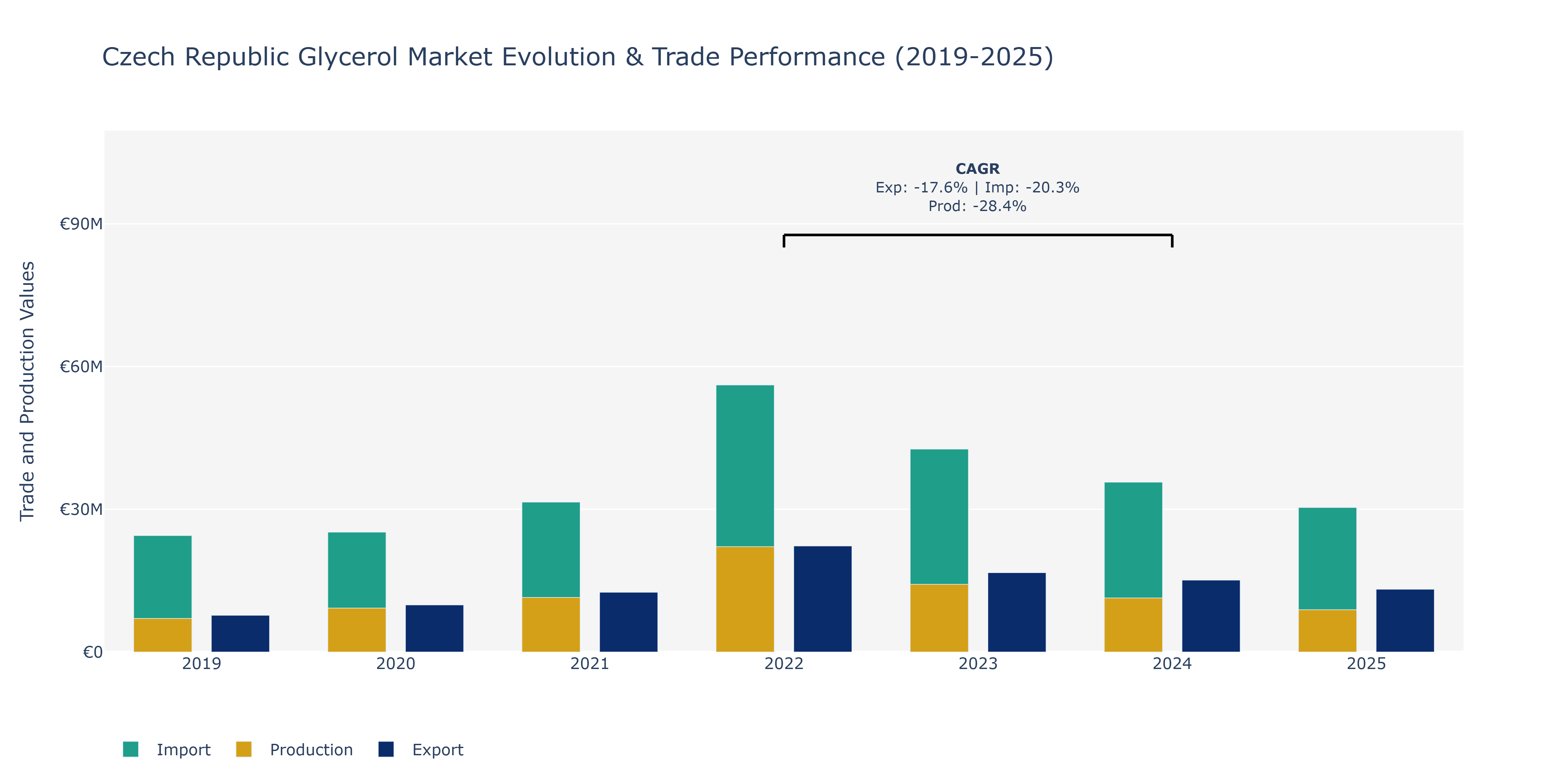
In the Czech Republic Glycerol Market, from 2019 to 2025, exports showcased a fluctuating trend with a peak in 2022 at €22.29 million, followed by a decline to €13.19 million in 2025. Imports demonstrated a similar pattern, reaching €56.13 million in 2022 before decreasing to €30.38 million in 2025. Production value also fluctuated, peaking at €22.14 million in 2022 and dropping to €8.89 million in 2025. These fluctuations can be attributed to various factors such as global demand shifts, changes in raw material prices, and market competition. The substantial decrease in production from 2022 to 2025 could be influenced by technological advancements leading to more efficient production processes or changes in consumer preferences towards alternative products. The fluctuations in exports and imports might be driven by international trade agreements, currency exchange rates, and geopolitical factors impacting supply chains within the glycerol market.
Czech Republic Glycerol Market Overview
The glycerol market in the Czech Republic overlaps with glycerin and glycerine, with the chemical being used in food, cosmetics, and industrial applications. Glycerols hygroscopic nature and its use in pharmaceuticals, as well as its role as a byproduct of biodiesel production, support market growth. The market sees increasing applications in the cosmetic and food industries, particularly in health-conscious and eco-friendly products.
Drivers of the market
The glycerol market in the Czech Republic is influenced by the increasing demand for glycerol as a versatile ingredient in various applications. Glycerol is widely used in food, cosmetics, and pharmaceuticals for its moisturizing and emulsifying properties. The trend towards natural and clean-label products contributes to the demand for glycerol-based formulations.
Challenges of the market
The Glycerol Market encounters challenges related to fluctuating demand and competition from bio-based alternatives. Changes in consumer preferences and regulatory frameworks can lead to variability in demand for glycerol, impacting market stability. Furthermore, the rise of bio-based glycerol from renewable sources necessitates ongoing innovation to enhance traditional glycerol offerings and compete effectively in a changing landscape.
Government Policy of the market
In the glycerol market, government policies focus on promoting sustainable practices and safety in chemical manufacturing. Regulations ensure compliance with health and safety standards for glycerol production and usage, fostering consumer confidence in its applications. The government supports research initiatives aimed at developing innovative glycerol derivatives that enhance performance and sustainability in various industries.
Key Highlights of the Report:
- Czech Republic Glycerol Market Outlook
- Market Size of Czech Republic Glycerol Market, 2024
- Forecast of Czech Republic Glycerol Market, 2031
- Historical Data and Forecast of Czech Republic Glycerol Revenues & Volume for the Period 2018 - 2031
- Czech Republic Glycerol Market Trend Evolution
- Czech Republic Glycerol Market Drivers and Challenges
- Czech Republic Glycerol Price Trends
- Czech Republic Glycerol Porter's Five Forces
- Czech Republic Glycerol Industry Life Cycle
- Historical Data and Forecast of Czech Republic Glycerol Market Revenues & Volume By Source for the Period 2018 - 2031
- Historical Data and Forecast of Czech Republic Glycerol Market Revenues & Volume By Biodiesel for the Period 2018 - 2031
- Historical Data and Forecast of Czech Republic Glycerol Market Revenues & Volume By Fatty Alcohols for the Period 2018 - 2031
- Historical Data and Forecast of Czech Republic Glycerol Market Revenues & Volume By Fatty Acids for the Period 2018 - 2031
- Historical Data and Forecast of Czech Republic Glycerol Market Revenues & Volume By Soap for the Period 2018 - 2031
- Historical Data and Forecast of Czech Republic Glycerol Market Revenues & Volume By Type for the Period 2018 - 2031
- Historical Data and Forecast of Czech Republic Glycerol Market Revenues & Volume By Crude for the Period 2018 - 2031
- Historical Data and Forecast of Czech Republic Glycerol Market Revenues & Volume By Refined for the Period 2018 - 2031
- Historical Data and Forecast of Czech Republic Glycerol Market Revenues & Volume By End-use for the Period 2018 - 2031
- Historical Data and Forecast of Czech Republic Glycerol Market Revenues & Volume By Food & Beverage for the Period 2018 - 2031
- Historical Data and Forecast of Czech Republic Glycerol Market Revenues & Volume By Pharmaceutical for the Period 2018 - 2031
- Historical Data and Forecast of Czech Republic Glycerol Market Revenues & Volume By Nutraceutical for the Period 2018 - 2031
- Historical Data and Forecast of Czech Republic Glycerol Market Revenues & Volume By Personal Care & Cosmetics for the Period 2018 - 2031
- Historical Data and Forecast of Czech Republic Glycerol Market Revenues & Volume By Industrial for the Period 2018 - 2031
- Historical Data and Forecast of Czech Republic Glycerol Market Revenues & Volume By Others for the Period 2018 - 2031
- Czech Republic Glycerol Import Export Trade Statistics
- Market Opportunity Assessment By Source
- Market Opportunity Assessment By Type
- Market Opportunity Assessment By End-use
- Czech Republic Glycerol Top Companies Market Share
- Czech Republic Glycerol Competitive Benchmarking By Technical and Operational Parameters
- Czech Republic Glycerol Company Profiles
- Czech Republic Glycerol Key Strategic Recommendations






































