Czech Republic Interior Design Market Size, Share & Growth Rate
The Czech Republic Interior Design Market was estimated at USD 270 Million in 2025 and is projected to reach USD 352 Million by 2032, growing at a CAGR of 3.9% from 2026 to 2032. This growth trajectory is largely fueled by rising disposable incomes, urbanization trends, and an expanding interest in bespoke home decor solutions. As more individuals seek to personalize their living spaces, the demand for innovative and functional designs is on the rise.
Czech Republic Interior Design Market Year-wise Growth Rate and Key Drivers
This graph highlights how the Czech Republic Interior Design Market has steadily grown over the years, supported by major growth factors.
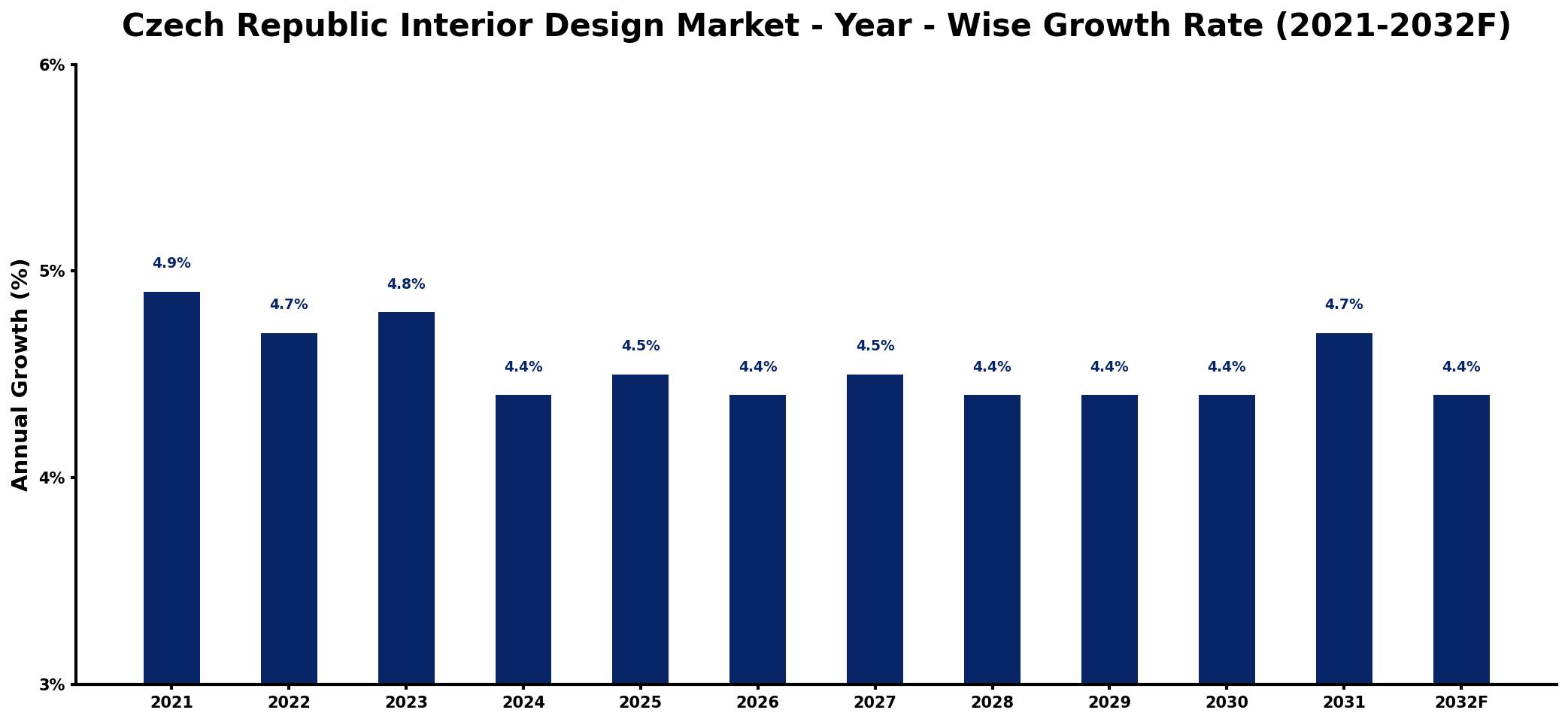
The table below presents the year‑wise growth rates along with the key drivers influencing the market
| Year | Growth Rate | Major Drivers |
| 2021 | 4.9% | Rising consumer spending on renovations |
| 2022 | 4.7% | Increased demand for sustainable materials |
| 2023 | 4.8% | Growth in remote work environments |
| 2024 | 4.4% | Expansion of online retail platforms |
| 2025 | 4.5% | Surge in urban living spaces |
| 2026 | 4.4% | Popularity of multifunctional furniture |
| 2027 | 4.5% | Investment in residential property upgrades |
| 2028 | 4.4% | Growing interest in smart technology |
| 2029 | 4.4% | Demand for personalized living spaces |
| 2030 | 4.4% | Shift towards wellness-focused environments |
| 2031 | 4.7% | Revival of traditional craftsmanship techniques |
| 2032 | 4.4% | Emergence of eco-friendly trends |
Note: Market size estimations and growth projections presented in this report are based on 6Wresearch's proprietary forecasting methodology, utilizing the latest available industry data, government publications, and primary research inputs.
Czech Republic Interior Design Market Synopsis
The Czech Republic's interior design landscape is currently in a dynamic phase, characterized by a blend of traditional Czech motifs and contemporary styles. Consumers increasingly favor designs that marry aesthetics with functionality, creating spaces that are both beautiful and practical.
As the market evolves, there's a notable shift towards sustainable design choices, reflecting the growing consumer awareness of environmental issues. Designers are not only incorporating modern minimalism but are also drawing inspiration from local craftsmanship and heritage, resulting in truly unique offerings.
Czech Republic Interior Design Market Key Takeaways
- The market is experiencing robust growth driven by urbanization and rising disposable incomes.
- There is a heightened interest in sustainable and eco-friendly design solutions among consumers.
- Integration of smart home technologies is increasingly influencing design preferences.
- Personalized and customized solutions are becoming a significant demand driver in the market.
- Competition from both local and international firms is shaping innovation and differentiation strategies.
Evaluation of Restraints in Czech Republic Interior Design Market
Despite its promising growth, the Czech Republic interior design market faces several notable restraints. The increase in competition from both domestic and international firms has led to pricing pressures, forcing designers to innovate and differentiate their offerings continually. Moreover, fluctuating consumer preferences compel designers to remain agile and attuned to market trends, necessitating ongoing investment in research and development.
Complex regulatory environments and bureaucratic procedures can also pose obstacles, making it challenging for firms to execute projects efficiently. Furthermore, economic uncertainties linked to the real estate sector add an additional layer of unpredictability, influencing the market demand for interior design services.
Czech Republic Interior Design Market Trends
Current trends in the Czech Republic interior design market highlight a clear consumer preference for sustainable and eco-friendly materials. There is a growing inclination towards Scandinavian minimalism and modern industrial styles that emphasize simplicity, natural elements, and neutral color schemes. Additionally, smart home technology integration is gaining traction, with homeowners keen on incorporating automation into their spaces.
As consumers seek to create personalized environments, elements of Czech traditional design are increasingly being integrated. This melding of modern and traditional influences results in unique spaces that not only showcase contemporary trends but also honor local culture and artisanal craftsmanship.
Czech Republic Interior Design Market Opportunities
The Czech Republic interior design market presents abundant opportunities for investment, particularly in residential design services aligned with the ongoing housing development boom. Firms specializing in sustainable design solutions will find a receptive market as consumer consciousness shifts towards eco-friendly practices.
Moreover, leveraging technology—such as virtual reality for design visualization and utilizing e-commerce platforms for furniture and decor sales—can open new revenue streams. Collaborations with local artisans to produce unique, handmade items can further differentiate offerings in this competitive landscape.
Government Initiatives in the Czech Republic Interior Design Market
Government policies in the Czech Republic focus on enhancing building regulations, fire safety standards, and promoting sustainable practices within the interior design sector. Authorities are increasingly advocating for compliance with stringent building codes, emphasizing the importance of safety and quality in design projects. Various initiatives aim to support the interior design industry through funding programs, training opportunities, and a push for advocacy within the profession, fostering a conducive environment for growth.
Future Insights of the Czech Republic Interior Design Market
Looking ahead to 2026-2032, the Czech Republic interior design market is set for promising growth driven by trends such as increasing disposable incomes and urbanization. A focus on sustainability will continue to dominate design considerations, encouraging the integration of natural materials and smart technologies in new projects. The rise of online design services and e-commerce will enhance consumer access to design solutions, further propelling the market forward.
Czech Republic Interior Design Market Latest Developments (2025 - 2026)
Recent developments in the Czech Republic's interior design market indicate a shift towards collaborative projects that highlight local craftsmanship. Designers are increasingly integrating local materials and artisanal techniques into their projects, creating distinctive offerings that resonate with culturally conscious consumers. Additionally, the market has witnessed an uptick in the adoption of smart home technologies, allowing designers to provide innovative solutions tailored to modern living needs.
Czech Republic Interior Design Market - Key Attractiveness of the Report
- 10 Years of Market Numbers
- Historical Data Starting from 2022 to 2025
- Base Year: 2025
- Forecast Data until 2032
- Key Performance Indicators Impacting the Market
- Major Upcoming Developments and Projects
Key Highlights of the Report:
- Czech Republic Interior Design Market Outlook
- Market Size of Czech Republic Interior Design Market, 2025
- Forecast of Czech Republic Interior Design Market, 2032
- Historical Data and Forecast of Czech Republic Interior Design Revenues & Volume for the Period 2022-2032F
- Czech Republic Interior Design Market Trend Evolution
- Czech Republic Interior Design Market Drivers and Challenges
- Czech Republic Interior Design Price Trends
- Czech Republic Interior Design Porter's Five Forces
- Czech Republic Interior Design Industry Life Cycle
- Historical Data and Forecast of Czech Republic Interior Design Market Revenues & Volume By End Use for the Period 2022-2032F
- Historical Data and Forecast of Czech Republic Interior Design Market Revenues & Volume By Commercial for the Period 2022-2032F
- Historical Data and Forecast of Czech Republic Interior Design Market Revenues & Volume By Residential for the Period 2022-2032F
- Historical Data and Forecast of Czech Republic Interior Design Market Revenues & Volume By Decoration Type for the Period 2022-2032F
- Historical Data and Forecast of Czech Republic Interior Design Market Revenues & Volume By New for the Period 2022-2032F
- Historical Data and Forecast of Czech Republic Interior Design Market Revenues & Volume By Renovations for the Period 2022-2032F
- Czech Republic Interior Design Import Export Trade Statistics
- Market Opportunity Assessment By End Use
- Market Opportunity Assessment By Decoration Type
- Czech Republic Interior Design Top Companies Market Share
- Czech Republic Interior Design Competitive Benchmarking By Technical and Operational Parameters
- Czech Republic Interior Design Company Profiles
- Czech Republic Interior Design Key Strategic Recommendations






































